Wood violet, the state flower of Wisconsin
The state flower of Wisconsin is the wood violet, also called the common blue violet, a small native wildflower with heart-shaped leaves and purple-blue, five-petaled flowers. It blooms in spring, from about April to June, and is one of Wisconsin's most common wildflowers. Schoolchildren chose it in a vote on Arbor Day 1909, and the Legislature made it official in 1949.
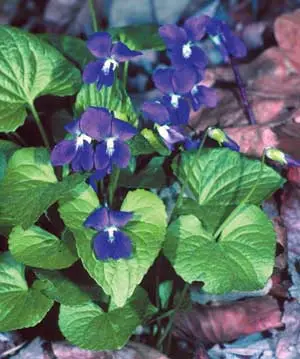
How to recognize it
The wood violet is a low perennial, about 3 to 10 inches tall. Its glossy, broadly heart-shaped leaves, up to about 3 or 4 inches long with rounded teeth, grow from the base of the plant, and each flower sits on its own stalk. The flowers have five petals, usually purple-blue with a white throat, about three-quarters of an inch to an inch and a quarter across; the two side petals carry tufts of white hairs. Each flower nods slightly on its stalk. Small flowers that never open also form near the ground and produce plenty of seed. In Wisconsin it blooms from about April to June.
Where it grows
The wood violet is native to eastern North America, including Wisconsin. It grows in prairies, fields, open woods, forests, along stream banks and roadsides, and in lawns, in sun or shade, and does best in rich, moist soil. In good conditions it spreads freely from seed.
Where to see it
It is one of Wisconsin’s most common wildflowers, with specimens recorded from about 70 of the state’s 72 counties. Look in spring in moist woods and shady lawns; Putnam Park in Eau Claire is one good place.
A wildflower you can eat
The leaves are high in vitamins A and C and can be eaten raw or cooked, and the flowers are used in candies and jellies.
The state flower since 1949
Wisconsin’s schoolchildren chose the violet long before the Legislature did. In 1908 they narrowed the candidates to four, the violet, wild rose, trailing arbutus and white water lily, and the violet won the final vote on Arbor Day 1909. The Legislature made it official in 1949, in the same law that named the robin and the sugar maple. The law uses the name Viola papilionacea, now treated as a synonym of Viola sororia. Wisconsin has no separate state wildflower, and New Jersey and Rhode Island have chosen the same violet.
Questions about the Wisconsin state flower
- What is the state flower of Wisconsin?
- The wood violet (Viola sororia), adopted in 1949. The law names it Viola papilionacea, which botanists now treat as the same species.
- When do violets bloom in Wisconsin?
- In spring, roughly April to June.
- How was the Wisconsin state flower chosen?
- Schoolchildren picked four finalists in 1908, the violet, wild rose, trailing arbutus and white water lily, and the violet won a final vote on Arbor Day 1909.
- Can you eat violets?
- Yes. The leaves are high in vitamins A and C and can be eaten raw or cooked, and the flowers are used in candies and jellies.
Sources
- Viola sororia Lady Bird Johnson Wildflower Center
- Notes on Viola sororia (Putnam Park) University of Wisconsin-Eau Claire
- Viola sororia (Cofrin Center herbarium) University of Wisconsin-Green Bay
- Wisconsin State Symbols (Wisconsin Blue Book 2007-2008) Wisconsin Legislative Reference Bureau
- Plant Profile: Viola sororia Willd., common blue violet USDA NRCS PLANTS Database