Minnesota state symbols
Minnesota has 22 official state symbols. The oldest is the motto of 1861; the newest, adopted in 2025, are a state fossil, the giant beaver, and a state constellation, Ursa Minor. In 2024 Minnesota replaced both its flag and its seal. Many of its symbols were proposed by schoolchildren.
Lady’s slipper, pine and loon
Minnesota’s first nature symbol was its flower, and it took two tries. In 1893 the Senate picked a lady slipper that does not grow wild in Minnesota. After a women’s study circle pointed out the mistake, a 1902 resolution chose the pink and white lady slipper, a large native orchid, instead; the choice became statute in 1967. The red pine, also called the Norway pine, became the state tree in 1953 at the urging of a Minneapolis women’s study club. The common loon followed as the state bird in 1961, after lawmakers had floated the goldfinch, the mourning dove, the pileated woodpecker and others in earlier bills.
Lakes and woods
Minnesota’s lakes supply several symbols. The walleye, the prized fish of Minnesota anglers, became the state fish in 1965. Wild rice, harvested by canoe from northern lakes, became the state grain in 1977. The Lake Superior agate, banded red and orange and found on the North Shore and across the state, became the state gem in 1969, after rock-hunting clubs insisted on keeping its traditional name rather than calling it the “Minnesota agate.”
Firsts and student ideas
In 1984 Minnesota named the morel, a prized edible mushroom, as the first official state mushroom in the country. The same year it adopted milk as the state drink. Schoolchildren proposed many of the symbols that followed. Third graders in Carlton asked for the blueberry muffin as the state muffin in 1988, inspired by a Massachusetts class that had won a state corn muffin. Fourth graders in Mahtomedi pushed for the monarch butterfly in 2000. Students in Bayport suggested the Honeycrisp apple, developed at the University of Minnesota, as the state fruit in 2006. And sixth graders in Minnetonka gathered more than 600 signatures to make ice hockey the state sport in 2009.
A photograph, a bee and a beaver
Some symbols are unusual. “Grace,” Eric Enstrom’s 1918 photograph of an elderly man praying over a simple meal, taken in Bovey, became the state photograph in 2002. The rusty patched bumble bee, an endangered species, became the state bee in 2019. In 2025 Minnesota adopted the giant beaver, an Ice Age beaver the size of a bear, as the state fossil, giving its Dakota and Ojibwe names, capa and amik, in the law, and Ursa Minor, the constellation that contains the North Star, as the state constellation.
A new flag and seal
In 2023 the legislature created a State Emblems Redesign Commission to replace the old flag and seal. It received 2,128 flag designs and 399 seal designs from the public, and its choices took effect on May 11, 2024. The new seal shows a common loon on stylized water, wild rice, a Norway pine and a four-pointed star, framed by the Dakota phrase Mni Sóta Makoce, “land where the waters reflect the skies.” Its outer ring of 98 gold bars stands for the state’s 87 counties and 11 federally recognized tribal nations.
The main symbols
The flag, the common loon and the lady’s slipper each have their own page. The state song is “Hail! Minnesota,” which began as a University of Minnesota song; to make it the state song in 1945, “our college dear” became “our state so dear.”
Flag, seal, song, motto and nickname
-
 2024
Near the hoist, a dark blue shape based on the outline of Minnesota carries a white eight-pointed star, with one point aimed north, standing for the North Star and the motto L'Etoile du Nord. The rest of the flag is a bright blue field representing the state's waters.
Minn. Stat. § 1.141; Laws of Minnesota 2023, ch. 62, art. 2, secs. 5 and 118
- 2024
Great Seal of Minnesota
SealA circular seal with a common loon on stylized water, wild rice, a Norway pine and a white four-pointed star for the Star of the North, framed by the Dakota phrase "Mni Sóta Makoce" (land where the waters reflect the skies). Its outer ring of 98 gold bars stands for the 87 counties and 11 federally recognized tribal nations.
Minn. Stat. § 1.135
- 1945
Hail! Minnesota
SongWritten in 1904. The lyrics are still under copyright, so they are not reproduced here. Official page.
Laws of Minnesota 1945, Joint Resolution 15
- 1861
L'Étoile du Nord
MottoFrench, meaning “The Star of the North”.
Laws of Minnesota 1861, chapter 43
Animals
-
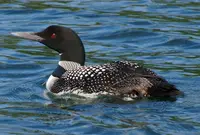 1961
Common loon
BirdGavia immerLawmakers floated several other birds before settling on the loon, among them the eastern goldfinch, mourning dove, pileated woodpecker, scarlet tanager and wood duck in bills from 1947 to 1953. The 1961 law was carried by Sen. Norman Walz and Rep. Loren Rutter and signed by Gov. Elmer L. Andersen.
Minn. Stat. § 1.145 · Office of the Revisor of Statutes, Minnesota Legislature
-
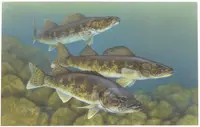 1965
Walleye
FishSander vitreusA walleye bill had been tried once before, in 1953; the 1965 law was sponsored by Rep. Keith Hinman and Sen. Clifford Lofvegren and signed by Gov. Karl Rolvaag. The statute uses the older name Stizostedion v. vitreum.
Minn. Stat. § 1.146 · Office of the Revisor of Statutes, Minnesota Legislature
- 2019
Rusty patched bumble bee
BeeBombus affinisThe rusty patched bumble bee, a once-common bee that has disappeared from most of its range and is federally listed as endangered, became the state bee in 2019. Minnesota still has some of its remaining populations.
Minn. Stat. § 1.1465 · Office of the Revisor of Statutes, Minnesota Legislature
-
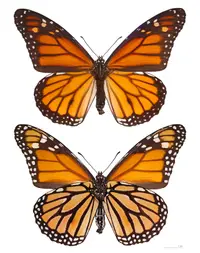 2000
Monarch butterfly
ButterflyDanaus plexippusA fourth-grade class at Anderson Elementary School in Mahtomedi promoted the bill, sponsored by Rep. Harry Mares and Sen. Chuck Wiger and signed by Gov. Jesse Ventura.
Minn. Stat. § 1.1497 · Office of the Revisor of Statutes, Minnesota Legislature
Plants and fungi
-
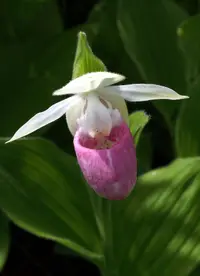 1967
Pink and white lady slipper (showy lady's slipper)
FlowerCypripedium reginaeAn 1893 Senate resolution picked a different lady slipper that does not grow wild in Minnesota; after the St. Anthony Study Circle pointed this out, a 1902 resolution passed by both chambers named the pink and white lady slipper instead. The choice was put into statute in 1967, and the plant is protected under Minn. Stat. § 18H.18.
Minn. Stat. § 1.142 · Office of the Revisor of Statutes, Minnesota Legislature
-
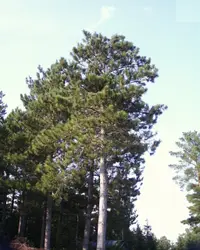 1953
Red pine (Norway pine)
TreePinus resinosaThe Friday Study Club of Minneapolis, backed by the Minnesota Federation of Women's Clubs, pushed for the designation, and Gov. C. Elmer Anderson signed it on February 18, 1953.
Minn. Stat. § 1.143 · Office of the Revisor of Statutes, Minnesota Legislature
- 1984
Morel
MushroomMorchella esculentaThe Minnesota Mycological Society suggested the designation, which made Minnesota the first state with an official mushroom.
Minn. Stat. § 1.149 · Office of the Revisor of Statutes, Minnesota Legislature
Earth and sky
- 2025
Giant beaver
FossilCastoroides ohioensisThe statute also gives the animal's Dakota name, capa, and Ojibwe name, amik. The giant beaver topped a 2021 Science Museum of Minnesota public poll; bills in 1988 and 2022 failed before the designation passed in the 2025 omnibus state government bill.
Minn. Stat. § 1.1466 · Office of the Revisor of Statutes, Minnesota Legislature
- 1969
Lake Superior agate
GemstoneSome legislators preferred calling it the Minnesota agate, but sponsor Sen. Mel Hanson said rock-hunting clubs wanted to keep the name Lake Superior agate; Gov. Harold LeVander signed the bill.
Minn. Stat. § 1.147 · Office of the Revisor of Statutes, Minnesota Legislature
- 2012
Lester soil
SoilThe Minnesota Association of Professional Soil Scientists had informally named Lester loam the state soil in 1987; the Legislature made it official in the 2012 omnibus agriculture bill (Laws 2012, ch. 244).
Minn. Stat. § 1.1485 · Office of the Revisor of Statutes, Minnesota Legislature
- 2025
Ursa Minor
ConstellationUrsa Minor, the Little Dipper, contains Polaris, the North Star of the state motto. It became the state constellation in 2025.
Minn. Stat. § 1.1493 · Office of the Revisor of Statutes, Minnesota Legislature
Food and drink
- 2006
Honeycrisp apple
FruitMalus domestica 'Honeycrisp'The apple variety was developed at the University of Minnesota, and the designation was suggested by students at Andersen Elementary School in Bayport; Gov. Tim Pawlenty signed it.
Minn. Stat. § 1.1475 · Office of the Revisor of Statutes, Minnesota Legislature
- 1977
Wild rice (manomin)
GrainZizania aquaticaWild rice, called manomin in Ojibwe, grows in shallow lakes and rivers of northern Minnesota and has been harvested by canoe for centuries. It became the state grain in 1977; botanically it is an aquatic grass.
Minn. Stat. § 1.148 · Office of the Revisor of Statutes, Minnesota Legislature
- 1984
Milk
BeverageChief sponsor Rep. Rick Krueger cited support for the dairy industry and tourism; Gov. Rudy Perpich signed the 1984 law (Laws 1984, ch. 645).
Minn. Stat. § 1.1495 · Office of the Revisor of Statutes, Minnesota Legislature
- 1988
Blueberry muffin
MuffinThird graders at South Terrace Elementary in Carlton asked for it, inspired by a Massachusetts class that won a state corn muffin; they chose blueberry to reflect southern wheat fields and northern wild blueberries.
Minn. Stat. § 1.1496 · Office of the Revisor of Statutes, Minnesota Legislature
Culture and history
- 2002
"Grace" by Eric Enstrom
PhotographThe picture of an elderly man bowing his head in thanks was taken in Bovey, Minnesota, in 1918; Rep. Loren Solberg, who lived in Bovey, co-sponsored the bill with Sen. Bob Lessard.
Minn. Stat. § 1.1498 · Office of the Revisor of Statutes, Minnesota Legislature
- 2009
Ice hockey
SportSixth graders at Minnetonka Middle School East gathered more than 600 signatures for the idea; it was first introduced in 2007 and became law in 2009.
Minn. Stat. § 1.1499 · Office of the Revisor of Statutes, Minnesota Legislature
Places and institutions
- 2023
Bill and Bonnie Daniels Firefighters Hall and Museum (Minneapolis)
Fire museumThe Bill and Bonnie Daniels Firefighters Hall and Museum in Minneapolis became the official state fire museum in 2023.
Minn. Stat. § 1.1471 · Office of the Revisor of Statutes, Minnesota Legislature
Questions about Minnesota's symbols
- What is the Minnesota state animal?
- Minnesota has no state mammal. Its official animals are the common loon (bird), the walleye (fish), the monarch (butterfly), the rusty patched bumble bee (bee) and, as a fossil, the giant beaver.
- What is the Minnesota state mushroom?
- The morel, adopted in 1984. Minnesota was the first state to name an official mushroom.
- What is the Minnesota state sport?
- Ice hockey, adopted in 2009 after sixth graders at Minnetonka Middle School East gathered more than 600 signatures.
- Why does Minnesota have a state photograph?
- The photograph "Grace," by Eric Enstrom, showing an elderly man bowing his head in thanks over a simple meal, was taken in Bovey, Minnesota, in 1918. It became the state photograph in 2002.
Photo credits (6)
- Flag of Minnesota: Original: Minnesota State Emblems Redesign Commission Vector: Jamie Eilat, Undertiago, Public domain, via Wikimedia Commons
- Common loon: John Picken from Chicago, USA, CC BY 2.0, via Wikimedia Commons
- Pink and white lady slipper: Orchi, CC BY-SA 3.0, via Wikimedia Commons
- Red pine: Unknown author, Public domain, via Wikimedia Commons
- Walleye: Timothy Knepp, Public domain, via Wikimedia Commons
- Monarch butterfly: Didier Descouens, CC BY-SA 4.0, via Wikimedia Commons
Something out of date? Tell us and we will check it against the law.
Sources
- Minn. Stat. § 1.141 State flag Office of the Revisor of Statutes, Minnesota Legislature
- Minn. Stat. § 1.135 State seal Office of the Revisor of Statutes, Minnesota Legislature
- Minnesota State Symbols Minnesota Legislative Reference Library
- Minnesota Statutes, Chapter 1 (state symbols) Office of the Revisor of Statutes, Minnesota Legislature
- State Emblems Redesign Commission final report State Emblems Redesign Commission