Michigan state symbols
Michigan has 19 official state symbols. The oldest are the seal and motto of 1835 and the apple blossom of 1897; the newest is the wood duck, which became Michigan's first state duck in 2026. Many of the symbols come from the Great Lakes, from the Petoskey stone on the beaches to the dwarf lake iris on the northern shores.
Blossom, robin and pine
Michigan’s oldest symbol after the seal is the apple blossom, adopted in 1897. The resolution praised the beauty of blossoming orchards and the reputation of Michigan apples, and noted that a fragrant native crabapple grows in the state. The robin followed in 1931, after a 1929 vote run by the Michigan Audubon Society in which close to 200,000 people chose among 21 birds; the robin narrowly beat the black-capped chickadee. Efforts to replace it with the Kirtland’s warbler or the chickadee have all failed. The white pine became the state tree in 1955.
Stones from ancient seas
Michigan’s geology gives it two famous stones. The Petoskey stone, the state stone since 1965, is a fossilized coral that lived in a warm sea about 350 million years ago; polished, it shows a honeycomb of six-sided cells, and collectors hunt for it on Lake Michigan beaches. Chlorastrolite, or Isle Royale greenstone, is the state gem. The mastodon, whose fossils turn up across the state, became the state fossil in 2002.
Great Lakes wildlife
The brook trout became the state fish in 1988, narrowing an earlier designation of “the trout.” The law even told the state to use up its old printed materials before printing new ones naming the brook trout. The painted turtle is the state reptile and the white-tailed deer the state game mammal. In 2026 Michigan adopted its first state duck, the wood duck, celebrated by its backers as a conservation success: once near extinction, it now numbers an estimated 100,000 in Michigan.
A rare wildflower
The state wildflower, the dwarf lake iris, adopted in 1998, is one of the rarest plants among the states’ symbols. It grows nowhere in the world except along the northern shores of Lakes Michigan and Huron, and most of its populations are in Michigan. It is protected as a threatened species under both state and federal law.
Water and rice
Two recent symbols honor water and the people of the Great Lakes. In 2004 Michigan named the American lotus its official clean water symbol. In 2023 it made manoomin, wild rice, the official native grain, describing it as a sacred plant important to wetlands and to the state’s Indigenous peoples.
The main symbols
The flag, the robin and the apple blossom each have their own page. The Great Seal may not be reproduced for any purpose unconnected with the state’s official business, so it is described here but not shown.
Flag, seal, song, motto and nickname
-
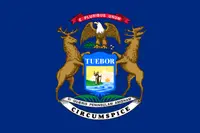 1911
Flag of Michigan
FlagA dark blue field charged with the state coat of arms: a shield showing a man on a peninsula beside a lake at sunrise, held by an elk and a moose, beneath an American eagle, with the Latin mottoes Tuebor, E Pluribus Unum and Si quaeris peninsulam amoenam circumspice.
Act 209 of 1911, MCL 2.23
- 1835
Great Seal of Michigan
SealDesigned by territorial governor Lewis Cass and adopted by the 1835 constitutional convention, the seal is the state coat of arms ringed by the words "Great Seal of the State of Michigan, A.D. MDCCCXXXV". The arms show an elk and a moose supporting a shield with a man whose raised hand signals peace while his other hand holds a gun, ready to defend the state (Tuebor, "I will defend").
Use restricted: MCL 2.45: no facsimile or reproduction of the great seal may be used in a way unconnected with official state functions; MCL 2.46 sets penalties
Act 19 of 1963 (2nd Ex. Sess.), MCL 2.41-2.47
- 1937
My Michigan
SongWritten in 1933. The lyrics are still under copyright, so they are not reproduced here.
Concurrent Resolution 17 of 1937
- 1835
Si quaeris peninsulam amoenam circumspice
MottoLatin, meaning “If you seek a pleasant peninsula, look about you”.
Part of the coat of arms adopted with the great seal on June 2, 1835; coat of arms codified at MCL 2.21-2.22 (Act 209 of 1911)
Animals
-
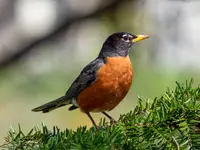 1931
American robin
BirdTurdus migratoriusThe Michigan Audubon Society held a statewide vote in 1929 in which close to 200,000 people chose among 21 candidate birds; the robin edged out the black-capped chickadee. The legislature endorsed the poll result by resolution in April 1931. Later efforts to substitute the Kirtland's warbler or the black-capped chickadee have all failed.
House Concurrent Resolution No. 30 of 1931 (not codified in the MCL) · Michigan Public
-
 1997
White-tailed deer (state game mammal)
MammalOdocoileus virginianusThe white-tailed deer became the state game mammal in 1997. Deer hunting is a major tradition in Michigan, especially on the opening day of firearm season in November.
Act 15 of 1997, MCL 2.71 · FindLaw (text of Michigan Compiled Laws)
-
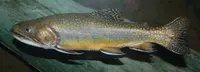 1988
Brook trout
FishSalvelinus fontinalisThe 1965 act named the trout in general as the state fish; the 1988 amendment narrowed it to the brook trout. The amendment told the state to use up existing printed materials naming the trout before producing new ones naming the brook trout.
Act 58 of 1965 as amended by Act 5 of 1988, MCL 2.15 · FindLaw (text of Michigan Compiled Laws)
-
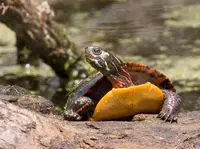 1995
Painted turtle
ReptileChrysemys pictaThe painted turtle, a common turtle of Michigan's ponds and lakes with red and yellow markings, became the state reptile in 1995.
Act 281 of 1995, MCL 2.14 · FindLaw (text of Michigan Compiled Laws)
- 2026
Wood duck
DuckAix sponsaState Rep. Alabas Farhat of Dearborn sponsored the bill, introduced January 30, 2025; Gov. Gretchen Whitmer signed it in March 2026, making the wood duck Michigan's first official duck. Backers presented it as a conservation success: the species was close to extinction in the early 1900s, and Michigan now has an estimated 100,000 wood ducks.
Public Act 7 of 2026 (2025 House Bill 4044), signed March 26, 2026. · WTVG 13abc
Plants and fungi
-
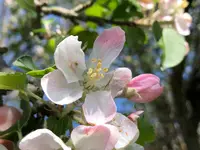 1897
Apple blossom
FlowerMalusThe resolution cites the beauty of blossoming orchards, the worldwide reputation of Michigan apples, and the fact that a fragrant native crabapple (named in the resolution as Pyrus coronaria, now Malus coronaria) grows in the state.
Joint Resolution 10 of 1897, MCL 2.11 · FindLaw (text of Michigan Compiled Laws)
-
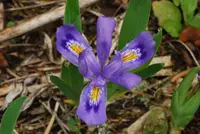 1998
Dwarf lake iris
WildflowerIris lacustrisThe dwarf lake iris is a tiny iris with deep blue flowers that grows nowhere in the world except along the northern shores of Lakes Michigan and Huron, most of it in Michigan. It is listed as threatened under both state and federal law.
Act 454 of 1998, MCL 2.81 · FindLaw (text of Michigan Compiled Laws)
-
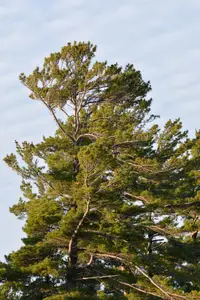 1955
White pine
TreePinus strobusThe white pine was the backbone of Michigan's lumber industry in the late 1800s, when the state led the nation in lumber production. It became the state tree in 1955.
Act 7 of 1955, MCL 2.31 · FindLaw (text of Michigan Compiled Laws)
Earth and sky
- 1965
Petoskey stone (state stone)
RockHexagonaria percarinataThe Petoskey stone is a fossilized colonial coral; the statute designates it the official state stone.
Act 89 of 1965, MCL 2.16 · FindLaw (text of Michigan Compiled Laws)
- 1972
Chlorastrolite (Isle Royale greenstone)
GemstoneChlorastrolite, or Isle Royale greenstone, is a green stone with a turtle-shell pattern found on Isle Royale and in the Keweenaw Peninsula of the Upper Peninsula. It became the state gem in 1972.
Act 56 of 1972, MCL 2.17 · FindLaw (text of Michigan Compiled Laws)
- 1990
Kalkaska soil series
SoilKalkaska sand, a soil of the northern forests, covers nearly a million acres in both peninsulas. It became the state soil in 1990.
Act 302 of 1990, MCL 2.61 · FindLaw (text of Michigan Compiled Laws)
- 2002
Mastodon
FossilMammut americanumMastodon fossils have been found across Michigan, many of them in old bogs and lake beds. The mastodon became the state fossil in 2002.
Act 162 of 2002, MCL 2.401 · FindLaw (text of Michigan Compiled Laws)
Food and drink
- 2023
Manoomin (Michigan wild rice)
Native grainZizania palustris; Zizania aquaticaThe act describes manoomin as a sacred plant important to wetlands and culturally significant to the state's Indigenous peoples.
Act 247 of 2023, MCL 2.19 · FindLaw (text of Michigan Compiled Laws)
Songs, words and language
- 1972
Pledge of allegiance to the state flag (by Harold G. Coburn)
Flag pledgeThe pledge describes Michigan as two beautiful peninsulas joined by a bridge of steel, a reference to the Mackinac Bridge.
Act 165 of 1972, MCL 2.29 · FindLaw (text of Michigan Compiled Laws)
Government emblems
- 2004
American lotus blossom
Clean water symbolNelumbo luteaThe American lotus, a native aquatic plant with huge pale yellow flowers, became Michigan's official clean water symbol in 2004.
Act 78 of 2004, MCL 2.18 · FindLaw (text of Michigan Compiled Laws)
Questions about Michigan's symbols
- What is the Michigan state animal?
- Michigan has no state animal as such. The white-tailed deer is the state game mammal, the painted turtle the state reptile, the brook trout the state fish, the robin the state bird and, since 2026, the wood duck the state duck.
- What is a Petoskey stone?
- Michigan's state stone, a fossil of an ancient colonial coral, Hexagonaria percarinata, about 350 million years old. Polished, it shows a pattern of six-sided cells, and it is found on beaches around Petoskey and the Little Traverse Bay.
- What is manoomin?
- Wild rice, a sacred plant and traditional food of the state's Indigenous peoples, which Michigan made its official native grain in 2023.
- What is the Michigan state song?
- "My Michigan," written in 1933 and adopted by a 1937 resolution. "Michigan, My Michigan" is popular but not official.
Photo credits (8)
- Flag of Michigan: Unknown author, Public domain, via Wikimedia Commons
- American robin: Rhododendrites, CC BY-SA 4.0, via Wikimedia Commons
- Apple blossom: Famartin, CC BY-SA 4.0, via Wikimedia Commons
- Dwarf lake iris: J M, CC BY-SA 2.0, via Wikimedia Commons
- White pine: Ryan Hodnett, CC BY-SA 4.0, via Wikimedia Commons
- White-tailed deer: USDA photo by Scott Bauer, Public domain, via Wikimedia Commons
- Brook trout: and (C)2007 Derek Ramsey (Ram-Man), CC BY-SA 2.5, via Wikimedia Commons
- Painted turtle: Jmalik, CC BY-SA 3.0, via Wikimedia Commons
Something out of date? Tell us and we will check it against the law.
Sources
- MCL Act 209 of 1911 Michigan Legislature
- Use of the Great Seal and Coat of Arms Michigan Department of State
- Michigan State Song State Symbols USA
- Michigan Compiled Laws, Chapter 2 (state symbols) FindLaw (text of the Michigan Compiled Laws)
- Why is the robin Michigan's state bird? Michigan Public
- Whitmer names wood duck Michigan's new state symbol 13abc