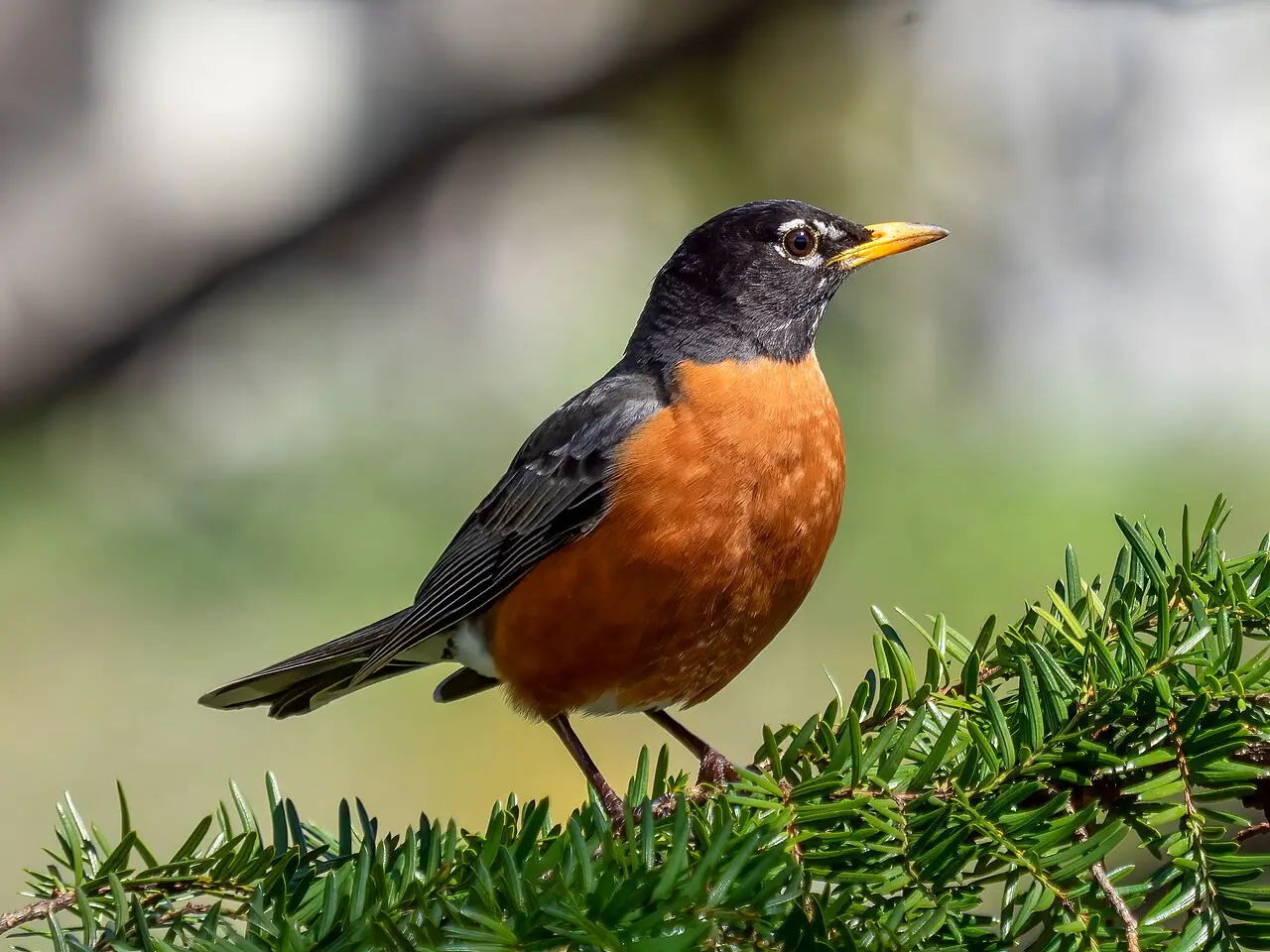
American robin, the state bird of Michigan
The state bird of Michigan is the American robin, adopted in 1931 after a statewide vote in which close to 200,000 people took part. It is the familiar red-breasted thrush of lawns and parks, and its caroling song is a sign of spring. But robins are not always newcomers in spring: some stay in Michigan all winter.
How to recognize it
The American robin is a large thrush, eight to eleven inches long, with a gray-brown back and a brick-red to orange breast. Males have a blacker head and slightly richer colors than females. Young robins have heavily spotted breasts and mottled backs, with only a reddish wash on the chest.
Its song is a run of rich, caroling phrases that rise and fall, often heard at dawn in spring and summer.
How it lives
Robins hunt on the ground, running a few steps across a lawn, stopping, and running again as they look for earthworms, which they find by sight. Worms and insects are their main food in early summer, but over the whole year fruit, mostly wild berries, makes up about 60 percent of their diet. Outside the nesting season they gather in roaming flocks.
Robins in winter
Many Michiganders think of the robin as the first sign of spring, but robins can be found in Michigan all year. Most move south for the winter, but some stay and travel in flocks in search of fruit, often in woods and swamps where people rarely see them. A winter bird survey at the University of Michigan-Dearborn has counted robins every winter since 1993.
Abundant
The American robin is one of the most abundant birds in North America, with an estimated population of about 370 million, and it is a species of least concern.
Chosen by vote
In 1929 the Michigan Audubon Society ran a statewide election for a state bird. Close to 200,000 people chose among 21 candidates, and the robin narrowly beat the black-capped chickadee. In April 1931 the legislature endorsed the result by a concurrent resolution, making the robin the state bird. The designation rests on that resolution and is not part of Michigan’s compiled laws.
Some have argued for a more distinctly Michigan bird, such as the Kirtland’s warbler, a rare songbird that nests mainly in the young jack-pine forests of northern Michigan, or the chickadee, which came second in 1929. Bills to make the change have all failed.
Questions about the Michigan state bird
- What is the state bird of Michigan?
- The American robin (Turdus migratorius), adopted by a resolution of the legislature in April 1931.
- Do robins stay in Michigan in winter?
- Some do. Most move south, but some stay and roam in flocks in search of fruit, so a robin seen in spring is not always a new arrival.
- Which other states have the robin as state bird?
- Connecticut and Wisconsin.
- Has Michigan tried to change its state bird?
- Yes. Bills to replace the robin with the Kirtland's warbler, a rare songbird that nests mainly in Michigan, or with the black-capped chickadee have been proposed, but none has passed.
Sources
- American Robin National Audubon Society
- "American robins: harbinger of spring or year-round resident?" Michigan State University Extension
- Why is the robin Michigan's state bird? Michigan Public