American robin, the state bird of three states
The American robin is the state bird of three states: Michigan, which chose it in 1931 after a statewide vote of nearly 200,000 people, Connecticut in 1943 and Wisconsin in 1949. With its gray back, brick-red breast and caroling song, it is one of the most familiar birds in North America, and one of the first heard at dawn.
The 3 states
| State | Designation | Name in state law | Adopted |
|---|---|---|---|
| Michigan | State bird | American robinHouse Concurrent Resolution No. 30 of 1931 (not codified in the MCL) | 1931 |
| Connecticut | State bird | American robinC.G.S. § 3-109 | 1943 |
| Wisconsin | State bird | American robinCh. 218, Laws of 1949; Wis. Stat. § 1.10(3)(f) | 1949 |
Three states
The American robin is the state bird of Michigan, Connecticut and Wisconsin. In each state the public had a say. The Michigan Audubon Society held a statewide vote in 1929 in which close to 200,000 people chose among 21 birds; the robin edged out the black-capped chickadee, and the Legislature endorsed the result in April 1931. Later attempts to replace it with the Kirtland’s warbler or the chickadee have all failed. Wisconsin’s schoolchildren voted for the robin in 1926 and 1927, giving it twice as many votes as any rival, and it became official in 1949. Connecticut adopted it in 1943.
A borrowed name
The American robin is a migratory thrush. English colonists named it after the familiar robin of England, a different bird, when they found a red-breasted bird in their new home.
How to recognize it
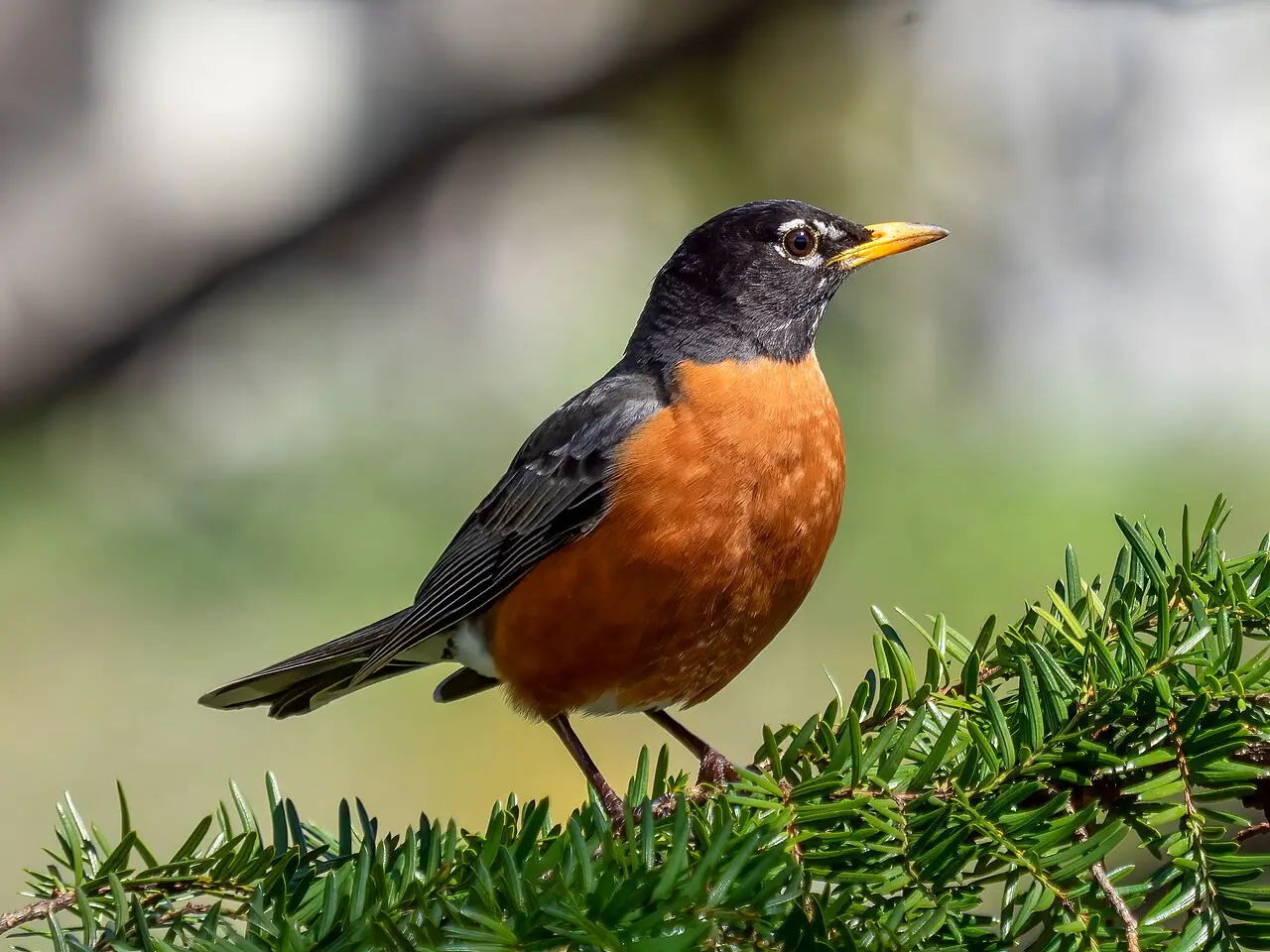
The American robin is a large thrush, about 8 to 11 inches long, with a gray back and a brick-red breast, white streaks on the chin and small white marks around the eye. Males usually have a darker head and slightly brighter colors. Its song is a run of rich, caroling phrases, often written as cheer-up, cheerily, and it is among the first songs heard at dawn.
Robins live across most of North America wherever there are trees to nest in and mud for building, in towns, lawns, farmland and forests. They hunt earthworms on lawns, but fruit makes up much of their diet over a year. In winter, flocks gather in woods with good berry crops, and many robins spend the whole winter in New England rather than migrating. Wisconsin’s first breeding bird atlas found the robin the most frequently reported breeding bird in the state.
Abundant
The American robin is abundant and widespread, with a population estimated at about 370 million birds, and it has grown markedly since the DDT era of the 1950s and 1960s. Because it feeds on lawns, it remains vulnerable to pesticides.
Questions people ask
- Which states have the robin as their state bird?
- Three - Connecticut, Michigan and Wisconsin.
- How was the robin chosen in Michigan?
- The Michigan Audubon Society held a statewide vote in 1929 in which close to 200,000 people chose among 21 birds; the robin narrowly beat the black-capped chickadee. The Legislature endorsed the result in 1931.
- Why is it called a robin?
- Colonists named this migratory thrush after the familiar English robin, a different bird.
- Do robins stay north in winter?
- Many do. Robins gather in flocks in winter in woods with good berry crops, and many spend the whole winter in New England.
Sources
- American Robin National Audubon Society
- Why is the robin Michigan's state bird? Michigan Public
- The State Bird State of Connecticut (reproduced from the Connecticut State Register & Manual, Secretary of the State)
- Wisconsin State Symbols (Wisconsin Blue Book 2007-2008, pp. 962-966) Wisconsin Legislative Reference Bureau