American robin, the state bird of Wisconsin
The state bird of Wisconsin is the American robin, chosen by Wisconsin schoolchildren in a 1926-27 vote in which it drew twice as many votes as any rival, and made official in 1949. It is a large thrush with a gray back and a brick-red breast, and its caroling song is one of the first heard at dawn. Wisconsin's first breeding bird atlas found it the most frequently reported breeding bird in the state.
How to recognize it
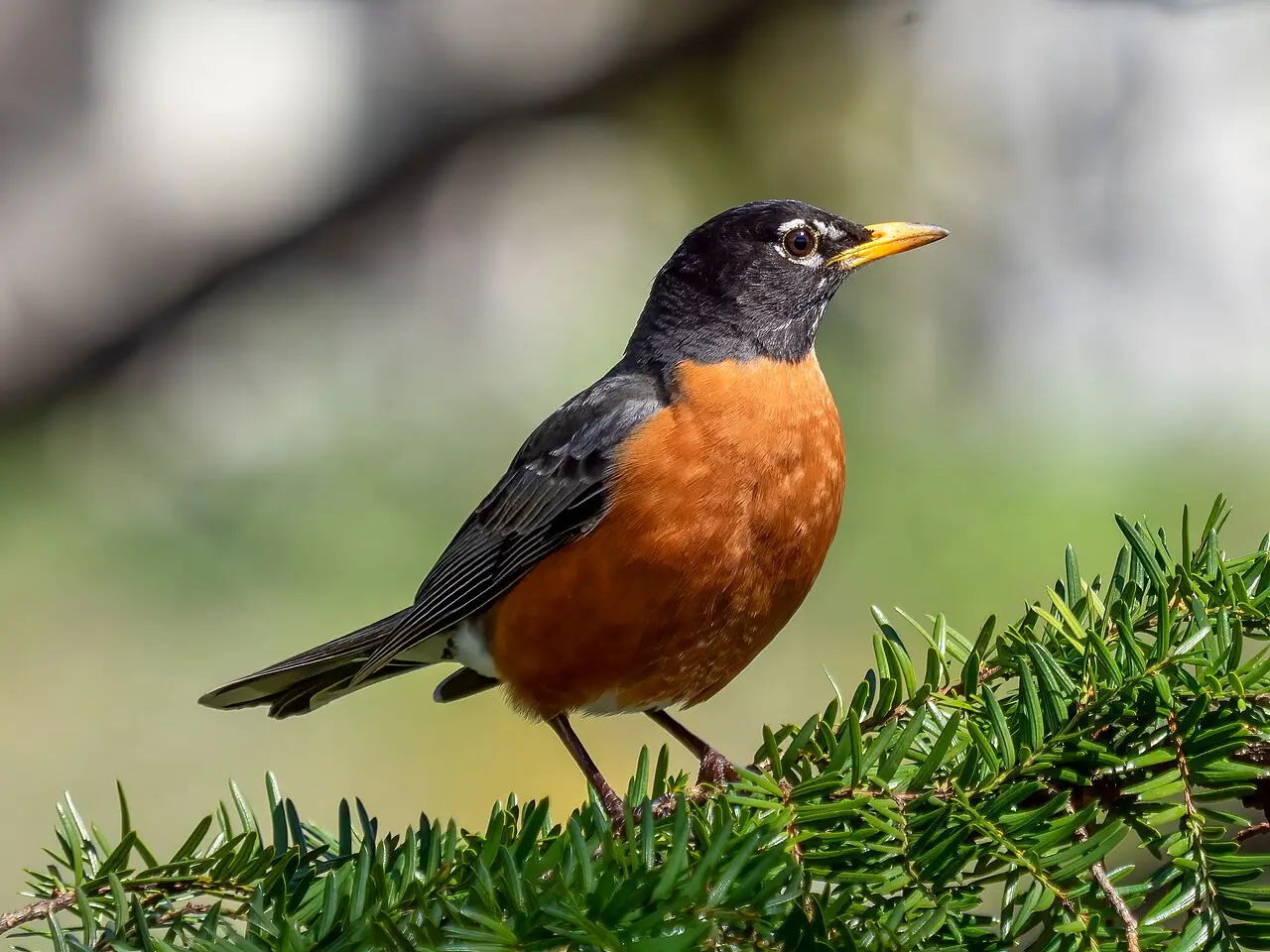
The American robin is a large thrush, about 8 to 11 inches long, weighing about 3 ounces. It has a gray back and a brick-red breast, with white streaks on the chin, small white marks around the eye and, usually, white tail corners. Males and females look alike, though males usually have a blacker head and slightly richer colors. Young robins have heavily spotted underparts and a mottled back.
The song is a run of rich, caroling phrases that rise and fall, often written as cheer-up, cheerily, and it is one of the first songs heard at dawn.
How it lives
Robins run and pause across open lawns, finding earthworms by sight. Insects and worms are their main food in early summer, but fruit, mostly wild berries, makes up perhaps 60 percent of the year-round diet. The female builds a grass cup set on a mud base and usually lays four sky-blue eggs, and a pair raises two, sometimes three, broods a season. Robins breed across most of North America wherever there are trees to nest in and mud for building.
Where to see one in Wisconsin
Robins are easy to find in Wisconsin yards, parks and farm country from spring through summer; the state’s first breeding bird atlas, from 1995 to 2000, found the robin the most frequently reported breeding species. In winter they are scarcer, but some stay and gather in flocks in fruiting trees.
Abundant, and an indicator
The American robin is a species of least concern, abundant and widespread, with Audubon estimating about 370 million birds. Because robins feed on lawns, they are vulnerable to pesticide poisoning and serve as an indicator of chemical pollution.
The state bird since 1949
In a 1926-27 vote by Wisconsin schoolchildren, the robin drew twice as many votes as any rival. The Legislature made it the state bird in 1949, in the same law that named the state flower and tree. Connecticut and Michigan have also chosen the robin.
Questions about the Wisconsin state bird
- What is the state bird of Wisconsin?
- The American robin (Turdus migratorius), adopted in 1949.
- How was the Wisconsin state bird chosen?
- By Wisconsin schoolchildren in 1926 and 1927. The robin drew twice as many votes as any other bird. The Legislature made it official in 1949.
- Do robins stay in Wisconsin in winter?
- Some do, gathering in flocks in fruiting trees, but they are much scarcer than in spring and summer.
- Which other states have the robin as state bird?
- Connecticut and Michigan.
Sources
- American Robin National Audubon Society
- American Robin Cornell Lab of Ornithology (All About Birds)
- Second Wisconsin Breeding Bird Atlas kicks off BirdWatching
- Wisconsin State Symbols (Wisconsin Blue Book 2007-2008) Wisconsin Legislative Reference Bureau