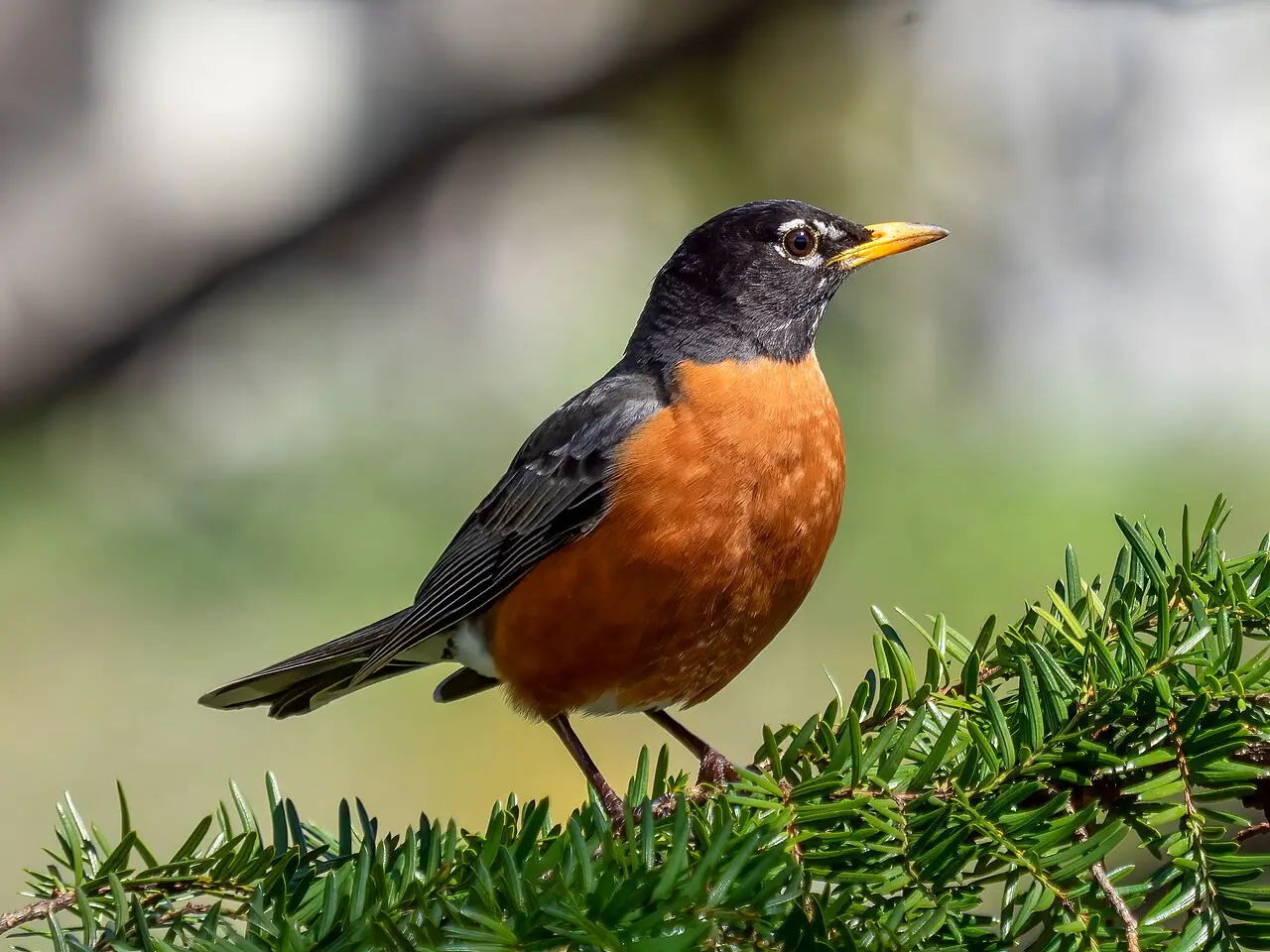
American robin, the state bird of Connecticut
The state bird of Connecticut is the American robin, adopted in 1943. It is the familiar red-breasted thrush of lawns and parks, and its caroling song is often the first heard at dawn. Many people think robins leave New England in winter, but many stay in Connecticut all year.
How to recognize it
The American robin is a large thrush, about 8 to 11 inches long, with a gray-brown back and a brick-red to orange breast. Look closely and you will see a white-streaked chin and small white marks around the eye. Males and females are similar, but males usually have darker, almost black heads and slightly brighter colors. Young robins are heavily spotted below, with only a hint of red on the breast.
Its song is one of the best-known sounds of spring: a run of rich, rising and falling phrases often written as cheer-up, cheerily, cheer-up. Robins are among the first birds to sing at dawn.
How it lives
Robins are a common sight on lawns, running a few steps, stopping, then running again as they hunt. They find earthworms by sight. In spring and early summer they eat earthworms, insects and other small creatures; in fall and winter they switch largely to berries and other fruit.
The female builds a cup nest of grass reinforced with mud, often in a tree, on a ledge or under the eaves of a house. She usually lays four eggs of the famous robin’s-egg blue, and a pair may raise two or three broods in a season.
Robins in winter
The robin is often called the first sign of spring, but in Connecticut that is not quite true. Many robins stay all winter. They change their habits instead of leaving: they form flocks, roost in evergreen swamps and move to woods with good crops of berries. Because they stop singing and spend less time on lawns, people see them far less often, and their reappearance in yards in March looks like a return.
Where to see one
From spring through summer, robins are common in yards, parks and farmland across Connecticut. In winter look for flocks feeding in berry-laden trees and shrubs, such as hollies and crabapples.
A conservation success
The robin is abundant and widespread, with a North American population estimated at about 366 million birds. It was hurt badly by the pesticide DDT in the 1950s and 1960s, which killed robins that ate poisoned earthworms, and its numbers have grown markedly since. Pesticides on lawns are still a threat.
The state bird since 1943
Connecticut adopted the robin as its state bird in 1943. The law is now section 3-109 of the Connecticut General Statutes. Michigan and Wisconsin have chosen the robin too.
Questions about the Connecticut state bird
- What is the state bird of Connecticut?
- The American robin (Turdus migratorius), adopted in 1943.
- Do robins stay in Connecticut in winter?
- Many do. Instead of leaving, they gather in flocks, roost in evergreen swamps and feed on berries, so they are much less visible than in spring and summer.
- Which other states have the robin as state bird?
- Michigan and Wisconsin.
- Why is it called a robin?
- English colonists named it after the robin of their homeland, a smaller, unrelated bird that also has an orange-red breast.
Sources
- American Robin National Audubon Society
- The State Bird State of Connecticut
- The American robin, Connecticut's state bird ConnecticutHistory.org
- Connecticut General Statutes, Chapter 33: State Seal, Arms, Flag and Symbols (sections 3-105 to 3-110) Connecticut General Assembly