Flag of Michigan
The flag of Michigan is blue, with the state coat of arms on both sides: an elk and a moose holding a shield that shows a man on a peninsula at sunrise, beneath an American eagle and three Latin mottoes. The arms were designed by Lewis Cass in 1835, and the present flag dates from a 1911 law. Michigan also has an official pledge to its flag.
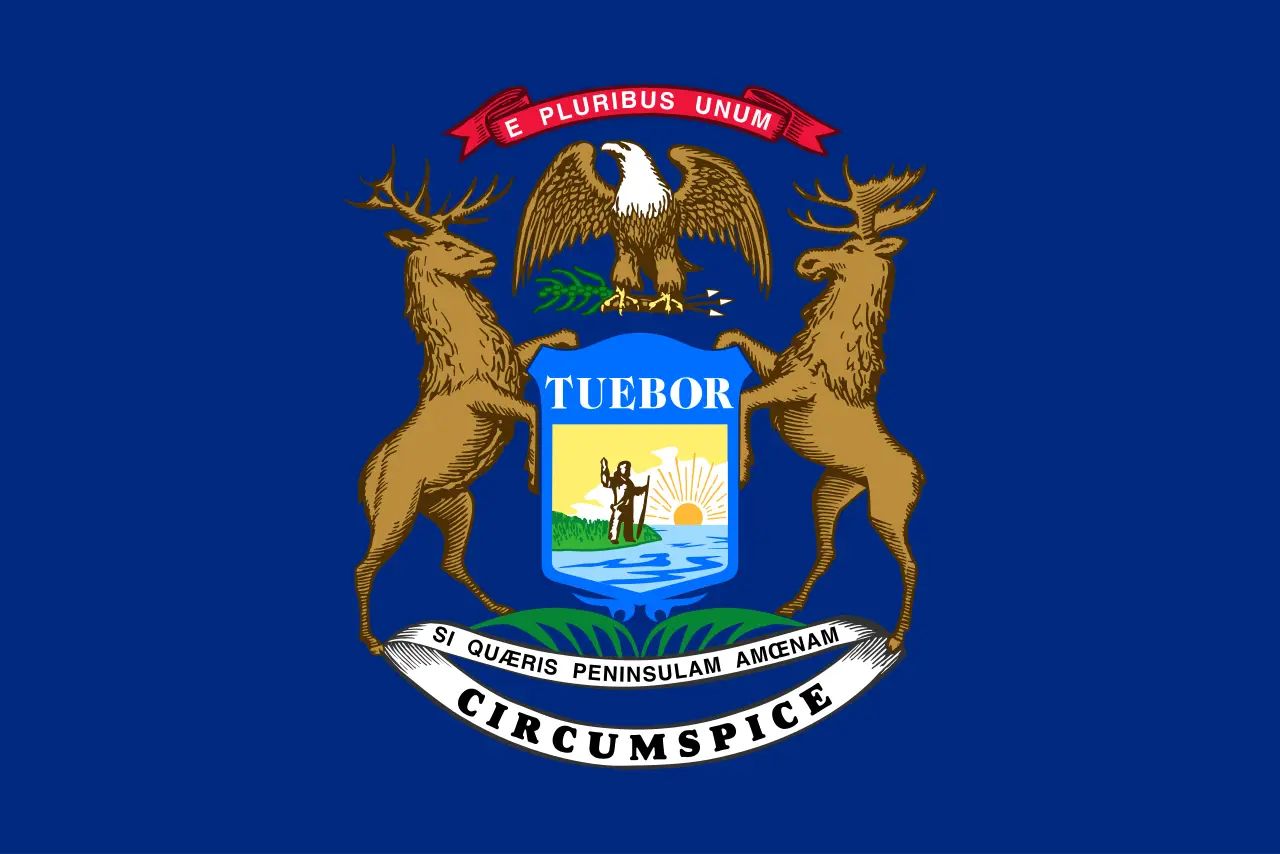
Cass’s coat of arms
The design on Michigan’s flag is older than the state. Lewis Cass, the longtime governor of Michigan Territory, designed a coat of arms and seal, and the 1835 constitutional convention adopted them on June 2, 1835, more than a year before statehood. The state flag is simply that coat of arms on a blue field.
Early flags
Several flags came before the present one. On February 22, 1837, a few weeks after statehood, Governor Stevens T. Mason presented a flag to the Brady Guard, a Detroit militia company. It was not an official state flag, but it is often called Michigan’s first: it showed the state arms with a soldier and a woman on one side and a portrait of Mason on the other. A fragment survives in the Capitol’s flag collection.
The first official state flag came at the end of the Civil War. Recommended by Adjutant General John Robertson and approved by Governor Henry Crapo, it showed the state coat of arms on blue on one side and the arms of the United States on the other. It was first flown on July 4, 1865, at the laying of the cornerstone of the soldiers’ monument at the national cemetery in Gettysburg.
In 1911 the legislature set the present design, in a law that took effect on August 1, 1911: a blue flag “charged with the arms of the state,” on both sides, with the US arms dropped.
What the arms show
- The elk and the moose. The two animals holding the shield, both native to Michigan.
- The man on the peninsula. On the shield, a man stands on a peninsula beside a lake at sunrise. His raised right hand stands for peace; the gun in his left shows that the state is ready to defend itself, as Michigan lies on an international border.
- Tuebor. Latin for “I will defend,” on the shield.
- The eagle. The crest, standing for the United States, holds an olive branch with 13 olives and three arrows.
- E Pluribus Unum. The national motto, “Out of many, one,” on a ribbon above.
- The state motto. Si quaeris peninsulam amoenam circumspice, “If you seek a pleasant peninsula, look about you,” on a ribbon below.
The flag pledge
Michigan has an official pledge to its flag, written by Harold G. Coburn and adopted in 1972. It describes Michigan as “two beautiful peninsulas united by a bridge of steel,” a reference to the Mackinac Bridge. A 2016 bill to hold a contest for a new flag design did not pass, and the 1911 flag remains in use.
Questions about the Michigan state flag
- What do the mottoes on the Michigan flag mean?
- "Tuebor" means "I will defend." "E Pluribus Unum," the national motto, means "Out of many, one." The state motto, "Si quaeris peninsulam amoenam circumspice," means "If you seek a pleasant peninsula, look about you."
- What animals are on the Michigan flag?
- An elk and a moose, animals native to Michigan, holding the shield, and an American eagle above it.
- When was the Michigan flag adopted?
- The present flag was set by Act 209 of 1911, effective August 1, 1911. An earlier official flag, with the US arms on the back, dated from 1865.
- What is the Michigan flag pledge?
- Written by Harold G. Coburn and adopted in 1972, it pledges allegiance to the flag of Michigan and to "two beautiful peninsulas united by a bridge of steel."
Sources
- History of the Great Seal and Coat of Arms Michigan Department of State
- The Brady Guards Michigan Department of Military and Veterans Affairs
- MCL 2.23 (state flag) FindLaw (text of the Michigan Compiled Laws)
- Michigan Compiled Laws § 2.22 FindLaw (text of Michigan Compiled Laws)
- Michigan Compiled Laws § 2.29 FindLaw (text of Michigan Compiled Laws)
- Now You Know: Michigan's state flag WOOD TV8
- Flying High Since 1911: The Story of Michigan's State Flag Northern Michigan History
- MCL Act 209 of 1911 Michigan Legislature