Ring-necked pheasant, the state bird of South Dakota
The state bird of South Dakota is the ring-necked pheasant, adopted in 1943. It is not native: the pheasant comes from Asia, and the first successful release in South Dakota was in Spink County in 1908. The male is a boldly colored, long-tailed bird with a white ring around its neck. It has become South Dakota's signature game bird, most numerous in the east-central part of the state.
How to recognize it
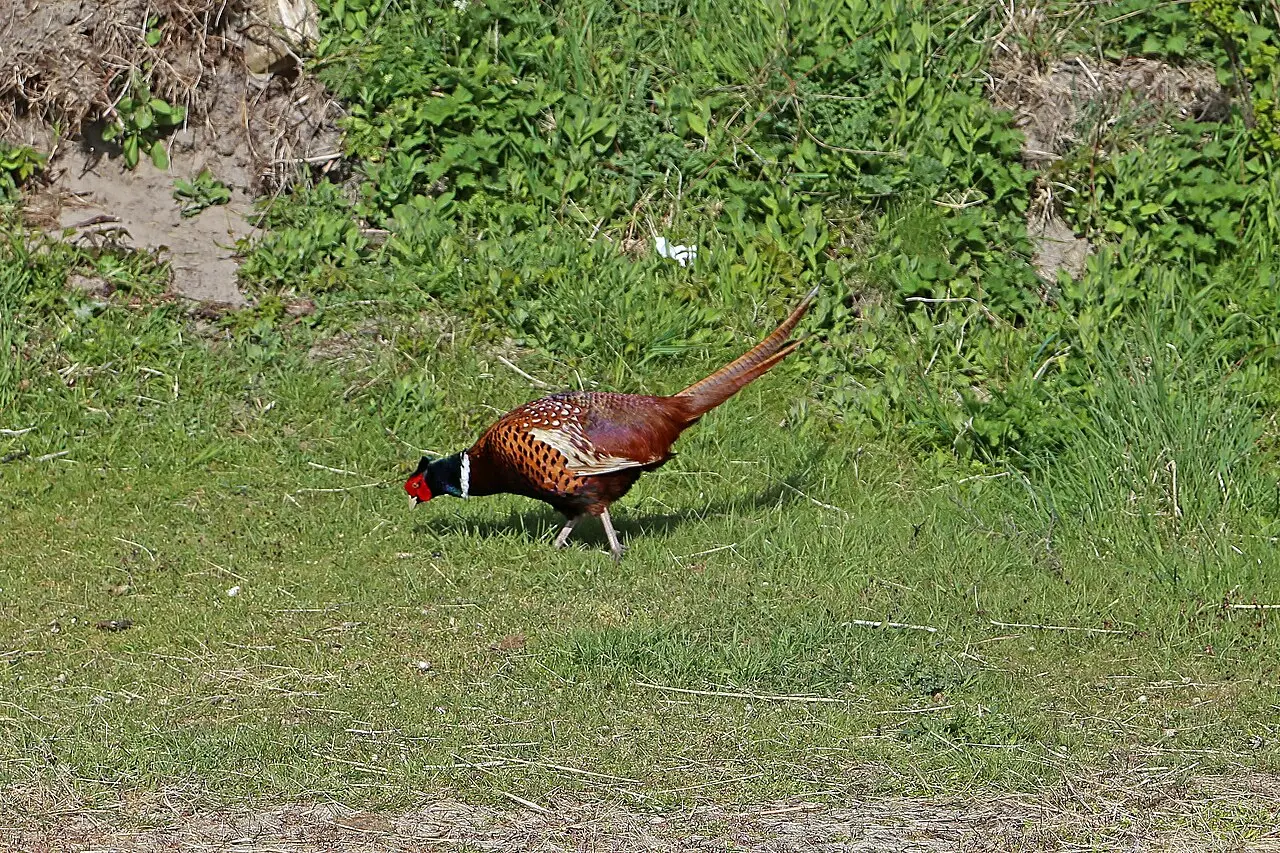
The ring-necked pheasant is a large, long-tailed game bird about 30 to 36 inches long, with the pointed tail making up much of that. The male is boldly iridescent, with a very long tail and a white ring around the neck. The female is much plainer and smaller, mottled brown with a long tail and a pale belly. The male’s call is a loud, crowing two-note squawk followed by a burst of wingbeats, and flushed birds burst into the air with a loud cackle.
How it lives
Pheasants eat almost anything: grain and small seeds, green shoots, buds, roots and berries, along with insects, spiders, earthworms and snails, and occasionally small vertebrates. Males hold territories with calls and wing displays and may have several mates. The hen nests on the ground and incubates her eggs for about 23 to 28 days. Pheasants favor semi-open country, such as farmland with mixed crops, brushy meadows, hedgerows and the edges of woods and marshes, and they do especially well on the northern prairies.
An Asian bird in South Dakota
The pheasant is native to Asia and was introduced to North America as a game bird. The secretary of state credits A. E. Cooper and E. L. Ebbert with the first successful release in South Dakota, in Spink County in 1908. The state’s wild population has risen and fallen with habitat conditions for more than a century, and Game, Fish and Parks tracks it each summer with brood-route surveys.
Where to see one in South Dakota
Pheasants are most numerous in east-central South Dakota, where idle grassland, row crops and winter cover mix. Game, Fish and Parks reports about 1.1 million acres of public hunting land within the core pheasant range.
The state bird since 1943
The 1943 Legislature named the ring-necked pheasant South Dakota’s state bird. As an introduced species, it is not a conservation priority in North America, but it is intensively managed as a game bird.
Questions about the South Dakota state bird
- What is the state bird of South Dakota?
- The ring-necked pheasant (Phasianus colchicus), adopted in 1943.
- Is the pheasant native to South Dakota?
- No. It is native to Asia. The first successful release in South Dakota was in Spink County in 1908, credited to A. E. Cooper and E. L. Ebbert.
- Where are pheasants found in South Dakota?
- They are most numerous in east-central South Dakota, where idle grassland, row crops and winter cover mix.
- What does a pheasant sound like?
- The male gives a loud, crowing two-note squawk followed by a burst of wingbeats. Flushed birds burst away with a loud cackle.
Sources
- Ring-necked Pheasant National Audubon Society
- State Seal and Symbols South Dakota Secretary of State
- Upland outlook South Dakota Game, Fish and Parks
- SDCL § 1-6-9, State bird South Dakota Legislature
- 2018 Ringneck Outlook South Dakota Game, Fish and Parks