Wyoming state symbols
Wyoming has 22 official state symbols, all set out in Title 8 of the Wyoming Statutes. The oldest is the Great Seal of 1893; the flag and the Indian paintbrush followed on the same day in 1917, and the newest, the blotched tiger salamander, was named in 2019. Wyoming's list includes some unusual entries: a state code of conduct, the Code of the West, a state coin, and a state dinosaur chosen by election.
Flag, flower and bird
Wyoming’s first symbols came from a campaign by the Wyoming Daughters of the American Revolution under Grace Raymond Hebard to give the state both a flag and a flower. On January 31, 1917, both became law: the bison flag and the Indian paintbrush, whose showy red color comes from its bracts rather than its small true flowers. The western meadowlark became the state bird in 1927, and the plains cottonwood the state tree in 1947.
Wildlife and fossils
The American bison, the centerpiece of the flag since 1917, became the state mammal in 1985. In 1987 the Legislature named the cutthroat trout, named for the orange-red mark under its jaw, the state fish and Knightia, an extinct schooling fish found by the thousands in the Green River Formation, the state fossil. The short-horned lizard, or horned toad, followed as state reptile in 1993, and in 1994 Triceratops became the state dinosaur, chosen by an election rather than written into the law. Sheridan’s green hairstreak, the earliest butterfly to emerge in Wyoming each spring, often while snow is still melting, became the state butterfly in 2009, and the blotched tiger salamander, one of North America’s largest salamanders, the state amphibian in 2019.
Stone, grass and sage
Jade, of the nephrite variety, became the state gemstone in 1967. Western wheatgrass, a native grass valued as forage and for controlling erosion, became the state grass in 2007, and Wyoming big sagebrush, proposed by the advanced biology class at Hulett High School, the state shrub in 2016.
Cowboys and a coin
Rodeo became the state sport in 2003. In 2004 Wyoming named the Sacagawea golden dollar its state coin; Sacagawea, the Shoshone woman who aided the Lewis and Clark expedition, is honored with a grave site at Lander. In 2010 the Legislature adopted the Code of the West, ten principles from James P. Owen’s book Cowboy Ethics, among them “Ride for the brand,” “Talk less, say more” and “Know where to draw the line.”
The Bucking Horse and Rider
Wyoming’s best-known image is not a designated symbol but a state trademark. The Bucking Horse and Rider was used by 1918 as an insignia of Wyoming National Guard units serving in France and Germany in World War I, designed by First Sergeant George N. Ostrom. Secretary of State Lester Hunt had the artist Allen T. True draw a bucking horse and rider for new license plates meant to foil counterfeiters, which debuted in 1936, the year the state copyrighted the mark. Today it is a registered trademark licensed jointly by the state and the University of Wyoming.
Flag, seal, song, motto and nickname
-
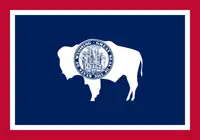 1917
Flag of Wyoming
FlagA white silhouette of a bison on a blue field, with the state seal shown in blue on the bison's side as if branded; the blue field is edged by a narrow white stripe and a wider red border. The statute sets the proportions (width seven-tenths of the length) and calls for a gold cord and tassels.
Wyo. Stat. § 8-3-102 (1917 Wyo. Sess. Laws ch. 8)
- 1893
Great Seal of Wyoming
SealA robed woman modeled on the Winged Victory of the Louvre stands on a pedestal holding a staff with an "Equal Rights" banner, with broken chains at her wrists; men representing ranching and mining flank her, and pillars topped by lamps of knowledge carry scrolls reading Livestock, Grain, Mines and Oil. A shield with a star and the number 44 sits on the pedestal under an eagle, and the dates 1869 and 1890 mark territorial organization and statehood.
The seal was adopted in 1893 and revised in 1921.
Wyo. Stat. § 8-3-101
- 1955
Wyoming
SongThe lyrics are still under copyright, so they are not reproduced here. Official page.
Wyoming has two official songs: the march "Wyoming," with words by Charles E. Winter and music by George E. Knapp, adopted in 1955, and "Wyoming Where I Belong" by Annie and Amy Smith, adopted in 2018.
Wyo. Stat. § 8-3-108
- 1955
Equal Rights
MottoEnglish.
Wyo. Stat. § 8-3-107
Animals
-
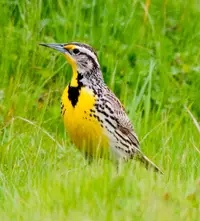 1927
Western meadowlark
BirdSturnella neglectaThe statute names only the genus Sturnella and the common name meadowlark; state sources identify it as the western meadowlark.
-
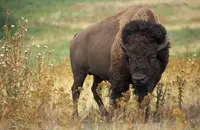 1985
American bison
MammalBison bisonA white bison silhouette had already been the centerpiece of the state flag since 1917.
-
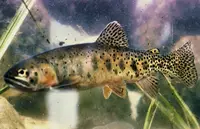 1987
Cutthroat trout
FishOncorhynchus clarkiiThe statute still uses the older name Salmo clarki; the fish is named for the orange-red mark under its lower jaw.
-
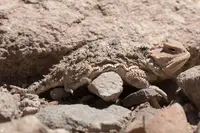 1993
Short-horned lizard (horned toad)
ReptilePhrynosoma hernandesiThe statute designates the eastern short-horned lizard, "Phrynosoma douglassi brevirostre", commonly called the horned toad.
-
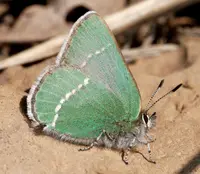 2009
Sheridan's green hairstreak
ButterflyCallophrys sheridaniiThe section is headed "State insect" but its text names the species the state butterfly. It is the earliest butterfly to emerge in Wyoming each spring, often flying while snow is still melting.
Wyo. Stat. § 8-3-122 (2009 Wyo. Sess. Laws, Enrolled Act No. 20, Senate File 16) · Wyoming Legislature
- 2019
Blotched tiger salamander
AmphibianAmbystoma mavortium melanostictumOne of North America's largest salamanders, it lives across most of Wyoming below about 10,000 feet.
Wyo. Stat. § 8-3-126 (2019 Wyo. Sess. Laws, Enrolled Act No. 16, Senate File 50) · Wyoming Legislature
Plants and fungi
-
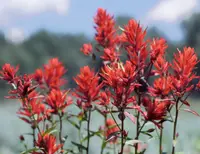 1917
Indian paintbrush
FlowerCastilleja linariifoliaIt was adopted on the same day as the state flag, during a push by the Wyoming Daughters of the American Revolution under Grace Raymond Hebard to give the state both a flag and a flower. The statute spells the name "Castillija linariaefolia"; the plant's showy red bracts, not its small flowers, provide the color.
- 1947
Plains cottonwood
TreePopulus deltoides subsp. moniliferaThe 1947 law was amended in 1961 to change the tree's scientific name; the statute today reads "Populus Sargentii", an older name for the plains cottonwood.
- 2007
Western wheatgrass
GrassPascopyrum smithiiA sod-forming native grass of the northern plains valued as forage for livestock and for erosion control.
Wyo. Stat. § 8-3-121 (2007 Wyo. Sess. Laws, Enrolled Act No. 63, Senate File 106) · Wyoming Legislature
- 2016
Wyoming big sagebrush
ShrubArtemisia tridentata subsp. wyomingensisThe idea came from the advanced biology class at Hulett High School. The governor signed the bill on March 4, 2016, and it took effect July 1, 2016.
Wyo. Stat. § 8-3-124 (2016 Wyo. Sess. Laws ch. 83, Senate File 52) · Wyoming Legislature, Legislative Service Office
Earth and sky
- 1967
Jade (nephrite)
GemstoneThe statute is headed "State stone" but names jade the official gemstone; the Secretary of State notes Wyoming's jade is the nephrite variety.
- 1987
Knightia
FossilKnightia is an extinct schooling fish found in great numbers in the Green River Formation of southwestern Wyoming.
- 1994
Triceratops
DinosaurUnusually, the statute does not name the dinosaur: it says the state dinosaur is chosen by an election and the result is filed with the Secretary of State, who lists Triceratops.
Culture and history
- 2003
Rodeo
Sport - 2010
Code of the West
CodeThe ten principles, such as "Ride for the brand" and "Talk less, say more", are drawn from James P. Owen's book Cowboy Ethics.
Government emblems
- 2004
Sacagawea golden dollar
CoinSacagawea, the Shoshone woman who aided the Lewis and Clark expedition, is honored with a grave site at Lander, Wyoming. Sacagawea had already been chosen as the subject of the new dollar coin by January 1999, before the coin entered circulation in 2000.
- —
State territorial flag
Territorial flagA blue flag with "WYOMING" across the top and the Latin phrase "CEDANT ARMA TOGAE" across the bottom, centered on a gold-bordered shield showing mountains and a train under the date 1869, farm and mining tools, and an arm holding a sword.
- 1936
Bucking Horse and Rider
Trademark (Bucking Horse and Rider)The image was used by 1918 as an insignia of Wyoming National Guard units serving in France and Germany in World War I, designed by First Sergeant George N. Ostrom. Secretary of State Lester Hunt had artist Allen T. True draw a bucking horse and rider for new anti-counterfeiting license plates, which debuted in 1936, the same year the state copyrighted the mark. It is now a federally and state registered trademark licensed jointly with the University of Wyoming.
Wyo. Stat. § 8-3-117 (licensing of the trademark by the Secretary of State) · Wyoming Secretary of State
Questions about Wyoming's symbols
- What is the Wyoming state mammal?
- The American bison, adopted in 1985. A white bison has been the centerpiece of the state flag since 1917.
- What is the Wyoming state dinosaur?
- Triceratops. Unusually, the law does not name it; it says the state dinosaur is chosen by an election and the result filed with the secretary of state.
- What is the Code of the West?
- Wyoming's official state code, adopted in 2010: ten principles such as "Ride for the brand" and "Talk less, say more," drawn from James P. Owen's book Cowboy Ethics.
- What is the Wyoming state gemstone?
- Jade, the nephrite variety, adopted in 1967.
- What is the Wyoming state fossil?
- Knightia, an extinct schooling fish found in great numbers in the Green River Formation of southwestern Wyoming.
Photo credits (7)
- Flag of Wyoming: User:Dbenbenn, Public domain, via Wikimedia Commons
- Indian paintbrush: Unknown author, Public domain, via Wikimedia Commons
- Western meadowlark: Kevin Cole from Pacific Coast, USA (en:User:Kevinlcole), CC BY 2.0, via Wikimedia Commons
- American bison: Jack Dykinga, Public domain, via Wikimedia Commons
- Cutthroat trout: Hazzard, Lloyde / U.S. Fish and Wildlife Service, Public domain, via Wikimedia Commons
- Short-horned lizard: Bettina Arrigoni, CC BY 2.0, via Wikimedia Commons
- Sheridan's green hairstreak: (c) Toby, some rights reserved (CC BY), CC BY 4.0, via Wikimedia Commons
Something out of date? Tell us and we will check it against the law.
Sources
- The Wyoming State Flag and the Women Who Made It Fly WyoHistory.org (Wyoming State Historical Society)
- Great Seal Wyoming Secretary of State
- Wyoming Facts and Symbols State of Wyoming
- Wyoming Statutes, Title 8 (state symbols) Wyoming Legislature
- Wyoming State Symbols (Student's Corner) Wyoming Secretary of State