Flag of Wyoming
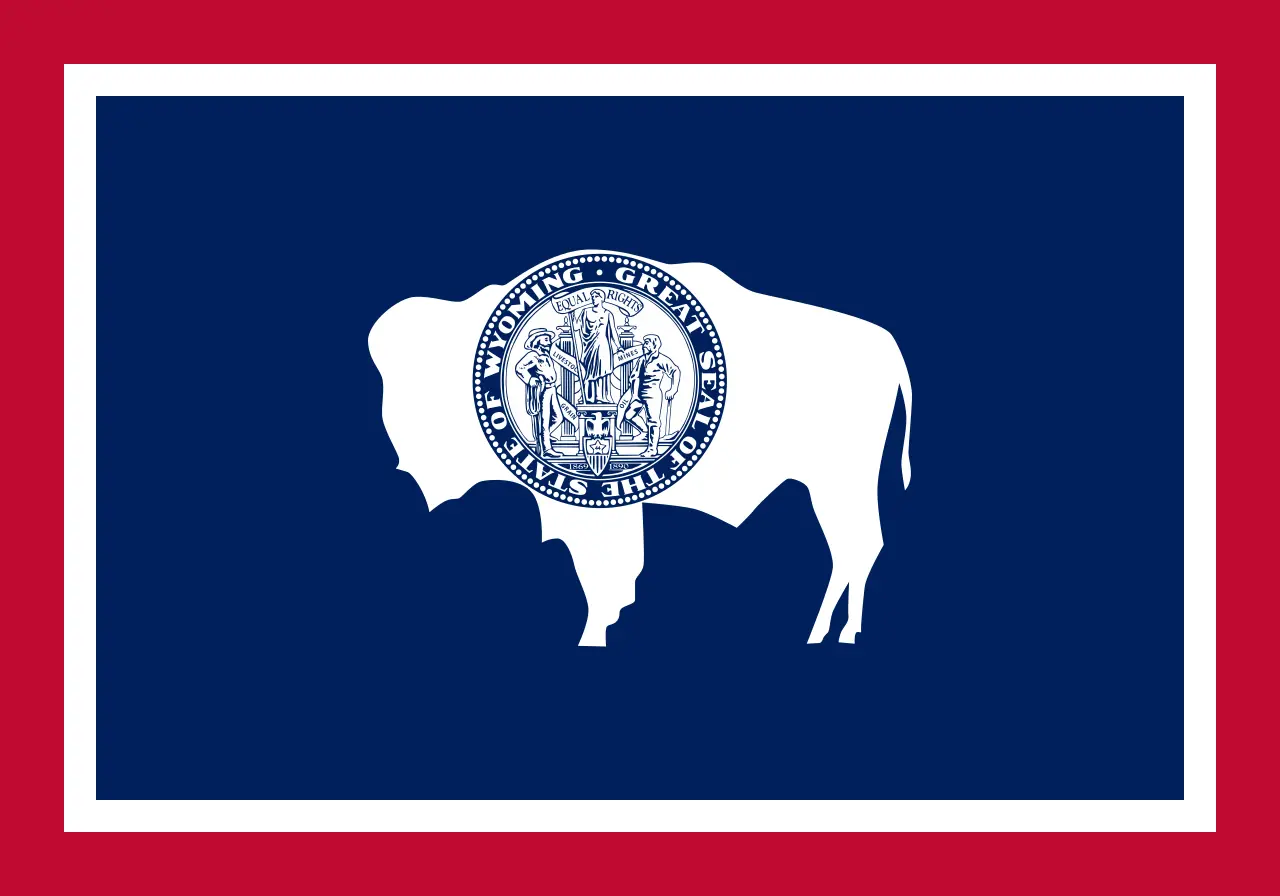
The flag of Wyoming is a blue field with a white bison in the center, the state seal shown in blue on its side as if it had been branded, all inside a narrow white stripe and a wider red border. It was designed by Verna Keays of Buffalo, who won a $20 prize in a 1916 Daughters of the American Revolution contest, and Governor John B. Kendrick signed it into law on January 31, 1917.
What the flag shows
- The red border. One-twentieth of the flag’s length. The official state description says it stands for the Native peoples and for the blood of the pioneers who died reclaiming the land.
- The white stripe. A narrow stripe inside the border, one-fortieth of the length, for purity and uprightness.
- The blue field. The color of Wyoming’s sky and mountains, standing for fidelity, justice and virility.
- The bison. A white bison silhouette in the center, half as long as the blue field, once the “monarch of the plains.” The designer said it symbolized freedom.
- The seal. The Great Seal in blue on the bison’s ribs, placed to suggest the ranching custom of branding.
By law the flag is seven-tenths as wide as it is long, carries a gold cord and tassels, and uses the same red, white and blue as the US flag.
A $20 contest
Wyoming had no state flag for its first 26 years of statehood. In 1916 the Wyoming Daughters of the American Revolution, led by its state regent, Grace Raymond Hebard, ran a design contest with a $20 prize and entries due by September 30. Verna Keays of Buffalo won with her bison design. The 14th Legislature adopted it, and Governor John B. Kendrick signed the law on January 31, 1917, the same day the Indian paintbrush became the state flower.
Turning the bison
Keays originally drew the bison facing outward, toward the fly, as if looking over the plains. Because the law did not say which way it should face, Hebard had it turned toward the staff, and by 1926 Keays herself was making flags only in that form.
The territorial flag
Wyoming law also describes a separate state territorial flag: a blue field with WYOMING across the top, the territorial motto Cedant arma togae across the bottom, and a gold-bordered shield showing mountains and a train under the date 1869, farm and mining tools, and an arm holding a sword.
Rules for the flag
Any citizen may fly the state flag on any occasion they consider appropriate, and the penalties for misusing the US flag apply to it too. The state historian must keep at least six state flags on hand to lend to citizens for public occasions, against a deposit. Wyoming has no official pledge or salute to its flag.
Questions about the Wyoming state flag
- What do the colors of the Wyoming flag mean?
- According to the official state description, the red border stands for the Native peoples and for the blood of pioneers, the white for purity and uprightness, and the blue, the color of Wyoming's sky and mountains, for fidelity, justice and virility.
- Why is there a bison on the Wyoming flag?
- The bison was once the "monarch of the plains," and the designer, Verna Keays, said it symbolized freedom. The seal on its side suggests the ranching custom of branding.
- Who designed the Wyoming flag?
- Verna Keays of Buffalo, later Mrs. A. C. Keyes of Casper, who won a $20 prize in a 1916 design contest run by the Wyoming Daughters of the American Revolution.
- Which way does the bison on the Wyoming flag face?
- Toward the staff. Keays first drew it facing the fly, as if looking over the plains, but because the law did not fix its direction, Grace Raymond Hebard had it turned to face the staff, and by 1926 Keays herself made flags only that way.
Sources
- The Wyoming State Flag and the Women Who Made It Fly WyoHistory.org (Wyoming State Historical Society)
- Wyoming Statutes, Title 8 (state flag) Wyoming Legislature
- Wyoming State Symbols (Student's Corner) Wyoming Secretary of State
- Wyoming Facts and Symbols State of Wyoming