Nebraska state symbols
Nebraska has 28 official state symbols. The oldest are the Great Seal and the motto "Equality Before the Law," both from 1867, the year of statehood; the newest is the ornate box turtle, chosen in a public vote and proclaimed the state reptile in 2022. Since 1997 the governor, not just the Legislature, has been able to name state symbols.
The early symbols
Nebraska’s seal and motto came with statehood in 1867. In 1895 the Legislature added both the goldenrod as state flower and a nickname, the Tree Planters’ State, which the Cornhusker State replaced in 1945. The western meadowlark became the state bird in 1929. The Legislature named John G. Neihardt the state’s poet laureate in 1921, a title the Blue Book says is still his. His central work is the Epic Cycle of the West, a set of five long narrative poems. The flag came in 1925.
Stones and bones
In 1967 the Legislature named three symbols from the ground. Blue agate, the state gemstone, is found in northwestern Nebraska, where it formed in wind-laid silt and claystone of the Chadron Formation. The prairie agate, the state rock, seldom shows the banding of most agates and is plentiful in the Oglala National Grassland, though it actually formed in rocks in Wyoming and South Dakota and was carried into Nebraska by streams. The state fossil is the mammoth. Its remains have turned up in most of the state’s counties, and a Lincoln County specimen, one of the largest elephant fossils known, is on display at the University of Nebraska State Museum in Lincoln.
Prairie and farm
Several symbols honor the land. Little bluestem, the state grass since 1969, is a valuable native hay and forage grass that grows in clumps in central and western Nebraska. The Holdrege soil series, named in 1979, is suited to sorghum, wheat and corn and is most common in south-central Nebraska. The cottonwood replaced the American elm, the first state tree, in 1972; settlers often carried cottonwood shoots to plant on their claims. The honeybee followed in 1975 and the white-tailed deer in 1981.
Named by the governor
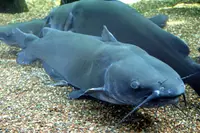
A 1997 law let the governor designate state symbols, and Governor Ben Nelson used the power often. Between September 1997 and September 1998 he named the channel catfish the state fish, the square dance the state’s American folk dance, “A Place Like Nebraska” by Sol Kutler the state ballad, St. Paul the historic baseball capital and Wakefield the baseball capital, the village of Cody the Village of Lights, the Platte River the state river, Kool-Aid, invented in Hastings in 1927, the state soft drink, and milk the state beverage. Governor Charles Thone had earlier proclaimed William Kloefkorn of Nebraska Wesleyan University the first state poet in 1982.
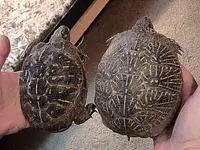
The newest symbol came from a public vote. In 2022 Nebraska Game and Parks asked people to choose among six native reptiles, and the ornate box turtle won. Governor Pete Ricketts proclaimed it the state reptile that October.
Flag, seal, song, motto and nickname
-
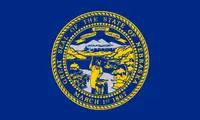 1925
Flag of Nebraska
FlagThe state seal in gold and silver, centered on a field of national blue. The law originally created it as the state banner; 90-102 now makes the banner the official state flag.
Neb. Rev. Stat. 90-102 to 90-104 (Laws 1925, c. 151; amended Laws 1963, c. 305 and Laws 1965, c. 570)
- 1867
Great Seal of Nebraska
SealA steamboat goes up the Missouri River, a blacksmith with hammer and anvil stands for the mechanic arts, and a settler's cabin with wheat sheaves and corn stands for agriculture. A train heads west toward the Rocky Mountains, the motto runs across the top, and the rim reads "Great Seal of the State of Nebraska, March 1st, 1867."
The cast-iron press with a lion's head bought in 1867 to stamp the Great Seal was used for 138 years before it was retired in 2005. The secretary of state says the seal is not in the public domain and gives written permission to use it only for official state business or for education, never for commercial or political purposes.
Use restricted: Neb. Rev. Stat. 84-501 bars imitation or counterfeiting; the Secretary of State allows use only for state agency business or public education, never for commercial or political purposes, and the same limits apply to the flag. Section 90-103 also bars using the flag as an advertisement or trademark (Class III misdemeanor under 90-104).
Neb. Const. art. IV, § 24; Neb. Rev. Stat. 84-501
- 1967
Beautiful Nebraska
SongThe lyrics are still under copyright, so they are not reproduced here. Official page.
The Legislature adopted "Beautiful Nebraska" in 1967, and the bill was signed on June 21 of that year. The law was amended in 2008.
Neb. Rev. Stat. 90-111 (Laws 1967, c. 613, LB 535; amended Laws 2008, LB728)
- 1867
Equality Before the Law
MottoEnglish.
Governor David Butler signed the seal and motto law in June 1867. The next day Nebraska ratified the Fourteenth Amendment, its first vote on a constitutional amendment as a state.
Neb. Rev. Stat. 84-501 (Act approved June 15, 1867; Laws 1867, § 1, p. 57)
- 1945
The Cornhusker State
NicknameThe 1945 Legislature made it the official state name, replacing the 1895 one. It comes from the University of Nebraska teams' nickname, which in turn refers to husking corn by hand before husking machines existed.
Animals
-
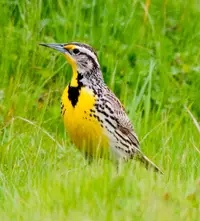 1929
Western meadowlark
BirdSturnella neglectaThe Secretary of State describes the meadowlark as common in every part of Nebraska and known for its cheerful song; it nests on the ground in grassy fields.
Neb. Rev. Stat. 90-107 (Laws 1929, c. 139, § 1) · Nebraska Legislature
-
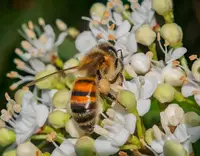 1975
Honeybee
InsectApis mellifera -
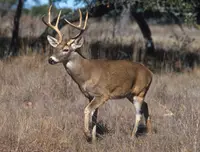 1981
White-tailed deer
MammalOdocoileus virginianus -
 1997
Channel catfish
FishIctalurus punctatusGov. Ben Nelson declared the channel catfish the state fish on September 13, 1997.
Governor's executive order of September 13, 1997, the date Neb. Rev. Stat. 90-119 (Laws 1997, LB 106, approved February 28, 1997) took effect · Clerk of the Nebraska Legislature
-
 2022
Ornate box turtle
ReptileTerrapene ornataNebraska Game and Parks held a public online vote among six native reptiles, and the ornate box turtle won. Gov. Pete Ricketts issued the proclamation at a Game and Parks ceremony at the Schramm Education Center near Gretna.
Governor's proclamation by Gov. Pete Ricketts under Neb. Rev. Stat. 90-119 · WOWT 6 News
Plants and fungi
-
 1895
Goldenrod
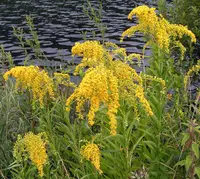
FlowerSolidago giganteaRep. L. P. Judd of Cedar Rapids introduced the resolution, which had the backing of University of Nebraska botanist Charles Bessey, and Gov. Silas A. Holcomb signed it on April 4, 1895. In the state senate, Sen. John C. Sprecher of Schuyler tried to swap in the violet, but the goldenrod carried the vote. Later that year the State Fair set aside September 17 as Golden Rod Day.
Legislative resolution approved April 4, 1895 (not part of the current revised statutes) · History Nebraska
- 1969
Little bluestem
GrassSchizachyrium scopariumThe statute uses the older scientific name Andropogon scoparius. In central and western Nebraska it grows in clumps and is sometimes called bunch grass or beard grass; it is a valuable native hay and forage grass.
Neb. Rev. Stat. 90-112 (Laws 1969, c. 829, § 1) · Nebraska Legislature
-
 1972
Cottonwood
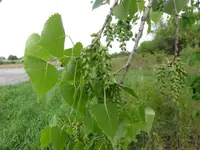
TreePopulus deltoidesThe American elm was Nebraska's first state tree, named in 1937, before the 1972 Legislature replaced it with the cottonwood. Settlers often carried cottonwood shoots to plant on their claims, and several well-known pioneer landmarks were cottonwoods.
Neb. Rev. Stat. 90-113 (Laws 1972, LB 1089, § 1) · Nebraska Legislature
Earth and sky
- 1967
Blue agate (blue chalcedony)
GemstoneBlue agate is found in northwestern Nebraska, where it formed in wind-deposited silt and claystone of the Chadron Formation, according to the Nebraska Blue Book.
Neb. Rev. Stat. 90-108 (Laws 1967, c. 608, § 1) · Nebraska Legislature
- 1967
Mammoth
FossilMammuthusThe Nebraska Blue Book says mammoth remains have turned up in most of the state's counties. A Lincoln County specimen, catalogued as Archidiskodon imperator maibeni and ranked among the largest elephant fossils known, is exhibited at the University of Nebraska State Museum in Lincoln.
Neb. Rev. Stat. 90-109 (Laws 1967, c. 609, § 1) · Nebraska Legislature
- 1967
Prairie agate
RockUnlike most agates, prairie agate seldom shows banding; it is plentiful in the Oglala National Grassland. According to the Nebraska Blue Book, it originally formed in sedimentary rocks in Wyoming and South Dakota and was carried into Nebraska by streams.
Neb. Rev. Stat. 90-110 (Laws 1967, c. 610, § 1) · Nebraska Legislature
- 1979
Holdrege series
SoilThe statute classifies Holdrege soils as Typic Argiustolls, fine-silty, mixed, mesic. The Nebraska Blue Book notes these soils are suited to sorghum, wheat and corn and are most common in south-central Nebraska and north-central Kansas.
Neb. Rev. Stat. 90-116 (Laws 1979, LB 475, § 1) · Nebraska Legislature
- 1998
Platte River
RiverFormed where the North Platte and South Platte meet near the city of North Platte, the river runs about 310 miles east to the Missouri. It is too shallow for navigation, but its valley carried the Oregon, Mormon and California trails, the Pony Express, the Union Pacific line and Interstate 80.
Governor's proclamation under Neb. Rev. Stat. 90-119 (Laws 1997, LB 106, approved February 28, 1997) · Clerk of the Nebraska Legislature
Food and drink
- 1998
Kool-Aid
Soft drinkEdwin E. Perkins, head of Perkins Products Co., developed the fruit-flavored drink in Hastings in 1927.
Governor's proclamation under Neb. Rev. Stat. 90-119 (Laws 1997, LB 106, approved February 28, 1997) · Clerk of the Nebraska Legislature
- 1998
Milk
BeverageGov. Ben Nelson made milk the state beverage, recognizing the dairy industry's place in Nebraska agriculture.
Governor's proclamation under Neb. Rev. Stat. 90-119 (Laws 1997, LB 106, approved February 28, 1997) · Clerk of the Nebraska Legislature
Songs, words and language
- 1997
"A Place Like Nebraska"
BalladGov. Ben Nelson proclaimed it the state ballad on October 9, 1997; Sol Kutler wrote both words and music.
Governor's proclamation under Neb. Rev. Stat. 90-119 (Laws 1997, LB 106, approved February 28, 1997) · Clerk of the Nebraska Legislature
- 1921
John G. Neihardt
Poet laureateThe 1921 Legislature named Neihardt (1881-1973) Nebraska's poet laureate, a title the Blue Book says remains his. He began writing "The Epic Cycle of the West," a set of five long narrative poems that became his central literary work.
- 1982
William Kloefkorn
State poetKloefkorn (1932-2011), an English professor at Nebraska Wesleyan University, became the first state poet; he helped start Nebraska's Poets-in-the-Schools program.
Governor's proclamation by Gov. Charles Thone · Clerk of the Nebraska Legislature
- 1963
Official state symbol and slogan
Symbol and sloganA 1963 law adopted a pictured state emblem and slogan and told state agencies to use them in promoting Nebraska and to print them on state letterhead and envelopes.
Neb. Rev. Stat. 90-105 and 90-106 (Laws 1963, c. 533) · Nebraska Legislature
Culture and history
- 1997
Square dance
DanceGov. Ben Nelson designated it the official state American folk dance on September 19, 1997.
Governor's proclamation under Neb. Rev. Stat. 90-119 (Laws 1997, LB 106, approved February 28, 1997) · Clerk of the Nebraska Legislature
Places and institutions
- 1997
St. Paul
Historic baseball capitalGov. Ben Nelson named St. Paul the official historic baseball capital of Nebraska.
Governor's proclamation under Neb. Rev. Stat. 90-119 (Laws 1997, LB 106, approved February 28, 1997) · Clerk of the Nebraska Legislature
- 1997
Wakefield
Baseball capitalGov. Ben Nelson named Wakefield the official baseball capital of Nebraska on the same day he honored St. Paul.
Governor's proclamation under Neb. Rev. Stat. 90-119 (Laws 1997, LB 106, approved February 28, 1997) · Clerk of the Nebraska Legislature
- 1997
Cody
Village of lightsGov. Ben Nelson declared the village of Cody Nebraska's official Village of Lights.
Governor's proclamation under Neb. Rev. Stat. 90-119 (Laws 1997, LB 106, approved February 28, 1997) · Clerk of the Nebraska Legislature
Questions about Nebraska's symbols
- What is the Nebraska state bird?
- The western meadowlark, adopted in 1929.
- What is the Nebraska state flower?
- The goldenrod, adopted in 1895. The resolution names giant goldenrod, then called Solidago serotina.
- What is Nebraska's state soft drink?
- Kool-Aid, developed in Hastings in 1927 by Edwin E. Perkins. Governor Ben Nelson made it the state soft drink in 1998.
- What is the Nebraska state fossil?
- The mammoth, adopted in 1967. Mammoth remains have been found in most of Nebraska's counties.
- Who is Nebraska's poet laureate?
- John G. Neihardt, named by the Legislature in 1921. The Nebraska Blue Book says the title remains his.
Photo credits (8)
- Flag of Nebraska: Liamgabby79, Public domain, via Wikimedia Commons
- Goldenrod: Unknown author, CC BY-SA 3.0, via Wikimedia Commons
- Western meadowlark: Kevin Cole from Pacific Coast, USA (en:User:Kevinlcole), CC BY 2.0, via Wikimedia Commons
- Cottonwood: R. A. Nonenmacher, CC BY-SA 4.0, via Wikimedia Commons
- Honeybee: Didier Descouens, CC BY-SA 4.0, via Wikimedia Commons
- White-tailed deer: USDA photo by Scott Bauer, Public domain, via Wikimedia Commons
- Channel catfish: Ryan Somma, CC BY-SA 2.0, via Wikimedia Commons
- Ornate box turtle: The, CC BY-SA 2.5, via Wikimedia Commons
Something out of date? Tell us and we will check it against the law.
Sources
- State Flag History Nebraska
- Permission to Use State Seal or State Flag Nebraska Secretary of State
- State Symbols Nebraska Secretary of State
- Nebraska Revised Statutes, Chapter 90 (state emblems) Nebraska Legislature
- Nebraska Blue Book 2012, state symbols Nebraska Legislature