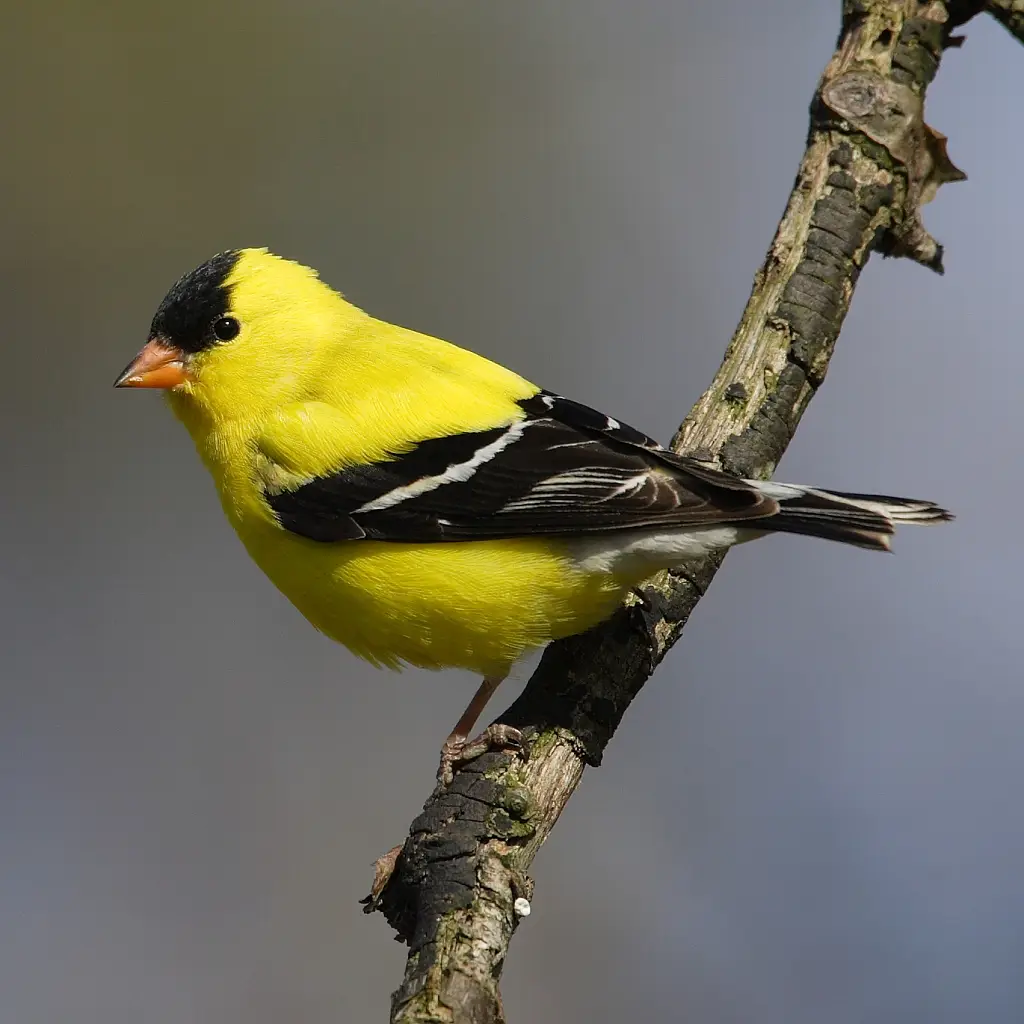
Eastern goldfinch, the state bird of Iowa
The state bird of Iowa is the eastern goldfinch, better known today as the American goldfinch and often called the wild canary. It was adopted in 1933 because it is common in Iowa and many stay through the winter. In summer the male is brilliant yellow with black wings; in winter both sexes turn a plain olive-brown.
How to recognize it
The goldfinch is a small finch, four to five inches long, with a short, cone-shaped bill and a short, notched tail. The breeding male is unmistakable: bright lemon yellow, with a black cap on his forehead, black wings with white markings and white patches above and below the tail. The female is duller, yellow below and olive above. In winter both sexes turn a plain, unstreaked brown with blackish wings and two pale wing bars, so different from the summer male that many people think they are seeing another bird.
Goldfinches fly in a bouncy, roller-coaster pattern, often calling a quick po-ta-to-chip with each dip. The male’s song is a long, jumbled warble.
A bird that eats seeds
The goldfinch is one of the strictest vegetarians among North American birds. It eats almost nothing but seeds, especially those of sunflowers, thistles, asters and dandelions, clinging acrobatically to the seed heads. At feeders it prefers nyjer and sunflower seed.
That diet shapes its whole year. Goldfinches nest late, in midsummer, waiting until thistles and other plants have gone to seed. They feed their nestlings seeds rather than insects, and they line their tightly woven cup nests with the soft down of thistles. In Iowa, nesting usually happens in late July and August, long after most birds have finished.
Where to see one in Iowa
Goldfinches are common across Iowa in weedy fields, open floodplains, roadsides, orchards, parks and backyards. They visit feeders all year, and many stay through the winter. In late summer, look for them feeding on the seed heads of coneflowers, sunflowers and thistles.
Common, but declining
The goldfinch is a bird of low conservation concern, with a global breeding population that Partners in Flight puts at about 44 million. The Breeding Bird Survey does show a decline of about 27 percent between 1966 and 2019.
The state bird since 1933
The General Assembly adopted the goldfinch by a concurrent resolution on March 22, 1933, choosing it because it is common in Iowa and often stays through the winter. The resolution called it the eastern goldfinch, a name for the eastern population of the American goldfinch. New Jersey and Washington chose the same bird.
Questions about the Iowa state bird
- What is the state bird of Iowa?
- The eastern goldfinch, now usually called the American goldfinch (Spinus tristis), adopted by a concurrent resolution on March 22, 1933.
- Which other states have the goldfinch as state bird?
- New Jersey and Washington.
- Why do goldfinches nest so late?
- They wait until midsummer, when thistles and other plants have gone to seed. They feed their young on seeds and line their nests with thistle down.
- Do goldfinches stay in Iowa in winter?
- Many do. They turn a dull olive-brown and gather at feeders and in weedy fields, which is one reason lawmakers chose them.
Sources
- American Goldfinch identification Cornell Lab of Ornithology
- American Goldfinch life history Cornell Lab of Ornithology
- Iowa State Symbols Iowa Legislative Services Agency
- Iowa Official Register 1957-1958 (Forty-seventh Number), "The Eastern Goldfinch, the State Bird of Iowa" State of Iowa (Superintendent of Printing); hosted by the Iowa Legislature