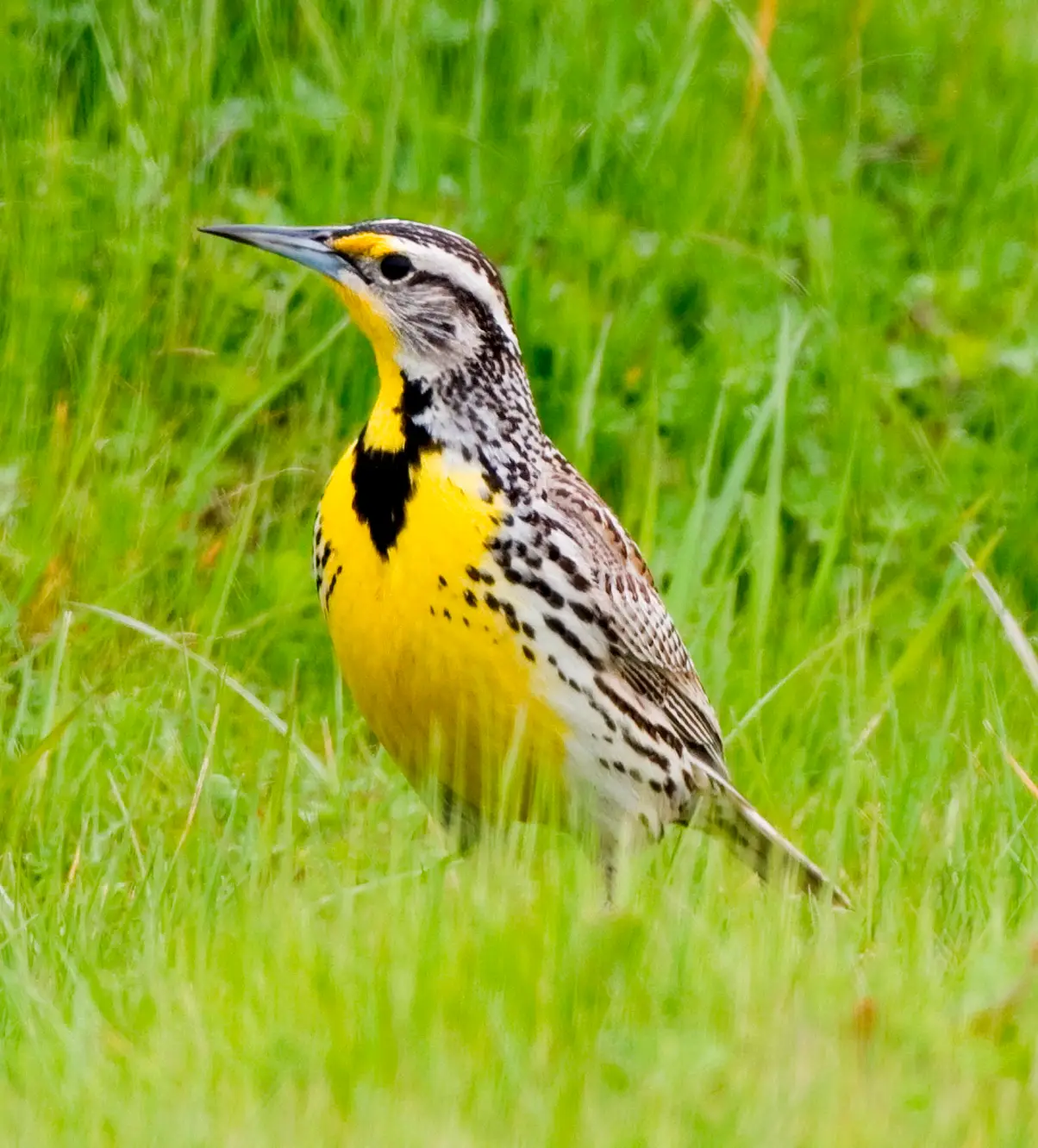
Western meadowlark, the state bird of North Dakota
The state bird of North Dakota is the western meadowlark, adopted in 1947. It is a chunky grassland bird with a bright yellow breast crossed by a black V, best known for the rich, flute-like song males deliver from fence posts. In North Dakota it is a summer resident, arriving in early March and leaving in late fall. Five other states share it as their state bird.
How to recognize it
The western meadowlark is a chunky, robin-sized songbird with a short tail, a flat head and a long, pointed bill. Males and females look alike: bright yellow underparts crossed by a black V on the chest, grayer in winter, and streaky brown, black and buff upperparts. The head has bold dark-brown and buff stripes, and white outer tail feathers show in flight, which is low, with stiff, quail-like wingbeats and glides.
It is best known for its rich, flute-like song, usually delivered by males from fence posts, shrubs or power lines in spring and summer. It looks nearly identical to the eastern meadowlark, but the song is different, a difference Meriwether Lewis noted in 1805.
How it lives
Meadowlarks forage on the ground for beetles, grasshoppers, cutworms, crickets and other insects in the warm months, and for grain and weed seeds in fall and winter. They pry the soil open with the bill, a technique called gaping. The female builds a nest on the ground, often with a woven grass roof, and does the incubating, and males commonly have two mates at once. The species lives in open native grassland, prairie, pasture, hayfields and weedy road edges, and avoids wooded edges and heavy shrub cover.
Where to see one in North Dakota
In North Dakota the meadowlark is a summer resident, typically arriving in early March and leaving in late October or early November. Look and listen in native prairie, pastures and hayfields from March into fall, especially for males singing from fence posts along rural roads. The state Game and Fish Department and its partners have tracked tagged birds in McLean County; North Dakota birds have wintered in southern Nebraska and central Kansas.
Common, but losing ground
The western meadowlark is still abundant, with a breeding population of about 100 million, and is rated of low concern. But the North American Breeding Bird Survey shows a decline of about 0.9 percent a year from 1966 to 2019, about 37 percent in all, and North Dakota Game and Fish links the drop to grassland loss: roughly 75 percent of the state’s native grassland is gone. A statewide Meadowlark Initiative works to restore the grasslands the bird depends on.
The state bird since 1947
North Dakota named the western meadowlark its state bird in 1947. Kansas, Montana, Nebraska, Oregon and Wyoming have also chosen it.
Questions about the North Dakota state bird
- What is the state bird of North Dakota?
- The western meadowlark (Sturnella neglecta), adopted in 1947.
- When do meadowlarks arrive in North Dakota?
- Typically in early March. They leave in late October or early November.
- Where do North Dakota's meadowlarks spend the winter?
- Birds tagged with GPS trackers in North Dakota have wintered in southern Nebraska and central Kansas.
- Why are meadowlarks declining?
- Mainly because of grassland loss. North Dakota Game and Fish notes that roughly 75 percent of the state's native grassland has been lost.
Sources
- Western Meadowlark Cornell Lab of Ornithology (All About Birds)
- Study follows state bird North Dakota Game and Fish Department
- Western Meadowlark State Historical Society of North Dakota
- All About Birds: Western Meadowlark Identification Cornell Lab of Ornithology
- All About Birds: Western Meadowlark Life History Cornell Lab of Ornithology