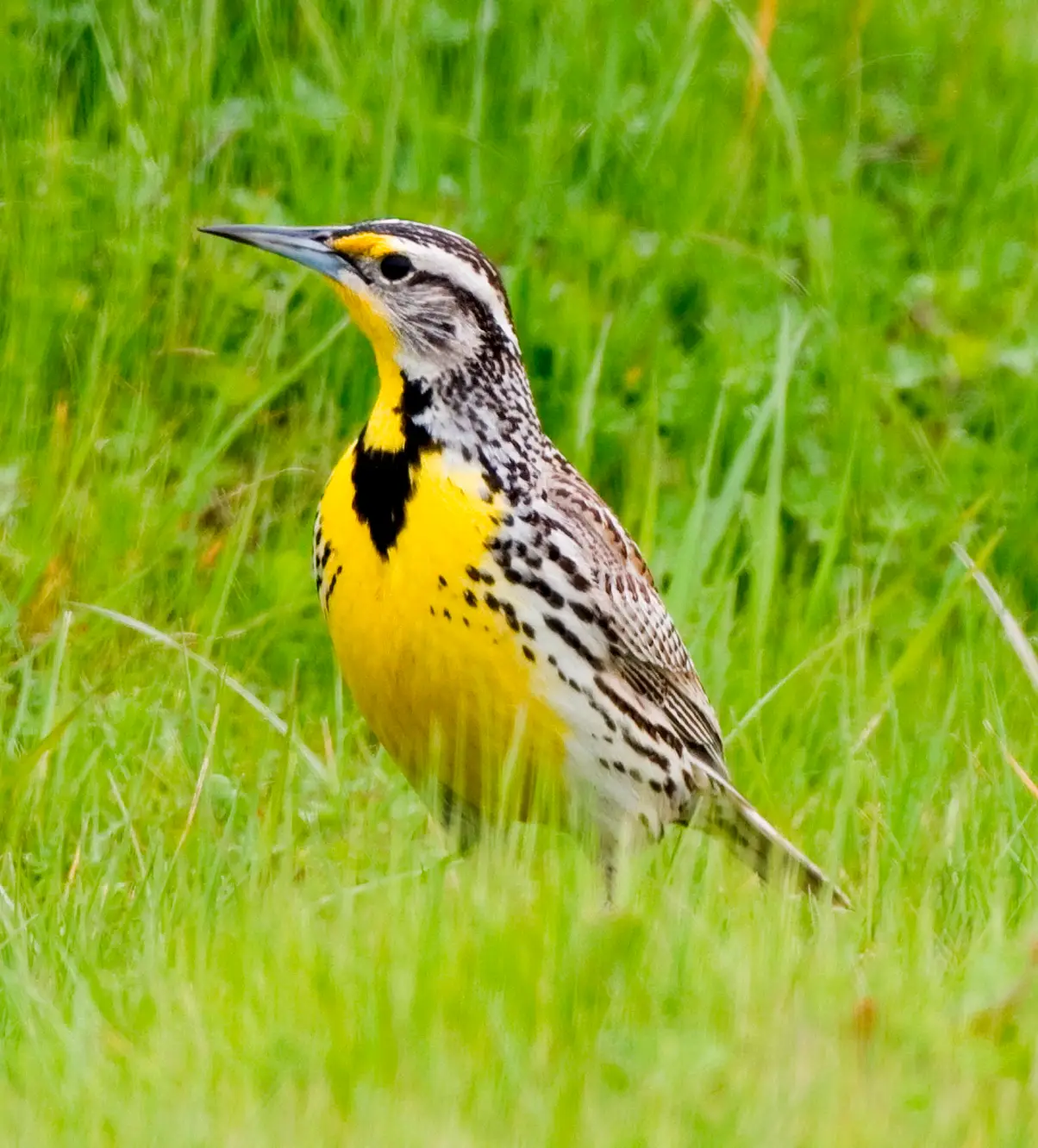
Western meadowlark, the state bird of six states
The western meadowlark is the state bird of six states, all in the Great Plains and the West: Oregon and Wyoming in 1927, Nebraska in 1929, Montana in 1931, Kansas in 1937 and North Dakota in 1947. Only the northern cardinal has been chosen by more. Schoolchildren picked it in several of these states, drawn by its bright yellow breast and its rich, flute-like song.
The 6 states
| State | Designation | Name in state law | Adopted |
|---|---|---|---|
| Oregon | State bird | Western meadowlark | 1927 |
| Wyoming | State bird | Western meadowlarkWyo. Stat. § 8-3-105 | 1927 |
| Nebraska | State bird | Western meadowlarkNeb. Rev. Stat. 90-107 (Laws 1929, c. 139, § 1) | 1929 |
| Montana | State bird | Western meadowlarkMont. Code Ann. § 1-1-504 | 1931 |
| Kansas | State bird | Western meadowlarkK.S.A. 73-901; L. 1937, ch. 319 | 1937 |
| North Dakota | State bird | Western meadowlarkN.D. Cent. Code § 54-02-06 | 1947 |
A bird of the plains
The western meadowlark is a bird of open country: native prairie, pastures, hayfields and sagebrush. That makes it a natural choice for the states of the Great Plains and the West, and six of them have made it their state bird. Oregon and Wyoming both adopted it in 1927, Nebraska in 1929, Montana in 1931, Kansas in 1937 and North Dakota in 1947.
Picked by children
Schoolchildren chose the meadowlark in several of these states. Oregon’s children voted for it in 1927 in a poll organized by the Oregon Audubon Society, and the governor proclaimed their choice; Oregon’s Legislature finally gave it formal standing in 2017 by naming it the state songbird. Montana’s schoolchildren voted for it in 1930, and the 1931 law that made it official cites their vote. In Kansas, the law itself says the bird was chosen because schoolchildren preferred it, and the Kansas Historical Society puts the number of students who took part at more than 121,000. Washington’s children picked it too, in 1928, but because other states had already claimed it, Washington later chose the goldfinch.
The meadowlark’s song
The western meadowlark is a chunky, robin-sized bird with a bright yellow breast crossed by a black V and streaky brown upperparts that hide it in the grass. It looks almost exactly like the eastern meadowlark, but its song is different: a rich, flute-like run of gurgling notes that usually falls in pitch. Males sing from fence posts, shrubs and power lines in spring and summer, and they nest on the ground in grass.
Losing ground
The western meadowlark is still common, with a breeding population of about 100 million, but breeding bird surveys show long-term declines, linked to the loss of grassland. North Dakota estimates that about three-quarters of its native grassland has been lost, and Oregon lists the meadowlark as a sensitive species.
Questions people ask
- Which states have the western meadowlark as state bird?
- Six - Kansas, Montana, Nebraska, North Dakota, Oregon and Wyoming.
- Why do so many states have the meadowlark?
- It is a common, conspicuous bird of the open grasslands and farm country that cover these states, and schoolchildren chose it in votes in Kansas, Montana and Oregon.
- Did any other state try to choose the meadowlark?
- Yes. Washington schoolchildren voted for it in 1928, but because several other states already had it, Washington eventually chose the goldfinch instead.
- How do you tell a western meadowlark from an eastern meadowlark?
- By sound. They look nearly identical, but the western's song is a rich, flute-like run of gurgling notes that usually falls in pitch.
Sources
- Western Meadowlark National Audubon Society
- Oregon Almanac: Abbreviation to Crustacean Oregon Secretary of State (Oregon Blue Book)
- Wyoming Facts and Symbols State of Wyoming
- Nebraska Revised Statutes, Chapter 90 (State Symbols and special acts), sections 90-101 to 90-120 Nebraska Legislature
- MCA 1-1-504. State bird Montana Legislature (Montana Code Annotated 2025)
- K.S.A. 73-901 Kansas Office of Revisor of Statutes
- Part 5: Symbols - Western Meadowlark State Historical Society of North Dakota (NDStudies.gov)