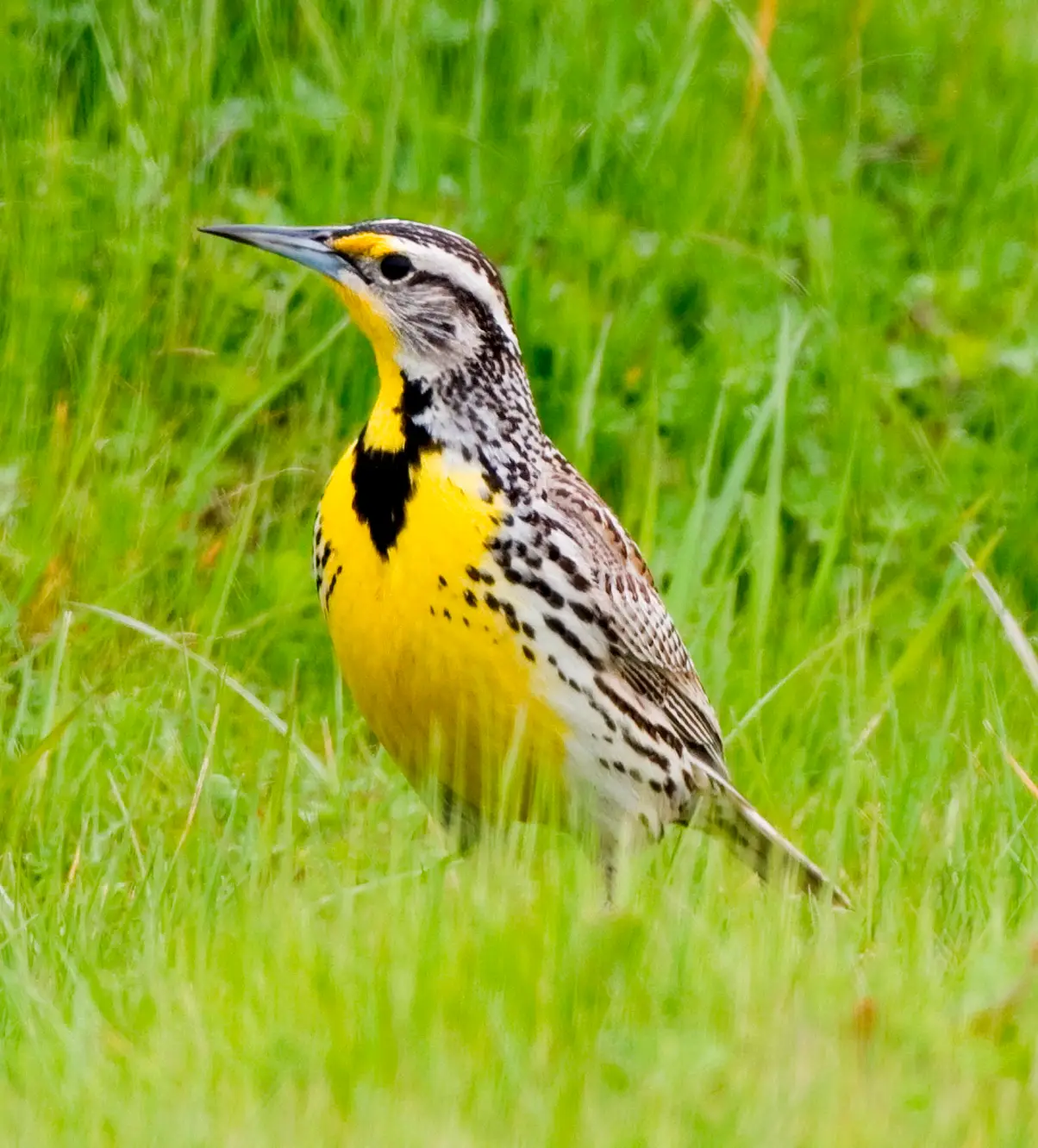
Western meadowlark, the state bird of Kansas
The state bird of Kansas is the western meadowlark, adopted in 1937. It is a stocky grassland bird with a bright yellow breast crossed by a black V, and its rich, flute-like song is one of the most familiar sounds of the prairie. The Kansas law still says it was chosen because the state's schoolchildren preferred it in a vote.
How to recognize it
The western meadowlark is about the size of a robin but stockier, with a short tail and a long, pointed bill. Its throat and breast are bright yellow, crossed by a bold black V like a necklace. In fall the V is partly hidden by paler feather tips. Its back is streaked brown, black and buff, which camouflages it in grass, and white outer tail feathers flash when it takes off or lands.
The song is the best way to identify it. The western meadowlark sings a rich, flute-like run of gurgling notes that usually drops in pitch, from fence posts and treetops across the prairie. Its call is a low chook. The eastern meadowlark, which also lives in eastern Kansas, looks almost the same but sings simpler, plaintive whistles.
How it lives
Meadowlarks are birds of open grassland: prairie, pasture, meadows and farm fields. The western meadowlark prefers shorter, drier grass than its eastern cousin. In summer it eats mostly insects, such as beetles, grasshoppers and crickets, probing the ground with its bill. Seeds make up about a third of its diet over the year, mainly in fall and winter.
Males sing to hold their territories, and some have more than one mate. The female builds a domed grass nest on the ground, often reached by a little tunnel through the grass, and lays three to seven eggs.
Where to see one in Kansas
The Kansas Historical Society says meadowlarks are often seen from the road across Kansas, perched on fence posts and tree limbs. Look and listen in open prairie and pasture, especially in spring and early summer, when males are singing. They migrate late in the fall and return early in spring, and some spend the winter in stubble fields.
Common, but declining
The western meadowlark is still widespread and common, with an estimated population of about 100 million, and the IUCN rates it as least concern. Surveys show it has declined in recent decades, as grassland has been lost.
Chosen by schoolchildren
In 1925 the Kansas Audubon Society held an election among the state’s schoolchildren for a state bird. The western meadowlark won with nearly 125,000 votes, ahead of the bobwhite and the northern cardinal; the Kansas Historical Society puts the number of students who took part at more than 121,000. The legislature made it official in 1937, and the law, now K.S.A. 73-901, says the bird was chosen because the schoolchildren preferred it. Five other states, Montana, Nebraska, North Dakota, Oregon and Wyoming, have the same state bird.
Questions about the Kansas state bird
- What is the state bird of Kansas?
- The western meadowlark (Sturnella neglecta), adopted in 1937.
- How was the Kansas state bird chosen?
- By schoolchildren. In a 1925 election run by the Kansas Audubon Society, the meadowlark won with nearly 125,000 votes, ahead of the bobwhite and the northern cardinal. The 1937 law says the bird was chosen because Kansas schoolchildren preferred it.
- Which other states have the western meadowlark as state bird?
- Montana, Nebraska, North Dakota, Oregon and Wyoming. With Kansas, six states share it.
- How can you tell a western meadowlark from an eastern meadowlark?
- Mainly by song. The western meadowlark sings a rich, gurgling, flute-like phrase that drops in pitch; the eastern meadowlark sings simpler, plaintive whistles. The two look almost identical.
Sources
- Western Meadowlark National Audubon Society
- Western Meadowlark Kansas Historical Society
- K.S.A. 73-901 (state bird) Kansas Office of Revisor of Statutes