Colorado state symbols
Colorado has 26 official state symbols. The oldest is the seal, which goes back to the territorial seal of 1861; the newest is the emperor mushroom, adopted in 2025. Schoolchildren and Girl Scouts proposed more of them than in almost any other state.
Chosen by young Coloradans
Colorado’s symbol list reads like a record of school projects. A fourth-grade class spent two years campaigning for Stegosaurus, traveling the state to build support, before Governor Richard Lamm declared it the state fossil in 1982. In 2007 fourth graders at Skyline Vista Elementary noticed that Colorado had no state reptile, studied the candidates and picked the western painted turtle, which the legislature adopted the next year. A nine-year-old at Dennison Elementary in Lakewood came up with the idea of making skiing and snowboarding the official winter sport. Students from several Denver-area schools lobbied for the western tiger salamander, and schoolchildren proposed making adopted shelter pets the state pets.
Girl Scouts have been just as effective. Lakewood Troop 357 petitioned for Yule marble as the state rock in 2004, and four girls from Castle Rock Troop 2518 led the 2014 campaign for the claret cup cactus.
Mountains, prairie and stone
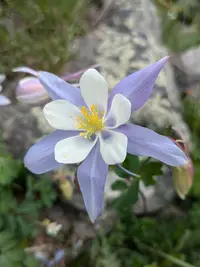
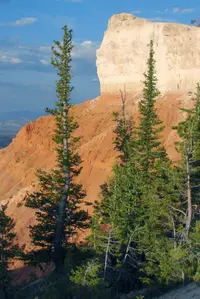
The oldest symbols describe the landscape. The columbine, a blue-and-white mountain wildflower, became the state flower in 1899, and in 1925 Colorado added legal protection for it, limiting how many can be picked. Schoolchildren voted for the blue spruce in 1892; the legislature followed in 1939. The lark bunting, a bird of the eastern plains, was adopted in 1931, and the bighorn sheep in 1961.
Colorado’s rocks and minerals come with records attached. Aquamarine, the state gem since 1971, is found on Mount Antero and White Mountain at around 14,000 feet, among the highest gem sites in the world. Rhodochrosite became the state mineral in 2002, over arguments for gold or silver; the Alma King, the largest known rhodochrosite crystal, came from the Sweet Home Mine near Alma and is on display in Denver. Yule marble, quarried in Gunnison County since 1906, was used for the Lincoln Memorial and the Tomb of the Unknown Soldier.
Sports, songs and a tartan
Colorado has two official sports: skiing and snowboarding in winter, and pack burro racing in summer. Pack burro racers run alongside a burro carrying a miner’s pack, a tradition that started with a race between Leadville and Fairplay in 1949. The state also has a tartan, in forest green and cerulean blue, that anyone may wear.
There are two state songs. “Where the Columbines Grow,” written by A. J. Fynn, was adopted in 1915. In 2007 the legislature added John Denver’s “Rocky Mountain High” as a second state song. Denver, born Henry John Deutschendorf Jr., had taken his stage name from Colorado’s capital.
The newest symbol
In 2025 Colorado adopted an official state mushroom, the emperor mushroom, Agaricus julius, a large mushroom with a scaly brown cap that smells of almonds.
The main symbols
The flag, the lark bunting and the columbine each have their own page. The state seal may be reproduced only by state agencies and educational organizations with the Secretary of State’s permission, so it is described here but not shown.
Flag, seal, song, motto and nickname
-
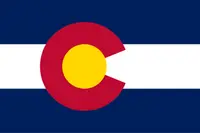 1911
Flag of Colorado
FlagThree equal horizontal stripes of blue, white and blue, with a red letter C near the hoist enclosing a golden disk. A gold-and-silver cord with one gold and one silver tassel is attached. The 1929 amendment set the red and blue to match the U.S. flag, and the 1964 amendment fixed the size and placement of the C.
C.R.S. § 24-80-904 (Senate Bill 118, 1911; amended 1929 and 1964)
- 1877
Great Seal of Colorado
SealA heraldic shield shows three snow-capped mountains on red above a miner's badge on gold. Above the shield are the Eye of God in a triangle and a Roman fasces banded with 'Union and Constitution'. The motto 'Nil Sine Numine' runs below, and the ring reads 'State of Colorado' and '1876'.
Use restricted: C.R.S. § 24-80-903: only the Secretary of State may affix the seal. § 24-80-902: illegal use or counterfeiting is a petty offense. The Secretary of State permits reproductions only by authorized state agencies and educational organizations, not by private businesses or political groups, and requests must be made in writing.
C.R.S. §§ 24-80-901 to 24-80-903 (based on the territorial seal of November 6, 1861; state act approved March 15, 1877)
- 1915
Where the Columbines Grow
SongThe lyrics are still under copyright, so they are not reproduced here. Official page.
C.R.S. § 24-80-909 (Senate Bill 308, 1915)
- 1861
Nil Sine Numine
MottoLatin, meaning “Nothing without Providence (or the Deity)”.
C.R.S. § 24-80-901 (motto prescribed as part of the state seal; territorial seal adopted November 6, 1861; state seal act approved March 15, 1877)
Animals
-
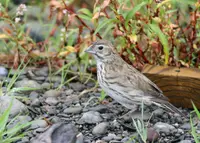 1931
Lark bunting
BirdCalamospiza melanocorysThe legislature made the lark bunting the state bird in 1931. It is a bird of the eastern plains; breeding males are black with bold white wing patches and turn grayish-brown like the females in winter.
C.R.S. § 24-80-910 (House Bill 222, 1931) · Colorado.Public.Law (text of the Colorado Revised Statutes)
- 1961
Rocky Mountain bighorn sheep
MammalOvis canadensis canadensisThe statute calls the bighorn the state animal and bars hunting or killing it except as Colorado's wildlife laws allow. Rams carry heavy curling horns, and herds live on steep, rocky slopes throughout the Rockies.
C.R.S. § 24-80-911 (Senate Bill 294, 1961) · Colorado.Public.Law (text of the Colorado Revised Statutes)
- 1994
Greenback cutthroat trout
FishOncorhynchus clarkii stomiasColorado's native trout. Mine pollution and introduced trout pushed it close to extinction, and it is federally listed as threatened; wildlife agencies have spent decades returning it to Colorado streams. People treated the rainbow trout as the state fish from 1954, but it never had official status.
C.R.S. § 24-80-911.5 (House Bill 94-1164) · Colorado.Public.Law (text of the Colorado Revised Statutes)
- 2008
Western painted turtle
ReptileChrysemys picta belliiFourth graders at Skyline Vista Elementary noticed in 2007 that Colorado had no state reptile, studied the options, and chose this turtle. Governor Bill Ritter signed the bill in 2008.
C.R.S. § 24-80-911.3 (House Bill 08-1017) · Colorado.Public.Law (text of the Colorado Revised Statutes)
-
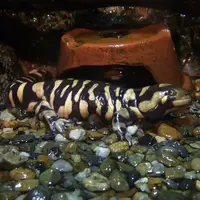 2012
Western tiger salamander
AmphibianAmbystoma mavortiumStudents from several Denver-area schools pushed for the bill, and Governor John Hickenlooper signed it in 2012.
C.R.S. § 24-80-911.4 (House Bill 12-1147) · Colorado.Public.Law (text of the Colorado Revised Statutes)
-
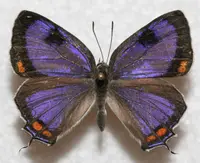 1996
Colorado hairstreak (butterfly)
InsectHypaurotis crysalusThis small purple-winged butterfly lives in scrub oak country on both sides of the Continental Divide.
C.R.S. § 24-80-913 (Senate Bill 96-122) · Colorado.Public.Law (text of the Colorado Revised Statutes)
- 2013
Dogs and cats adopted from Colorado animal shelters and rescues
PetsCanis familiaris; Felis catusSchoolchildren proposed the idea. Governor Hickenlooper signed the bill on May 13, 2013, and it took effect August 7, 2013.
C.R.S. § 24-80-910.5 (Senate Bill 13-201) · Colorado.Public.Law (text of the Colorado Revised Statutes)
Plants and fungi
-
 1899
White and lavender columbine (Rocky Mountain columbine)
FlowerAquilegia caeruleaThe General Assembly declared the columbine the state flower in 1899. A 1925 law made protecting it a civic duty: uprooting it on public land is forbidden, gathering there is capped at 25 stems, buds or blossoms per day, and picking it on private land requires the owner's consent.
C.R.S. §§ 24-80-905 to 24-80-908 (Senate Bill 261, 1899; protection added 1925) · Colorado.Public.Law (text of the Colorado Revised Statutes)
-
 1939
Colorado blue spruce
TreePicea pungensSchoolchildren picked the blue spruce in an Arbor Day vote in 1892, but the legislature did not make it official until 1939. Botanist C. C. Parry found the species on Pikes Peak in 1862, and George Engelmann gave it its scientific name in 1879.
House Joint Resolution 7, 1939 · Colorado State Archives
- 1987
Blue grama
GrassBouteloua gracilisBlue grama is a long-lived native warm-season grass whose dense shallow roots help keep prairie soil from blowing away. One stated aim of the designation was to teach people about it.
Senate Joint Resolution 13, 1987 · Colorado State Archives
- 2014
Claret cup cactus
CactusEchinocereus triglochidiatusFour girls from Girl Scout Troop 2518 in Castle Rock led the effort.
C.R.S. § 24-80-915 (House Bill 14-1024) · Colorado.Public.Law (text of the Colorado Revised Statutes)
- 2025
Emperor mushroom
MushroomAgaricus juliusGovernor Jared Polis signed the bill on March 31, 2025, and it took effect August 6, 2025. Sponsors were Representative Jacque Phillips and Senator Kyle Mullica. The species was formerly nicknamed the 'Prince' mushroom. It has a large scaly brown cap and smells of almonds.
C.R.S. § 24-80-916 (House Bill 25-1091, 2025 Colo. Sess. Laws ch. 40) · Colorado General Assembly
Earth and sky
- 1982
Stegosaurus
FossilA plant-eating dinosaur of the Late Jurassic, about 150 million years ago, with tall plates along its back and spikes on its tail. After a fourth-grade class campaigned around the state for two years, Governor Richard Lamm designated it by executive order in 1982. The Denver Museum of Nature & Science displays a skeleton found by a Cañon City High School teacher and his students.
Executive order of Governor Richard D. Lamm (1982) · Colorado State Archives
- 1971
Aquamarine
GemstoneMount Antero and White Mountain, at around 14,000 feet, are among the best places in the world for gem aquamarine, and among the highest.
C.R.S. § 24-80-912 (House Bill 71-1104) · Colorado.Public.Law (text of the Colorado Revised Statutes)
- 2002
Rhodochrosite
MineralGovernor Bill Owens signed the bill in 2002. Some had argued for gold or silver instead. The Alma King, the largest known rhodochrosite crystal, came from the Sweet Home Mine near Alma and is on display at the Denver Museum of Nature & Science.
C.R.S. § 24-80-912.5 (2002 Colo. Sess. Laws ch. 102) · Colorado Virtual Library (Colorado State Library)
- 2004
Yule marble
RockLakewood Girl Scout Troop 357 petitioned the legislature for it. The stone is a nearly pure white calcite marble quarried on Yule Creek in Gunnison County since 1906.
C.R.S. § 24-80-912.7 (House Bill 04-1023) · Colorado.Public.Law (text of the Colorado Revised Statutes)
Songs, words and language
- 2007
Rocky Mountain High
Second state songJohn Denver wrote it with Mike Taylor, and it came out in 1972 (album in September 1972, single on October 30, 1972); it became a top-10 hit in early 1973. Some critics claimed it promoted drug use; Denver later said they had clearly never experienced the Rockies. Denver was born Henry John Deutschendorf Jr. and took his stage name from Colorado's capital.
Senate Joint Resolution 07-023 · Colorado State Archives
Culture and history
- 1992
Square dance (state folk dance)
DanceThe statute's definition is broad: rounds, clogging, contra, line dancing, the Virginia reel and heritage dances all count.
C.R.S. § 24-80-909.5 (House Bill 92-1058) · Colorado.Public.Law (text of the Colorado Revised Statutes)
- 1997
Colorado state tartan
TartanThe sett has forest green and cerulean blue blocks separated by black bands, with lavender and white lines and a gold stripe edged in red. It is a district tartan that anyone may wear, with or without Celtic ancestry.
House Joint Resolution 97-1016 · Colorado Virtual Library (Colorado State Library)
- 2008
Skiing and snowboarding (state winter recreational sport)
SportThe idea came from a nine-year-old fourth grader at Dennison Elementary in Lakewood and was carried by Representatives Gwyn Green and Christine Scanlan.
House Joint Resolution 08-1008 · Colorado State Archives
- 2012
Pack burro racing
Summer heritage sportRacers run alongside a burro carrying a pack, honoring Colorado's mining past. The first organized race, between Leadville and Fairplay, was held in 1949.
House Joint Resolution 12-1021 · Colorado Virtual Library (Colorado State Library)
Places and institutions
- —
Wings Over the Rockies Air and Space Museum
Air and space museumWings Over the Rockies, in Denver, occupies the former Lowry Air Force Base. State law names it Colorado's official air and space museum.
C.R.S. § 24-80-914 · Colorado.Public.Law (text of the Colorado Revised Statutes)
Questions about Colorado's symbols
- What is the Colorado state animal?
- The Rocky Mountain bighorn sheep, adopted in 1961.
- What is the Colorado state fossil?
- Stegosaurus, designated by Governor Richard Lamm in 1982 after a two-year campaign by fourth graders.
- Does Colorado have two state songs?
- Yes. "Where the Columbines Grow," by A. J. Fynn, became the state song in 1915, and John Denver's "Rocky Mountain High" was added as a second state song in 2007.
- What is Colorado's state pet?
- Dogs and cats adopted from Colorado animal shelters and rescues. A pet only counts if it was adopted.
Photo credits (6)
- Flag of Colorado: Original: Andrew Carlyle Carson Vector: Fleminra, Public domain, via Wikimedia Commons
- Lark bunting: Ryan Douglas, CC BY-SA 3.0, via Wikimedia Commons
- White and lavender columbine: MtBotany, CC BY-SA 4.0, via Wikimedia Commons
- Colorado blue spruce: Quinn Dombrowski from Chicago, USA, CC BY-SA 2.0, via Wikimedia Commons
- Western tiger salamander: Daiju Azuma, CC BY-SA 2.5, via Wikimedia Commons
- Colorado hairstreak: Megan McCarty, CC BY-SA 3.0, via Wikimedia Commons
Something out of date? Tell us and we will check it against the law.
Sources
- C.R.S. § 24-80-904 – State flag Colorado.Public.Law (text of the Colorado Revised Statutes)
- The Colorado State Seal Colorado Secretary of State
- C.R.S. § 24-80-909 – State song Colorado.Public.Law (text of the Colorado Revised Statutes)
- Colorado Revised Statutes, Title 24, Article 80, Part 9 (state emblems) Colorado.Public.Law (text of the Colorado Revised Statutes)
- Symbols and Emblems Colorado State Archives