Columbine, the state flower of Colorado
The state flower of Colorado is the white and lavender columbine, also called the Rocky Mountain or Colorado blue columbine, adopted in 1899. It has lavender-blue outer petals around a white cup with long spurs. Colorado law protects it: uprooting it on public land is banned, and picking there is limited to 25 stems a day.
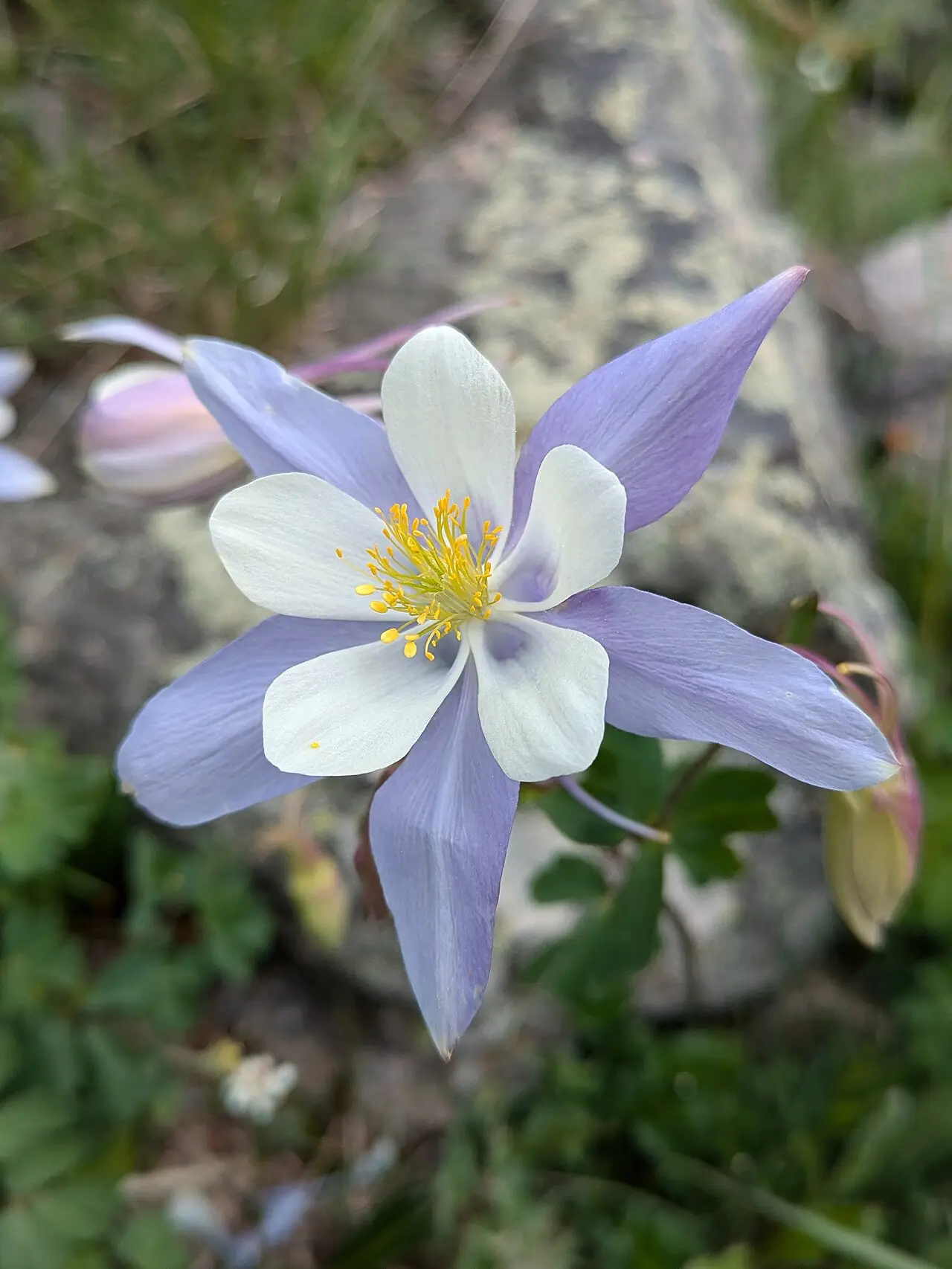
How to recognize it
The Colorado columbine is a bushy, clump-forming plant about one to two feet tall and wide. Its flowers are among the most elegant in the Rockies. Each upright bloom has five spreading outer sepals, usually lavender or sky blue, around five white petals that form a cup. The petals sweep back into long, slender spurs with small knobs at their tips, which hold the flower’s nectar. Bees are its main pollinators.
The classic color combination is blue or lavender around white, the colors that inspired the blue and white of Colorado’s flag, but wild plants range from nearly all white to deep blue and sometimes pinkish. The leaves grow mostly at the base and are divided into threes, much like the leaves of meadow-rue.
Where it grows
The columbine is native to the Rocky Mountains. In Colorado it grows from about 6,000 to 10,000 feet, in sagebrush and pinyon-juniper country, mountain shrubland, aspen groves, Douglas-fir and spruce-fir forest and even alpine tundra. It is especially common in aspen stands and likes rich, moist soil with light shade. Depending on elevation it blooms from about April to July.
Where to see it
Head for Colorado’s mountains in late spring and summer. Look in aspen groves and moist, partly shaded meadows and slopes from the foothills up to the subalpine zone. In the high country the main bloom usually comes in early to midsummer.
Protected by law
Colorado gives its state flower legal protection. A 1925 law, still on the books, declares it the duty of every citizen to protect the columbine from waste or destruction. On public land and along highways, nobody may uproot the plant, and no one may gather more than 25 stems, buds or blossoms in one day. On private land, picking it requires the owner’s consent. Breaking these rules is a civil infraction.
The state flower since 1899
The General Assembly adopted the columbine as the state flower by Senate Bill 261, approved on April 4, 1899. Its link to Colorado runs deep: blue and white are said to be among the flag’s colors partly in its honor, and the state song, adopted in 1915, is “Where the Columbines Grow.”
The plant is lovely but not edible. All parts of the columbine are poisonous if eaten.
Questions about the Colorado state flower
- What is the state flower of Colorado?
- The white and lavender columbine (Aquilegia caerulea), also known as the Rocky Mountain columbine or Colorado blue columbine. It became the state flower in 1899.
- Is it illegal to pick columbines in Colorado?
- There are limits. On public land and along highways, uprooting a columbine is forbidden and picking is limited to 25 stems, buds or blossoms per person per day. On private land you need the owner's permission. Violations are a civil infraction.
- Where do columbines grow in Colorado?
- In the mountains, from about 6,000 to 10,000 feet, especially in aspen groves and moist, partly shaded meadows and slopes.
- Is the columbine poisonous?
- Yes. All parts of the plant are poisonous if eaten.
Sources
- C.R.S. §§ 24-80-905 to 24-80-908 (state flower and its protection) Colorado.Public.Law (text of the Colorado Revised Statutes)
- Colorado columbine Utah State University Extension
- Aquilegia coerulea plant profile USDA PLANTS Database
- C.R.S. 24-80-907 - Limitation on picking state flower Colorado.Public.Law (text of the Colorado Revised Statutes)
- In Relation to the State Flower (1899) University of Colorado Law School, Colorado Session Laws collection
- Regarding the Blue Columbine, Adopting It as a State Emblem... (1925) University of Colorado Law School, Colorado Session Laws collection