Cardinal, the state bird of Indiana
The state bird of Indiana is the northern cardinal, adopted in 1933. The male is bright red with a black face, the female warm brown with red tinges, and both sing loud, whistled songs. Cardinals live in Indiana all year and are among the most familiar birds at the state's backyard feeders.
How to recognize it
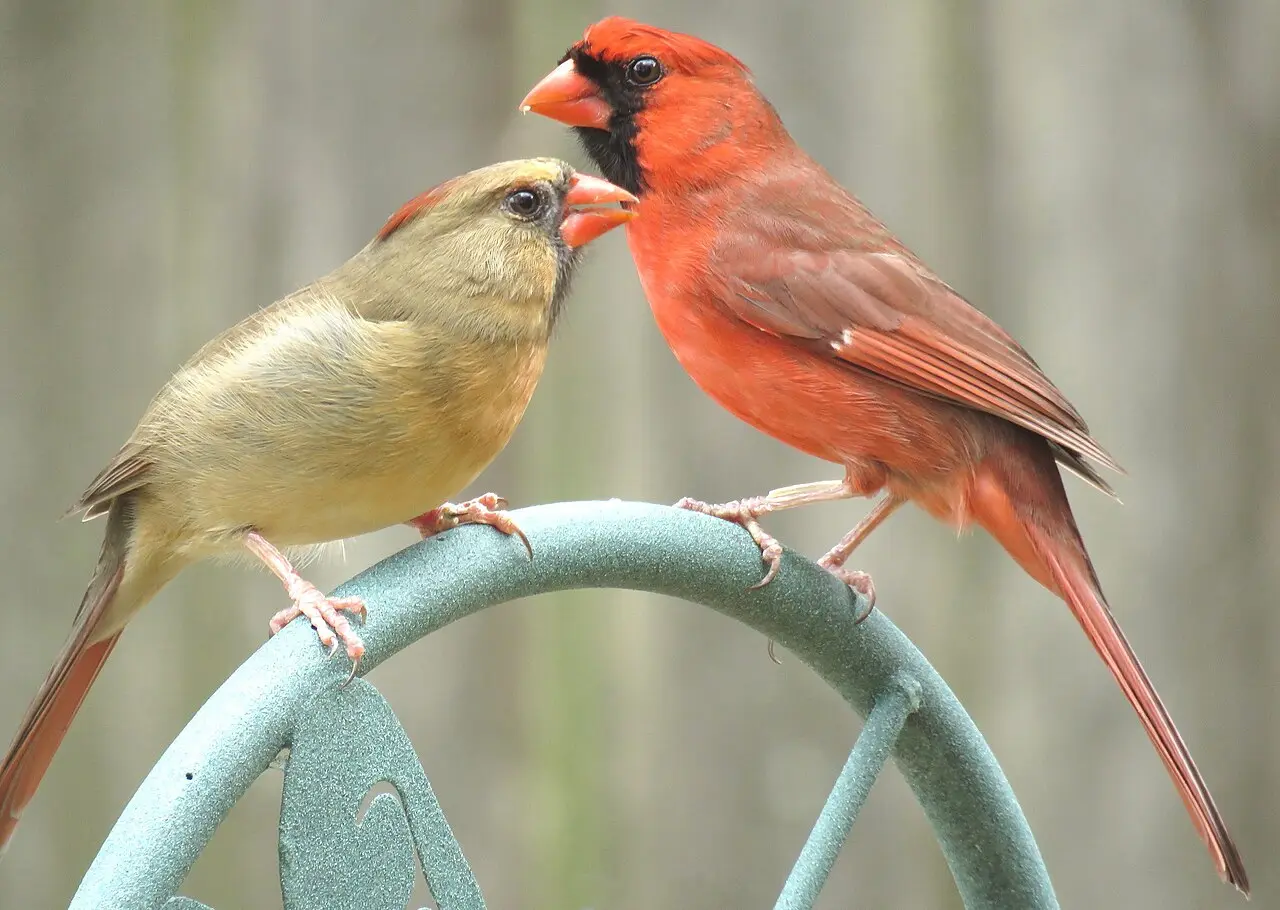
The northern cardinal is a fairly large songbird, eight to nine inches long, with a long tail, a pointed crest and a short, thick bill built for cracking seeds. The male is bright red all over, with a black face around a red bill. The female is pale brown with warm red tinges on her crest, wings and tail, and she shares the black face and red-orange bill. Cardinals often sit hunched with their tails pointing down.
Both males and females sing loud, clear whistled phrases, often written as cheer, cheer, cheer or birdie, birdie, birdie. Their call is a sharp, metallic chip.
How it lives
Cardinals live in shrubby places: forest edges, hedgerows, overgrown fields, thickets, backyards and parks. They forage on or near the ground and in low shrubs, in pairs during nesting season and in loose flocks in winter. They eat mostly seeds and fruit, including the seeds of the tulip tree, Indiana’s state tree, as well as wild grapes, dogwood berries and sumac. Insects make up most of what they feed their nestlings. Cardinals often nest in bramble thickets and low saplings.
Where to see one in Indiana
Cardinals live in Indiana all year, in every part of the state, in yards, parks and along woodland edges. They are regulars at backyard feeders, especially in winter, when the red males are easy to spot against snow. Sunflower seed is their favorite at feeders.
Doing well
The northern cardinal is not of conservation concern. The North American Breeding Bird Survey shows a slight increase since 1966, and Partners in Flight estimates the global breeding population at about 130 million birds. The spread of suburbs, with their shrubs and feeders, has helped cardinals expand their range northward.
The state bird since 1933
The Indiana General Assembly adopted the cardinal in 1933. The law, now IC 1-2-8-1, names it the “Red Bird or Cardinal” and uses an older scientific name, Richmondena cardinalis cardinalis. Indiana is one of seven states with the cardinal as state bird, more than for any other species.
Questions about the Indiana state bird
- What is the state bird of Indiana?
- The northern cardinal (Cardinalis cardinalis), adopted in 1933. The law calls it the "Red Bird or Cardinal."
- Which other states have the cardinal as state bird?
- Illinois, Kentucky, North Carolina, Ohio, Virginia and West Virginia. Seven states share it, more than any other state bird.
- What do cardinals eat?
- Mostly seeds and fruit, including tulip-tree seeds, wild grapes, dogwood berries, sumac and sunflower seeds at feeders, plus insects, which make up most of what they feed their young.
Sources
- Indiana State Bird Indiana Historical Bureau
- Northern Cardinal identification Cornell Lab of Ornithology
- Northern Cardinal life history Cornell Lab of Ornithology