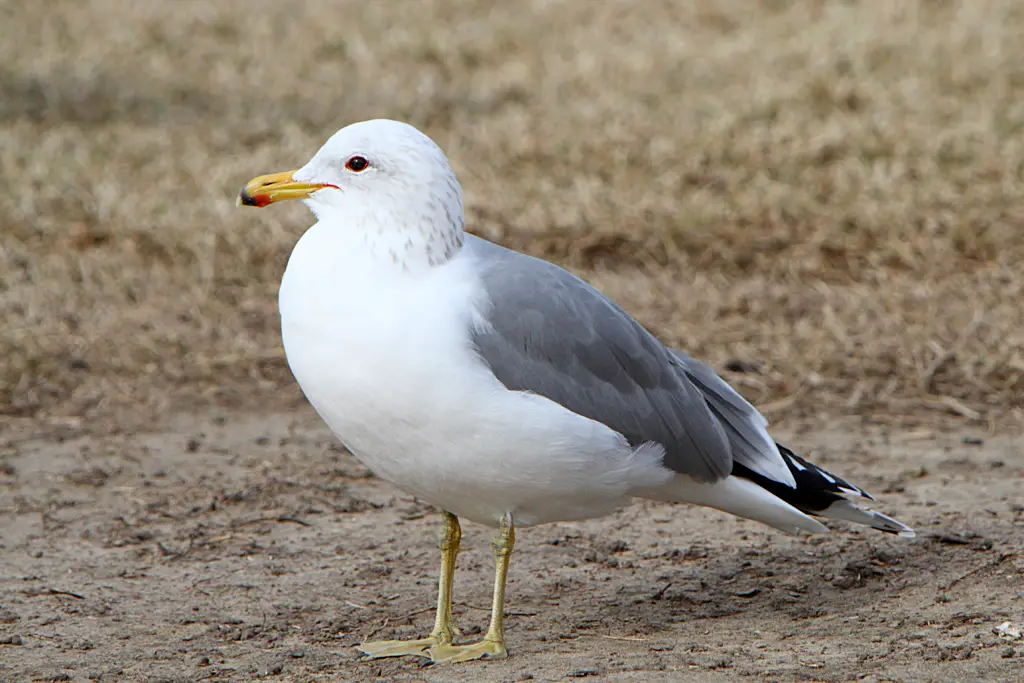
California gull, the state bird of Utah
The state bird of Utah is the California gull, which the 1955 law calls simply the "sea gull." It honors the 1848 "Miracle of the Gulls," when gulls ate swarms of crickets attacking the pioneers' crops. Far from the sea, the Great Salt Lake holds the species' largest nesting colonies, estimated at 130,000 to 150,000 birds in the early 1990s.
How to recognize it
The California gull is a mid-sized gull, about 19 to 26 inches long, with a wingspan of about 4 to 5 feet. Adults are white with a gray back that is darker than in similar gulls, and they have dark eyes and greenish-yellow legs. The yellow bill has both a black spot and a red spot near the tip. Young birds start out dark brown all over and do not reach adult plumage until their fourth winter. The call is a repeated kee-yah.
How it lives
Inland in summer, the California gull eats mostly insects, along with worms, spiders, rodents, carrion and other birds’ eggs and chicks; on the coast it takes fish and other sea life and scavenges refuse. It forages while walking, wading, swimming or flying, and lays two or three eggs in a shallow, lined scrape on the ground within a colony. It nests at lakes and marshes in the interior West and northern plains, and in winter most move west or southwest to the Pacific coast.
Where to see one in Utah
The Great Salt Lake is the place. Its islands and shorelines, including sites around Antelope Island, hold the species’ largest nesting concentration, estimated at about 130,000 to 150,000 birds in 1988 to 1991. Studies have found that changing lake levels moved birds between colonies even when the overall population stayed steady. Away from the lake, the gulls feed on farms, at other lakes and in towns.
Secure worldwide, vulnerable in Utah
The California gull is a species of least concern, and Audubon describes its numbers as having grown in many areas in recent decades, to about 1.1 million birds. NatureServe ranks it secure globally but vulnerable in Utah.
The Miracle of the Gulls
In 1848, the year after the pioneers arrived, swarms of crickets attacked their crops, and California gulls flew in and ate them, an event remembered as the Miracle of the Gulls. A Seagull Monument on Temple Square dates from 1913, and on February 16, 1955, Governor J. Bracken Lee signed the bill naming the gull the state bird. The law says only “sea gull”; a proposal to write “California” into it never made it into the code.
Questions about the Utah state bird
- What is the state bird of Utah?
- The California gull (Larus californicus). The 1955 law calls it the "sea gull."
- Why is a gull Utah's state bird?
- To honor the 1848 "Miracle of the Gulls," when gulls ate swarms of crickets attacking pioneer crops. A Seagull Monument on Temple Square in Salt Lake City dates from 1913.
- Where can I see California gulls in Utah?
- At the Great Salt Lake, whose islands and shorelines, including sites around Antelope Island, hold the species' largest nesting colonies. The gulls also feed on farms, at other lakes and in towns.
- Is the California gull endangered?
- No. It is of least concern worldwide, with about 1.1 million birds, though NatureServe ranks it as vulnerable in Utah.
Sources
- California Gull National Audubon Society
- Larus californicus NatureServe Explorer
- California Gulls HSWRI (Hubbs-SeaWorld Research Institute)
- Bird (Utah State Symbols) Utah State Library (archived)