Arizona state symbols
Arizona has 25 official state symbols. The saguaro blossom was the territorial flower as early as 1901; the newest symbol is Pluto, the official state planet since 2024. In between, Arizona has named a state necktie, a state revolver, a state drink and a hummingbird capital.
From desert flowers to a dwarf planet
Arizona’s earliest symbols came straight from the desert. The white blossom of the saguaro was chosen as the territorial flower in 1901 and confirmed as the state flower in 1931, the same year the cactus wren became the state bird. The palo verde, a green-barked desert tree, followed in 1954, and turquoise, the state gemstone, in 1974. The state colors, blue and old gold, are older still: they were adopted in 1915, two years before the flag.
In 1986 the legislature added four animals at once: the ringtail, the Arizona ridge-nosed rattlesnake, the Apache trout and the Arizona tree frog. They were reportedly chosen by schoolchildren in a wildlife awareness program run by the state’s Game and Fish Department. The two-tailed swallowtail followed in 2001 as the state butterfly, with an unusual clause stating that the designation gives no legal protection to the butterfly or its habitat.
Copper, rocks and a dinosaur
Mining shaped Arizona, and its symbols show it. Copper became the official state metal in 2015 after a fourth-grade civics class at Copper Creek Elementary School proposed it to their state senator. Petrified wood is the state fossil, wulfenite the state mineral since 2017, and Sonorasaurus, a long-necked dinosaur found in the southern Arizona desert, the state dinosaur since 2018.
The unexpected ones
Some of Arizona’s newer symbols are pure Southwest style. The bola tie has been the official state neckwear since 1971. The Colt Single Action Army revolver, the “Peacemaker” of Western films, became the official state firearm in 2011, making Arizona the second state with one. Lemonade became the official state drink in 2019. And in 2021 the legislature named Sierra Vista, in the southeastern corner of the state, the official hummingbird capital of Arizona, slipping the title into a bill that had started out being about archaeology.
The newest symbol looks furthest afield. In 2024 Arizona adopted Pluto as its official state planet. Pluto was discovered in 1930 at Lowell Observatory in Flagstaff, and Arizonans have stayed loyal to it even after astronomers reclassified it as a dwarf planet in 2006.
Songs
Arizona has two official songs. The state song is the “Arizona March Song,” written in 1915 and adopted in 1919; its words are old enough to be in the public domain. In 1982 the legislature also named “Arizona,” written and recorded by Willcox native Rex Allen Jr., as an alternate state anthem. The state owns its copyright.
The main symbols
The flag, the cactus wren and the saguaro blossom each have their own page. The state seal, set out in the constitution, may be reproduced only with the Secretary of State’s approval, so it is described here but not shown.
Flag, seal, song, motto and nickname
-
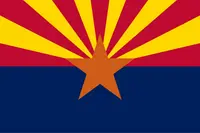 1917
Flag of Arizona
FlagThe lower half is a blue field and the upper half has 13 rays, seven red and six yellow, spreading from the center; a copper-colored five-pointed star sits in the middle. The law describes it as Arizona's copper star rising from a blue field against a setting sun, and the 13 rays are commonly said to stand for the original colonies.
A.R.S. § 41-851(B)-(C)
- 1912
Great Seal of Arizona
SealMountains with the sun rising behind them, a storage reservoir and dam, irrigated fields and orchards, grazing cattle, and a quartz mill with a miner holding a pick and shovel, all under the motto Ditat Deus. The surrounding band reads 'Great Seal of The State of Arizona' along with the year of admission (1912).
Use restricted: A.R.S. § 41-130: the seal or any likeness may be used only with the Secretary of State's approval, may not be used by non-state-agencies to advertise merchandise or for other commercial purposes, and knowing violation is a class 3 misdemeanor.
Ariz. Const. art. 22, § 20
- 1919
Arizona March Song
SongWritten in 1915. The lyrics are in the public domain. Official page.
Laws 1919, ch. 28
- 1912
Ditat Deus
MottoLatin, meaning “God enriches”.
Ariz. Const. art. 22, § 20 (design of state seal)
- 2011
The Grand Canyon State
NicknameLong used informally in honor of the Grand Canyon in the state's northwest; the legislature made it official by statute in 2011 (SB 1015), shortly before the statehood centennial.
Animals
-
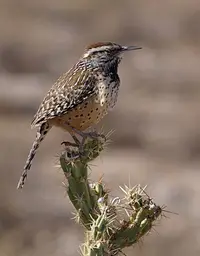 1931
Cactus wren
BirdCampylorhynchus brunneicapillusThe statute names it as Coues' cactus wren, using the older name Heleodytes brunneicapillus couesi.
-
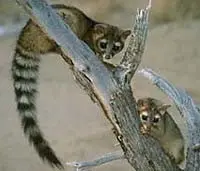 1986
Ringtail
MammalBassariscus astutusA small, big-eyed nocturnal animal with a long black-and-white ringed tail. It is often called a ringtail cat, but it is actually a relative of the raccoon and the coati. It lives in rocky canyons across Arizona.
-
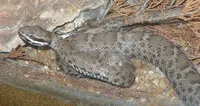 1986
Arizona ridge-nosed rattlesnake
ReptileCrotalus willardiA small rattlesnake of the sky-island mountains of southeastern Arizona, named for the raised scales on the tip of its snout. Arizona's subspecies is found in only a few mountain ranges near the Mexican border.
-
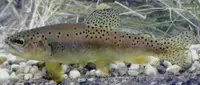 1986
Apache trout (Arizona trout)
FishOncorhynchus apacheA golden-yellow trout found only in the high mountain streams of east-central Arizona, in the White Mountains. The statute calls it the Arizona trout.
- 1986
Arizona tree frog
AmphibianDryophytes wrightorumA small green frog of high-elevation forests and meadows. The law uses an older scientific name; the Arizona population is now treated as its own species.
-
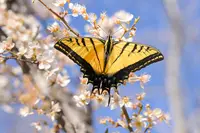 2001
Two-tailed swallowtail
ButterflyPapilio multicaudataThe law states explicitly that the designation gives no legal protection to the butterfly or its habitat.
Plants and fungi
-
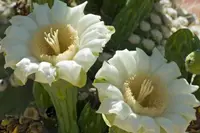 1931
Saguaro blossom
FlowerCarnegiea giganteaThe law designates the pure white, waxy flower of the giant saguaro cactus, which it calls Cereus giganteus. The blossom had been chosen as the territorial flower in 1901 before being confirmed as the state flower.
-
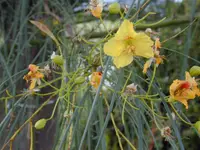 1954
Palo verde
TreeParkinsoniaThe statute designates the whole palo verde genus (listed under the older genus name Cercidium) rather than a single species.
Earth and sky
- 1988
Petrified wood
FossilAraucarioxylon arizonicumArizona's petrified wood comes mostly from logs of ancient conifers that were buried about 225 million years ago and slowly turned to stone. The best-known deposits are protected in Petrified Forest National Park.
- 2018
Sonorasaurus
DinosaurSonorasaurus thompsoniA long-necked plant-eating dinosaur that lived about 100 million years ago. Its fossils were found in southern Arizona in 1994, and it is named for the Sonoran Desert.
A.R.S. § 41-860.05 (Laws 2018, ch. 172, SB 1517) · Arizona State Legislature
- 1974
Turquoise
GemstoneArizona is one of the leading sources of turquoise in the United States, much of it found as a byproduct of copper mining. It is widely used in Native American jewelry.
- 2017
Wulfenite
MineralA bright orange to yellow mineral that forms thin, square crystals. Some of the finest wulfenite specimens in the world came from the Red Cloud Mine in western Arizona.
A.R.S. § 41-860.04 (Laws 2017, ch. 45, HB 2092) · Arizona State Legislature
- 2015
Copper
MetalThe bill was sponsored by Sen. Steve Smith after a fourth-grade civics class at Copper Creek Elementary School proposed the idea. Copper is one of Arizona's traditional 'Five C's' (copper, cattle, cotton, citrus and climate).
A.R.S. § 41-860.03 (SB 1441, 2015) · Arizona State Legislature
- 2024
Pluto
PlanetPluto was discovered in 1930 at Lowell Observatory in Flagstaff.
A.R.S. § 41-860.08 (Laws 2024, ch. 38, HB 2477) · Arizona State Legislature
Food and drink
- 2019
Lemonade
Beverage
Songs, words and language
- 1982
"Arizona" (I Love You, Arizona) by Rex Allen Jr.
Alternate state anthemWritten and performed by Willcox native Rex Allen Jr. (copyright 1981), it was named an alternate state anthem by the 35th Legislature. The state owns the copyright under an agreement with Boxer Music, which still handles permission requests.
Laws 1982, ch. 1 (HB 2300) · Arizona State Library, Archives and Public Records
Culture and history
- 2011
Colt Single Action Army revolver
FirearmThe Colt revolver that became famous in the Old West. When Governor Jan Brewer signed the bill in 2011, Arizona became the second state, after Utah, to name an official firearm; the bill had failed in the House at first before passing on a second vote.
A.R.S. § 41-860.02 (SB 1610, 2011) · Arizona State Legislature
- 1915
Blue and old gold
ColorsThe statute requires the blue to match the shade used in the U.S. flag.
- 1971
Bola tie
NeckwearThe bola tie, a cord fastened with an ornamental slide, often silver and turquoise, is closely tied to the Southwest. Arizona made it the state's official neckwear in 1971.
Places and institutions
- 2021
Sierra Vista
Hummingbird capitalThe designation was added to a bill originally about the archaeology advisory commission through a strike-everything amendment.
A.R.S. § 41-860.07 (Laws 2021, ch. 362, HB 2807) · Arizona State Legislature
Questions about Arizona's symbols
- What is the Arizona state animal?
- Arizona's state mammal is the ringtail, adopted in 1986 along with a state reptile (the Arizona ridge-nosed rattlesnake), a state fish (the Apache trout) and a state amphibian (the Arizona tree frog).
- Why is Pluto Arizona's state planet?
- Pluto was discovered in 1930 at Lowell Observatory in Flagstaff, by Clyde Tombaugh. The legislature made it the official state planet in 2024.
- What is Arizona's state drink?
- Lemonade, adopted in 2019.
- Does Arizona have a state song?
- It has two. The official state song is the "Arizona March Song" (1915, adopted 1919), and "Arizona," written and sung by Rex Allen Jr., is the alternate state anthem (1982).
Photo credits (8)
- Flag of Arizona: Original: Unknown author Vector: Madden, Public domain, via Wikimedia Commons
- Cactus wren: Mark Wagner, CC BY 2.5, via Wikimedia Commons
- Saguaro blossom: Ken Bosma, CC BY 2.0, via Wikimedia Commons
- Palo verde: Forest & Kim Starr, CC BY 3.0, via Wikimedia Commons
- Ringtail: Unknown author, Public domain, via Wikimedia Commons
- Arizona ridge-nosed rattlesnake: TimVickers, Public domain, via Wikimedia Commons
- Apache trout: U.S. Fish and Wildlife Service Headquarters, Public domain, via Wikimedia Commons
- Two-tailed swallowtail: Becca, CC BY 4.0, via Wikimedia Commons
Something out of date? Tell us and we will check it against the law.
Sources
- A.R.S. § 41-851 State colors; state flag Arizona State Legislature
- Arizona Constitution Article 22 Section 20 - Design of state seal Arizona State Legislature
- Arizona Almanac: State Song and March Arizona State Library, Archives and Public Records