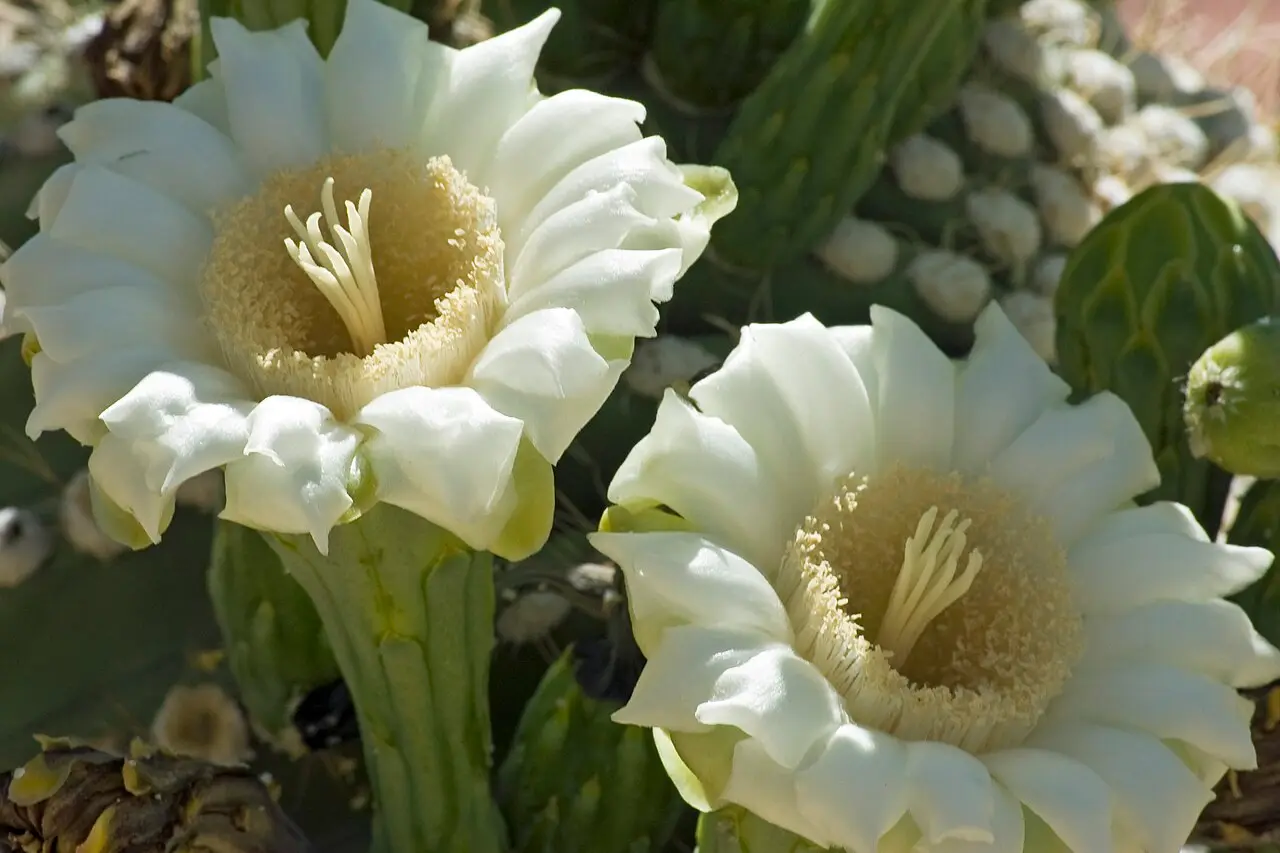
Saguaro blossom, the state flower of Arizona
The state flower of Arizona is the saguaro blossom, the large, waxy white flower of the giant saguaro cactus. Each flower opens at night and closes by the next afternoon. It was the territorial flower from 1901 and became the state flower in 1931, and the saguaro itself has become the best-known symbol of the American Southwest.
A flower that lasts a day
Saguaro blossoms are large and creamy white, with a thick cluster of yellow stamens at the center. They grow in crowns at the tips of the saguaro’s trunk and arms, and sometimes along its sides. Each flower opens after dark and closes the following afternoon, so it has less than a day to be pollinated.
That short window is filled by a night and day shift of visitors. At night nectar-feeding bats push their faces into the flowers. In the morning white-winged doves, hummingbirds, bees and other insects take over. A single saguaro opens a few flowers at a time over several weeks, which spreads its chances.
The bloom runs from late April to early June. Pollinated flowers become red, juicy fruits, each holding about 2,000 tiny black seeds. Birds, bats and other animals eat the fruit, and the Tohono O’odham people harvest it each summer.
The giant behind the flower
The saguaro is the largest cactus in the United States. It commonly grows 40 feet tall and can reach about 50, with a pleated, spiny trunk that swells to store water after rain. It grows slowly: a saguaro usually flowers for the first time at about 35 years old and may not grow its first arms until it is 50 to 100.
It grows only in the Sonoran Desert, mainly from central Arizona south into Sonora, Mexico, generally below about 4,500 feet, because it cannot survive hard freezes. Young saguaros often begin life in the shade of a “nurse” tree, frequently a palo verde, Arizona’s state tree.
Where to see the bloom
Saguaro National Park, on both sides of Tucson, protects one of the largest saguaro forests. Peak bloom there usually comes in the last week of May and the first week of June. Look up: the flowers are often at the very tops of the cactus, 30 feet or more above the ground. Early morning, before the flowers start to close, is the best time.
Protected by law
Saguaros are protected under Arizona’s native plant law. Moving or salvaging a saguaro from where it grows requires a permit, tag and seal from the Arizona Department of Agriculture, although cactus grown by people are exempt. For the Tohono O’odham the saguaro is a sacred plant, used in ceremony and for food.
The state flower since 1931
The saguaro blossom was chosen as Arizona’s territorial flower in 1901 and confirmed as the state flower in 1931. The law, now section 41-855 of the Arizona Revised Statutes, describes it as “the pure white waxy flower” of the giant cactus, which it calls by an older name, Cereus giganteus.
Questions about the Arizona state flower
- What is the state flower of Arizona?
- The saguaro blossom, the white flower of the saguaro cactus (Carnegiea gigantea). It became the state flower in 1931 after serving as the territorial flower from 1901.
- When does the saguaro bloom?
- From late April to early June. At Saguaro National Park the peak usually comes in the last week of May and the first week of June.
- Is it illegal to move a saguaro?
- Saguaros are protected under Arizona's native plant law. Moving or salvaging one from where it grows requires a permit, tag and seal from the Arizona Department of Agriculture; plants grown by people are exempt.
- How old is a saguaro when it first flowers?
- About 35 years old. Many saguaros do not grow their first arms until they are 50 to 100 years old.
Sources
- Saguaro National Park Service, Saguaro National Park
- Saguaro cactus facts National Park Service
- A.R.S. § 41-855 (state flower) Arizona State Legislature
- A.R.S. § 3-906 (protected native plants) Arizona State Legislature
- Flowers - Saguaro National Park U.S. National Park Service