California state symbols
California has 52 official state symbols. The oldest is the Great Seal, designed in 1849. The newest are the giant garter snake and the bigberry manzanita, added in 2025. Most of the list is recent: 17 symbols have been added since 2010.
How California picks its symbols
A California state symbol is created the same way as any other law. A legislator introduces a bill, it passes both houses, the governor signs it, and the new emblem is written into the Government Code, in the chapter on state emblems that starts at section 420. A handful were made official by a legislative resolution instead of a statute, which is why the golden trout (1947), the Pasadena Playhouse (1937) and the shelter pet (2015) do not appear in the code. Every entry below lists the law or resolution behind it.
That process also explains what is missing. Avocados and artichokes are often called California’s state fruit and vegetable, but they come from a 2013 proclamation by an acting governor, not from the Legislature, and they are left off this list.
A list that started slowly
For its first half-century California had a seal and little else. The Great Seal dates from the 1849 constitutional convention. The poppy followed in 1903 and the Bear Flag in 1911, and by the end of the 1940s the only additions were a bird, a tree, a fish and a theater. The list has grown much faster in recent years. Seventeen symbols have been adopted since 2010, from the lace lichen and the banana slug to the Dungeness crab and the pallid bat.
Many of them began outside the Capitol. The San Joaquin soil was proposed by a group of eighth graders. The state tartan was the idea of the St. Andrew’s Society of Los Angeles, and it is based on the tartan of John Muir’s family. Surfing became the state sport in 2018, more than fifty years after the 1966 world championships in San Diego helped set the rules for international contests.
Firsts and oddities
California was the first state to name an official rock, choosing serpentine in 1965, and the first to name an official lichen, in 2015. It names four state nuts at once (the almond, walnut, pistachio and pecan) and two state ghost towns: Bodie, for the gold rush, and Calico, for silver. It has a state fabric, denim, a nod to the riveted work trousers patented in San Francisco in 1873. And it still has an official historical society that no longer exists: the California Historical Society dissolved in 2025, but the law naming it has not changed.
Animals that are gone or in trouble
The bear on the flag is the most striking case. The California grizzly became the state animal in 1953, about thirty years after the last known one was seen. Several newer symbols were chosen partly to draw attention to animals that are in danger now. The black abalone, the state seashell since 2024, is federally endangered after disease and overharvesting. The California red-legged frog, the giant garter snake and the desert tortoise are all protected species, and the giant garter snake, added in 2025, lives nowhere outside the wetlands and rice fields of the Central Valley.
The pages for the big four
The state flag, the state bird and the state flower each have their own page, with their history and how to recognize them. The California overview covers the capital, the motto and the state’s history.
Flag, seal, song, motto and nickname
-
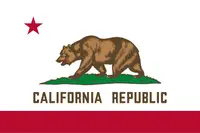 1911
A white field with a red five-pointed star in the upper hoist corner and, in the center, a brown grizzly bear walking left on a green grass plot. The words CALIFORNIA REPUBLIC run beneath the grass, and a red stripe runs along the bottom.
Cal. Gov. Code § 420 (adopted Stats. 1911, ch. 2; detailed specifications Stats. 1953, ch. 1140)
- 1849
Great Seal of California
SealThe goddess Minerva sits beside a grizzly bear and a shield, next to a sheaf of wheat and a grapevine. A miner works with a pick near a rocker and pan, ships sail on the water below the Sierra Nevada, and the word Eureka and 31 stars appear above, the stars standing for California as the 31st state.
Use restricted: Cal. Gov. Code § 402: using a reproduction of the Great Seal maliciously or for commercial purposes is a misdemeanor (limited exceptions); § 402.5 also bars deceptive use in campaign literature
Cal. Gov. Code §§ 400-405 (design codified Stats. 1943, ch. 134)
- 1951
I Love You, California
SongWritten in 1913. The lyrics are in the public domain. Official page.
Cal. Gov. Code § 421.7 (statutory recognition Stats. 1988, ch. 1198, renumbered Stats. 1989, ch. 1360; originally designated Stats. 1951, ch. 87)
- 1963
Eureka
MottoGreek, meaning “I have found it”.
Cal. Gov. Code § 420.5 (Stats. 1963, ch. 1237)
- 1968
The Golden State
NicknameGold gave California its nickname long before the law did. The phrase was in print by the 1850s, and the Legislature made it official in 1968.
Animals
-
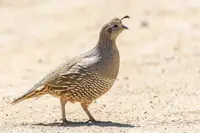 1931
California quail (California valley quail)
BirdCallipepla californicaA plump gray-and-brown quail with a black, comma-shaped plume that nods forward over its face. It lives in groups called coveys in oak woodland, chaparral, farm edges and suburban gardens across most of the state.
Cal. Gov. Code § 423 (originally Stats. 1931, ch. 777, AB 776; codified Stats. 1943, ch. 134) · California State Capitol Museum
- 1953
California grizzly bear
AnimalUrsus arctos californicusThe bear on the flag and the seal. The California grizzly was a subspecies of brown bear that once lived from the coast to the Sierra Nevada; hunting and settlement wiped it out, and none had been seen for about thirty years when it became the state animal.
Cal. Gov. Code § 425 (Stats. 1953, ch. 1140, AB 1014) · California State Capitol Museum
-
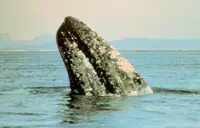 1975
California gray whale
Marine mammalEschrichtius robustusGray whales pass along the California coast each winter and spring on one of the longest migrations of any mammal, between Arctic feeding grounds and Baja California calving lagoons.
Cal. Gov. Code § 425.5 (Stats. 1975, ch. 328, AB 258) · California State Capitol Museum
-
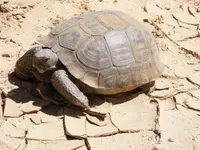 1972
California desert tortoise
ReptileGopherus agassiziiThe tortoise spends most of its life in burrows in the Mojave and Colorado deserts. It has been federally threatened since 1990, and in 2024 California's Fish and Game Commission voted to list it as endangered under state law. Touching, harming or collecting one is illegal.
Cal. Gov. Code § 422.5(a) (originally Stats. 1972, ch. 683, AB 1089; amended Stats. 2012, ch. 591) · California State Capitol Museum
- 2012
Pacific leatherback sea turtle
Marine reptileDermochelys coriaceaThe leatherback is the largest living turtle and crosses the Pacific between California waters and Indonesian nesting beaches.
Cal. Gov. Code § 422.5(b) (Stats. 2012, ch. 591, AB 1776) · California State Capitol Museum
- 2025
Giant garter snake
SnakeThamnophis gigasThe largest garter snake, sometimes more than five feet long. It lives only in Central Valley marshes, rice fields and canals, and is listed as threatened under both state and federal law.
Cal. Gov. Code § 422.6 (Stats. 2025, ch. 482, SB 765; effective 2026-01-01) · California State Capitol Museum
-
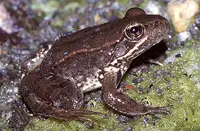 2014
California red-legged frog
AmphibianRana draytoniiThe largest native frog in the western United States. It has disappeared from about 70 percent of its former range and is federally listed as threatened, mainly because of habitat loss and introduced predators such as bullfrogs.
Cal. Gov. Code § 422.7 (Stats. 2014, ch. 77, AB 2364) · California State Capitol Museum
- 1947
California golden trout (state freshwater fish)
FishOncorhynchus mykiss aguabonitaThe golden trout is native only to California, originally to a few cold headwater streams of the Kern River south of Mount Whitney. Stocking has since spread it to many high-elevation Sierra Nevada lakes and streams.
Assembly Concurrent Resolution No. 52, Res. Ch. 90, Stats. 1947 (not codified in the Government Code) · California Legislature, Joint Committee on Fisheries and Aquaculture
-
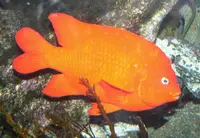 1995
Garibaldi (state marine fish)
Saltwater fishHypsypops rubicundusThe designation came with a moratorium on commercial collection, after concern that the aquarium trade was depleting the bright orange reef fish.
Cal. Gov. Code § 425.6 (Stats. 1995, ch. 948, AB 77; effective 1996-01-01) · California Legislature, Joint Committee on Fisheries and Aquaculture
-
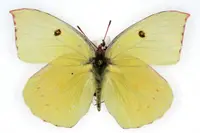 1972
California dogface butterfly
InsectZerene eurydiceThe male's wing pattern looks like the silhouette of a dog's head, which gives the butterfly its name. It lives almost entirely in California, from the north-central part of the state south into northern Baja California.
Cal. Gov. Code § 424.5 (Stats. 1972, ch. 521, AB 1834) · California State Capitol Museum
- 2024
Black abalone (state seashell)
ShellHaliotis cracherodiiDisease and overharvest drove this rocky-reef snail to endangered status.
Cal. Gov. Code § 425.14 (Stats. 2024, ch. 669, AB 2504; effective 2025-01-01) · California State Capitol Museum
- 2023
Pallid bat
BatAntrozous pallidusPallid bats eat insects that damage crops and forests, which supporters cited as a natural form of pest control.
Cal. Gov. Code § 425.12 (Stats. 2023, ch. 502, SB 732) · California State Capitol Museum
- 2024
Banana slug
SlugAriolimaxThe law names the whole genus Ariolimax rather than a single species. The banana slug has been the mascot of UC Santa Cruz since 1986.
Cal. Gov. Code § 425.13 (Stats. 2024, ch. 668, AB 1850) · California State Capitol Museum
- 2024
Dungeness crab
CrustaceanMetacarcinus magisterThe crab supports commercial and recreational fisheries in coastal communities.
Cal. Gov. Code § 425.15 (Stats. 2024, ch. 667, AB 1797) · California State Capitol Museum
- 2015
Shelter pet
PetThe Legislature named shelter animals the state pet to encourage adoptions.
Assembly Concurrent Resolution No. 56, Res. Ch. 184, Stats. 2015 · California State Capitol Museum
Plants and fungi
-
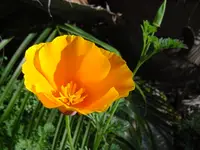 1903
California poppy (golden poppy)
FlowerEschscholzia californicaThe same code section names April 6 of every year California Poppy Day. Penal Code section 384a does not mention poppies; it bars cutting or removing any plant on highway rights-of-way, public land, or someone else's land without the owner's written permission, which covers poppies along with other wildflowers.
Cal. Gov. Code § 421 (originally Stats. 1903, ch. 69; current text amended Stats. 2016, ch. 86) · California State Capitol Museum
-
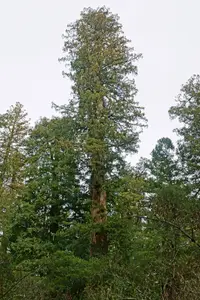 1937
California redwood (coast redwood and giant sequoia)
TreeSequoia sempervirens; Sequoiadendron giganteumTwo species share the title. The coast redwood grows in the fog belt along the northern and central coast and is the tallest tree on Earth; the giant sequoia grows in groves on the western slope of the Sierra Nevada and is the largest by volume. The law named both in 1953.
Cal. Gov. Code § 422 (codified Stats. 1943, ch. 134; amended Stats. 1953, ch. 1140 to name both species) · California State Capitol Museum
- 2004
Purple needlegrass
GrassStipa pulchraA long-lived native bunchgrass with very deep roots, which carry it through dry summers. It is widely planted to restore native grassland and to hold soil against erosion.
Cal. Gov. Code § 425.10 (Stats. 2004, ch. 243, SB 1226) · California State Capitol Museum
- 2015
Lace lichen
LichenRamalina menziesiiCalifornia was the first state to adopt an official lichen.
Cal. Gov. Code § 424.6 (Stats. 2015, ch. 113, AB 1528) · California State Capitol Museum
- 2023
California golden chanterelle
MushroomCantharellus californicusThis edible mushroom forms partnerships with tree roots, especially oaks.
Cal. Gov. Code § 425.11 (Stats. 2023, ch. 644, AB 261) · California State Capitol Museum
- 2025
Bigberry manzanita
ShrubArctostaphylos glaucaIts berries are the largest edible fruit of any manzanita, and its seeds sprout after fire.
Cal. Gov. Code § 425.16 (Stats. 2025, ch. 481, AB 581; effective 2026-01-01) · California State Capitol Museum
Earth and sky
- 1973
Saber-toothed cat
FossilSmilodon californicusSmilodon is one of the most common mammal fossils pulled from the Rancho La Brea tar pits in Los Angeles.
Cal. Gov. Code § 425.7(b) (originally Stats. 1973, ch. 792, AB 940; amended Stats. 2017, ch. 264) · California State Capitol Museum
- 2017
Augustynolophus morrisi
DinosaurThis duck-billed hadrosaur is known from only two specimens, both found in California (Fresno County in 1939 and San Benito County in 1941). Its name honors philanthropist Gretchen Augustyn and paleontologist William J. Morris.
Cal. Gov. Code § 425.7(a) (Stats. 2017, ch. 264, AB 1540) · California State Capitol Museum
- 1985
Benitoite
GemstoneThe blue gem was first found in 1907 in the San Benito Mountains and is named for that county.
Cal. Gov. Code § 425.3 (Stats. 1985, ch. 1365, AB 2357) · California State Capitol Museum
- 1965
Native gold
MineralGold drew the 1849 rush and gave the state its nickname; the statute calls it the state's mineralogic emblem.
Cal. Gov. Code § 425.1 (Stats. 1965, ch. 89) · California State Capitol Museum
- 1965
Serpentine
RockCalifornia was the first state to name an official rock. Serpentine was chosen partly for economic reasons, as a source of asbestos, a material later restricted because of its health dangers.
Cal. Gov. Code § 425.2 (Stats. 1965, ch. 89, SB 265) · California State Capitol Museum
- 1997
San Joaquin soil
SoilA group of eighth graders proposed honoring the soil of their San Joaquin Valley. The statute says the soil is about 50,000 to 250,000 years old and was laid down by glacial-era runoff from the Sierra Nevada.
Cal. Gov. Code § 425.9 (Stats. 1997, ch. 331, SB 389) · California State Capitol Museum
Food and drink
- 2017
Almond, walnut, pistachio and pecan
NutPrunus dulcis; Juglans; Pistacia vera; Carya illinoinensisThe almond, walnut, pistachio and pecan were all named at once in 2017. California grows virtually all of the country's almonds, walnuts and pistachios.
Cal. Gov. Code § 422.3 (Stats. 2017, ch. 49, AB 1067) · California State Capitol Museum
Culture and history
- 1988
West Coast Swing
DanceThe style grew out of the Lindy Hop and jitterbug, and its straight-line form suited Hollywood filming better than circular swing dances.
Cal. Gov. Code § 421.5(a) (Stats. 1988, ch. 1645, SB 2460) · California State Capitol Museum
- 1988
Square dance
Folk danceThe Capitol Museum suggests square dancing probably reached California from Appalachia during the Gold Rush.
Cal. Gov. Code § 421.5(b) (Stats. 1988, ch. 1645, SB 2460) · California State Capitol Museum
- 2001
California state tartan
TartanThe idea came from the St. Andrew's Society of Los Angeles, and the design is based on the tartan of naturalist John Muir's family. By law, any California resident may claim the tartan.
Cal. Gov. Code § 424.3 (Stats. 2001, ch. 100, AB 614) · California State Capitol Museum
- 1951
Blue and gold
ColorsBlue and gold were first linked to the University of California at Berkeley, whose yearbook was called Blue and Gold. Secretary of State Frank C. Jordan started tying official documents with blue and gold ribbon in 1913, and his son, Secretary of State Frank M. Jordan, suggested making the colors official.
Cal. Gov. Code § 424 (originally Stats. 1951, ch. 1214, SB 122; amended Stats. 2017, ch. 573) · California State Capitol Museum
- 2018
Surfing
SportCalifornia hotel owners helped introduce surfing from Hawaii, and the world championships held in San Diego in 1966 helped set rules for international contests.
Cal. Gov. Code § 424.7 (Stats. 2018, ch. 162, AB 1782) · California State Capitol Museum
- 2003
Californian (state tall ship)
ShipThe topsail schooner, launched in 1984, is a replica of a 19th-century U.S. Revenue Cutter Service vessel and is now operated by the Maritime Museum of San Diego.
Cal. Gov. Code § 423.5 (Stats. 2003, ch. 113) · California State Capitol Museum
- 2016
Denim
FabricSan Francisco merchant Levi Strauss and tailor Jacob Davis patented riveted work clothes in 1873, the origin of the modern blue jean.
Cal. Gov. Code § 423.6 (Stats. 2016, ch. 873, AB 501) · California State Capitol Museum
- 1991
Chipped Stone Bear (bear-shaped eccentric)
Prehistoric artifactThe roughly 2.5-inch volcanic-stone carving, thought to be more than 7,000 years old, was excavated in San Diego County in 1985. According to the Capitol Museum, California is the only state with an official prehistoric artifact.
Cal. Gov. Code § 425.8 (Stats. 1991, ch. 73, SB 404) · California State Capitol Museum
- 1997
California Consolidated Drum Band
Fife and drum bandFounded in 1996, the band plays music from the Revolutionary War through the Civil War in period dress.
Assembly resolution, Res. Ch. 58, Stats. 1997 (resolution number not confirmed) · California State Capitol Museum
Government emblems
- 1957
Seal of the Governor of the State of California
Governor's sealThe design shows the Bear Flag, a rising sun and poppies, plus roman numerals giving the governor's number in the sequence of office.
Cal. Gov. Code §§ 426-427 (Stats. 1957, ch. 963) · California.Public.Law (text of Cal. Gov. Code)
- 1957
Flag of the Governor of the State of California
Governor's flagThe flag is Yale blue with a white star in each of its four corners, a golden fringe and a central seal showing Minerva, a miner, a ship and a cornucopia.
Cal. Gov. Code §§ 428-429 (Stats. 1957, ch. 963) · California.Public.Law (text of Cal. Gov. Code)
Places and institutions
- 2002
Bodie
Gold rush ghost townThe Mono County boomtown peaked at an estimated 8,000 to 10,000 residents around 1879-1881 and has been a state historic park since 1962.
Cal. Gov. Code § 429.7 (Stats. 2002, ch. 365) · California State Capitol Museum
- 2005
Calico
Silver rush ghost townCalico grew up after an 1880s silver strike, and Walter Knott of Knott's Berry Farm bought and restored it in the 1950s; it is now a San Bernardino County regional park.
Cal. Gov. Code § 429.8 (Stats. 2005, ch. 90) · California State Capitol Museum
- 1979
California Historical Society
Historical societyFounded in 1871, the society dissolved in 2025 and moved its collections to Stanford University Libraries, though the code section still names it.
Cal. Gov. Code § 429.5 (Stats. 1979, ch. 52, SB 63) · California State Capitol Museum
- 2004
California State Military Museum and Resource Center
Military museumThe museum opened in Old Sacramento in 1991; that site closed in 2014, and a new site is being developed.
Cal. Gov. Code § 429.6 (Stats. 2004, ch. 133) · California State Capitol Museum
- 2013
California Vietnam Veterans Memorial
Vietnam veterans memorialDedicated in 1988 in Capitol Park in Sacramento, the memorial lists 5,822 Californians who died or went missing in the war.
Cal. Gov. Code § 429.9 (Stats. 2013, ch. 191, AB 1289; effective 2014-01-01) · California State Capitol Museum
- 2018
LGBTQ Veterans Memorial, Desert Memorial Park, Cathedral City
LGBTQ veterans memorialDedicated in 2001, it is described by the Capitol Museum as the first memorial of its kind in the United States.
Cal. Gov. Code § 429.4 (Stats. 2018, ch. 172, AB 2439) · California State Capitol Museum
- 1993
The Ramona Pageant
Outdoor playRamona, based on Helen Hunt Jackson's 1884 novel, was first staged in 1923 in an outdoor bowl in the hills near Hemet and has run there almost every year since. The Legislature named it the state outdoor play in 1993.
Senate Concurrent Resolution No. 5, Res. Ch. 9, Stats. 1993 · California Legislature
- 1937
Pasadena Playhouse
TheaterThe Spanish Revival playhouse opened in 1924 and trained generations of actors at its theater school.
Resolution Chapter 45, Stats. 1937 · California State Capitol Museum
Questions about California's symbols
- What is the California state animal?
- The California grizzly bear, adopted in 1953. It is also the bear on the state flag, although the California grizzly was hunted to extinction by the 1920s.
- What are California's state bird, flower and tree?
- The bird is the California quail (1931), the flower is the California poppy (1903), and the tree is the California redwood, a title shared by the coast redwood and the giant sequoia.
- Does California have a state fruit?
- Not by law. The avocado and the artichoke are often listed as California's state fruit and vegetable, but they were named in a 2013 proclamation by an acting governor, not by the Legislature, so they are not on this list.
- How does something become a California state symbol?
- Almost always by a bill passed by the Legislature and signed by the governor, which adds it to the state emblems chapter of the Government Code. A few, such as the golden trout and the shelter pet, were named by legislative resolution instead.
Photo credits (9)
- Flag of California: Original: Donald Graeme Kelley Vectorization: Devin Cook, Public domain, via Wikimedia Commons
- California quail: Becky Matsubara from El Sobrante, California, CC BY 2.0, via Wikimedia Commons
- California poppy: Artslave, CC BY 2.0, via Wikimedia Commons
- California redwood: Allie_Caulfield from Germany, CC BY 2.0, via Wikimedia Commons
- California gray whale: Unknown author, Public domain, via Wikimedia Commons
- California desert tortoise: Tigerhawkvok, CC BY-SA 3.0, via Wikimedia Commons
- California red-legged frog: Unknown author, Public domain, via Wikimedia Commons
- Garibaldi: Stan Shebs, CC BY-SA 3.0, via Wikimedia Commons
- California dogface butterfly: Colorado State University, CC BY 3.0, via Wikimedia Commons
Something out of date? Tell us and we will check it against the law.
Sources
- Flag - California State Capitol Museum California State Capitol Museum
- Seal - California State Capitol Museum California State Capitol Museum
- Song - “I Love You, California” - California State Capitol Museum California State Capitol Museum
- Ramona Bowl, Site of the Ramona Pageant California Office of Historic Preservation
- "Cracking the Market: U.S. Dominance over Tree Nut Exports" USDA Foreign Agricultural Service
- California quail Cornell Lab of Ornithology
- State Symbols California State Capitol Museum
- Determination of Threatened Status for the California Red-legged Frog US Fish and Wildlife Service
- Giant garter snake species profile Endangered Species Recovery Program, CSU Stanislaus
- California Fish and Game Commission finds Mojave desert tortoise status warrants uplisting Defenders of Wildlife