California quail, the state bird of California
The state bird of California is the California quail, also called the California valley quail, adopted in 1931. It is a plump ground bird with a black, comma-shaped plume curling forward from its forehead, and it lives across most of the state, from oak woodland and brushy hillsides to city parks.
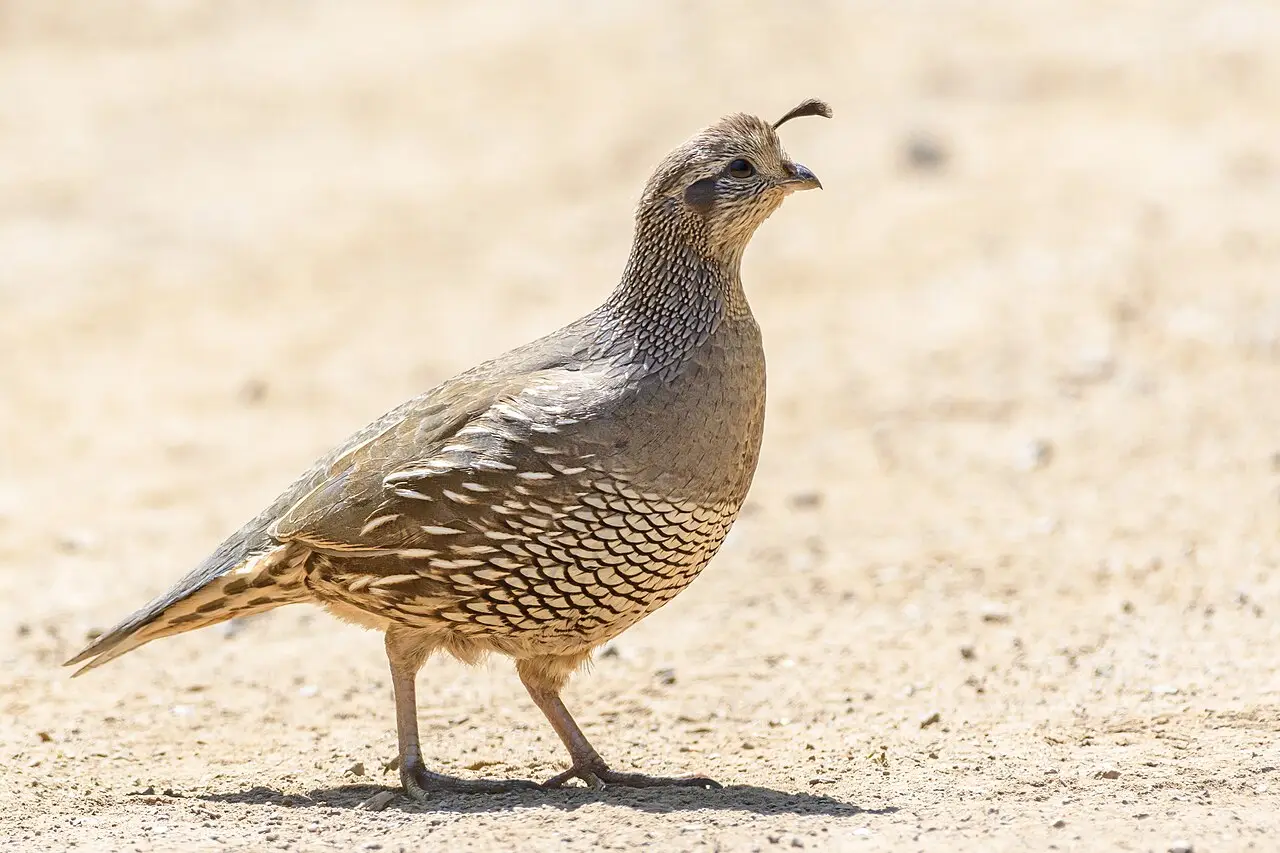
How to recognize it
A California quail is about 10 inches long, round-bodied and short-necked, and spends most of its time on the ground. The giveaway is the plume: a black topknot made of six overlapping feathers that curls forward from the forehead like a comma or a teardrop. Both sexes have one, but the male’s is larger.
Males are gray and brown, with a black face outlined by bold white stripes. Females are plainer brown and gray, without the face pattern, which hides them well on the nest. Both have a striking belly patterned in white, cream and chestnut, like fish scales.
You will often hear one before you see it. The best-known call is a loud, three-note chi-CA-go, the middle note highest, which sounds a little like someone calling the city’s name.
Where it lives
The quail is a permanent resident: it does not migrate. It lives in most of California outside the high mountains, in chaparral, coastal sage scrub, oak woodland and foothill forest, and it has adapted well to farms, parks and large suburban gardens. Its range runs north into Oregon and Washington and south into Baja California, and it has been introduced farther inland.
How it lives
California quail feed on the ground, mostly in the morning and evening, scratching for seeds, leaves, flowers, acorns and berries, with a few insects. About 70 percent of the diet is plant matter. In fall and winter they gather in coveys that can number in the dozens, and at night they roost together in trees or dense shrubs. In spring the coveys break into pairs. A female lays about 12 to 16 cream-colored, spotted eggs, and both parents look after the chicks, which leave the nest within a day of hatching and can fly short distances at about ten days old.
Where to see one
Look along the edges of brush and oak woodland, especially early in the morning, and listen for the chi-CA-go call. Parks with patches of low cover are good places: quail often feed in the open a few steps from shelter and run for it at the first sign of danger. In many towns they come to seed scattered on the ground in backyards.
A common bird, still hunted
Unlike several of California’s newer animal symbols, the quail is not in trouble. The Cornell Lab of Ornithology lists it as a species of low conservation concern, with a breeding population of about 5.8 million, and Breeding Bird Survey counts rose slightly between 1966 and 2019. It is also still one of California’s main game birds.
The state bird since 1931
The Legislature named the quail the state bird in 1931. The law, now section 423 of the Government Code, still uses an older scientific name for it, Lophortyx californica. Today it is classified as Callipepla californica.
Questions about the California state bird
- What is the state bird of California?
- The California quail (Callipepla californica), also known as the California valley quail. It became the state bird in 1931.
- What sound does a California quail make?
- Its best-known call is a loud three-note "chi-CA-go," with the middle note highest. Flocks also make soft clucks while feeding, and the birds burst into the air with a loud whirring of wings when startled.
- Do California quail migrate?
- No. They stay in the same area all year, gathering in larger flocks, called coveys, in fall and winter and splitting into pairs to nest in spring.
Sources
- California Quail Identification Cornell Lab of Ornithology
- California Quail Life History Cornell Lab of Ornithology
- California Quail National Audubon Society
- Bird - California Valley Quail California State Capitol Museum
- California Government Code section 423 California.Public.Law (text of the California codes)
- Bird - California Valley Quail - California State Capitol Museum California State Capitol Museum