Oregon state symbols
Oregon has 34 official state symbols. The oldest are the seal of 1859 and the Oregon grape, the state flower since 1899; the newest is the T-bone steak, named in 2025. Most were adopted by legislative resolution, and one, the western meadowlark, was chosen by schoolchildren and proclaimed by the governor in 1927, the only Oregon emblem not originally picked by lawmakers.
Grape, bird and tree
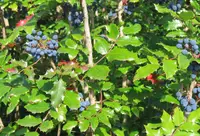
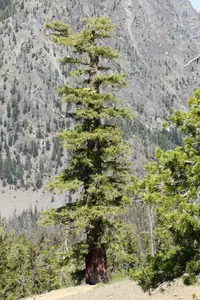
The Oregon Horticultural Society proposed the Oregon grape at its 1892 convention, and the Legislature adopted it as the state flower by resolution in 1899. In 1927 Oregon schoolchildren voted for the western meadowlark in a poll organized by the Oregon Audubon Society, and Governor Isaac Patterson proclaimed their choice that July; the Legislature formally named it the state songbird only in 2017, in the same resolution that made the osprey the state raptor. The Douglas-fir, requested by the Daughters of the American Revolution, became the state tree in 1939. It is named for the Scottish botanist David Douglas, who traveled in Oregon in the 1820s, and despite its name it is not a true fir.
Fish, beaver and butterfly
The Chinook salmon, the largest Pacific salmon, became the state fish in 1961; many Oregon Chinook runs are now listed as threatened or endangered because of overfishing, dams and habitat loss. The beaver became the state animal in 1969. The Oregon swallowtail, a yellow-and-black butterfly of the sagebrush canyons of the Columbia River system, became the state insect in 1979, after a rain beetle proposed in 1977 was rejected because it damages orchards. The Dungeness crab, the basis of Oregon’s most valuable single-species fishery, became the state crustacean in 2009, after fourth graders in West Linn lobbied for it.
Stones, soil and a fossil
Rockhounds chose the thunderegg in a poll promoted by the Oregon Museum of Science and Industry, and it became the state rock in 1965. Plain on the outside, these nodules hide agate, jasper or opal inside, and most are found in Crook, Jefferson, Malheur, Wasco and Wheeler counties. The Oregon sunstone, a transparent, often colorful feldspar, became the state gemstone in 1987; the public may collect sunstones near Plush in Lake County. Jory soil, a deep, brick-red soil weathered from old volcanic rock that covers more than 300,000 acres of western Oregon hillsides, became the state soil in 2011. Oregon was the last western state to name a state fossil, choosing the dawn redwood, Metasequoia, in 2005.
Food and drink
Oregon’s food symbols say a lot about its farms. Students from Tillamook County asked lawmakers to honor milk, the state beverage since 1997. The hazelnut, long called the filbert in Oregon, became the state nut in 1989; Oregon grows about 99 percent of the US commercial crop. The pear, the state’s top-selling tree fruit, followed in 2005, and marionberry pie in 2017; the marionberry came from a 1950s blackberry breeding program and is named for Marion County, where it was tested. The Pacific golden chanterelle became the state mushroom in 1999, and brewer’s yeast, which leavens bread and ferments beer, the state microbe in 2013. The potato won out over the onion as state vegetable in 2023, with supporters citing the tater tot, invented in Ontario, Oregon, in 1953, and the T-bone became the state steak in 2025.
People and pageants
Two pioneers hold honorary titles. Dr. John McLoughlin, the Hudson’s Bay Company chief factor at Fort Vancouver who aided many early American settlers, was named the Father of Oregon in 1957, and Tabitha Moffatt Brown, who crossed to Oregon at 66 and started a school for orphans that grew into Pacific University, the Mother of Oregon in 1987. The Champoeg Historical Pageant is the official pageant of statehood, and Pendleton’s Happy Canyon Indian Pageant and Wild West Show, staged by tribal members and local volunteers, the official outdoor pageant. The state square dance, the Oregon tartan and the state pet, rescued shelter dogs and cats, round out the list.
Flag, seal, song, motto and nickname
-
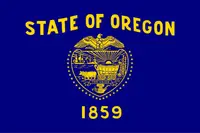 1925
Flag of Oregon
FlagNavy blue with gold elements. The front carries the shield from the state seal ringed by 33 stars, with 'State of Oregon' above and '1859' below; the back shows a beaver.
ORS 186.010 (originally Senate Bill 195, signed by Gov. Walter Pierce on February 26, 1925)
- 1859
Great Seal of Oregon
SealA shield ringed by 33 stars and topped by an American eagle, crossed by a banner reading 'The Union'. Above it are mountains, an elk, a covered wagon and the Pacific with a departing British warship and an arriving American ship; below are a sheaf of wheat, a plow and a pickax, with the legend 'State of Oregon 1859'.
State law bars embossing documents with the seal without the secretary of state's authorization, or using it in any way that falsely implies state endorsement or holds it up to ridicule.
Use restricted: ORS 186.023: no embossing with the seal without Secretary of State authorization, and no use that falsely implies state endorsement or holds the seal up to ridicule
ORS 186.020
- 1927
Oregon, My Oregon
SongWritten in 1920. The lyrics are in the public domain.
"Oregon, My Oregon" won a 1920 contest and was adopted in 1927. In 2021 the Legislature replaced its lyrics with new ones by Amy Shapiro.
Designated by the 1927 Legislature (instrument not confirmed); lyrics revised by House Concurrent Resolution 11 (2021)
- 1987
Alis Volat Propriis
MottoLatin, meaning “She flies with her own wings”.
"Alis volat propriis" dates from territorial days. In 1957 the Legislature replaced it with "The Union," and in 1987 it restored the Latin phrase.
ORS 186.040 (1957 c.355; 1987 c.848)
Animals
-
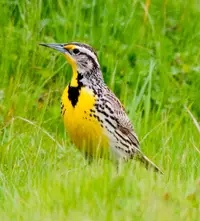 1927
Western meadowlark
BirdSturnella neglectaOregon schoolchildren picked the meadowlark in a 1927 vote organized by the Oregon Audubon Society, and Governor Isaac Patterson proclaimed the choice in July 1927. The Legislature never ratified the bird by resolution; it is the only Oregon emblem chosen by proclamation rather than by lawmakers. In 2017 the Legislature named the same bird the official state songbird (see songbird entry).
- 2017
Western meadowlark
SongbirdSturnella neglectaThe 2017 Legislature gave the 1927 schoolchildren's choice formal legislative standing by naming the meadowlark the state songbird, in the same resolution that created a state raptor.
Senate Concurrent Resolution 18 (2017) · Oregon Secretary of State (Oregon Blue Book)
- 2017
Osprey
RaptorPandion haliaetusLawmakers described the fish-eating hawk as a symbol of the state's independence and resilience and of its rivers, lakes and coast.
Senate Concurrent Resolution 18 (2017) · Oregon Secretary of State (Oregon Blue Book)
-
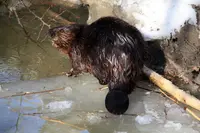 1969
American beaver
AnimalCastor canadensisAlthough Oregon had long been called the Beaver State, the animal was not formally adopted until after The Oregonian pointed out the gap in 1968; Governor Tom McCall and Secretary of State Clay Myers then backed it. Heavy trapping in the fur-trade era wiped beavers out of much of the state, but managed protection let them return to many waterways. A beaver appears on the reverse of the state flag and appeared on the territorial seal and on 1849 'beaver money'.
-
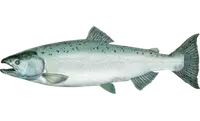 1961
Chinook salmon
FishOncorhynchus tshawytschaAlso called king, spring or tyee salmon, it is the largest Pacific salmon; the 1961 Legislature named it the state fish. Many Oregon Chinook runs are now listed as threatened or endangered because of overfishing, dams and habitat loss.
- 1979
Oregon swallowtail
InsectPapilio machaon oregoniusA rain beetle was proposed in 1977 but rejected because it damages orchards; Portland Zoo director Warren Iliff then suggested the swallowtail, which the 1979 Legislature adopted. The yellow-and-black butterfly lives mainly in the sagebrush canyons of the Columbia River system, including the Snake River basin.
- 1989
Oregon hairy triton
ShellFusitriton oregonensisThe Oregon Society of Conchologists asked for the designation; the shell can reach about five inches and washes up on the coast at high tide. Its species name honors the Oregon Territory.
- 2009
Dungeness crab
CrustaceanMetacarcinus magisterFourth graders at Sunset Primary School in West Linn lobbied for the crab, working with the Oregon Dungeness Crab Commission and testifying to lawmakers. The Dungeness fishery is described as the most valuable single-species fishery in Oregon.
House Joint Resolution 37 (2009) · Oregon Secretary of State (Oregon Blue Book)
- 2023
Rescued shelter dogs and cats
PetRather than a breed, the 2023 Legislature honored dogs and cats adopted from shelters and rescues.
House Concurrent Resolution 8 (2023) · Oregon Secretary of State (Oregon Blue Book)
Plants and fungi
-
 1899
Oregon grape
FlowerBerberis aquifoliumThe Oregon Horticultural Society proposed the plant at its 1892 convention, and the Legislature adopted it by resolution in 1899. Despite the name it is not a grape but an evergreen, holly-like shrub of the barberry family with yellow flowers and dark blue, tart berries.
Resolution of the 1899 Legislature (number not confirmed) · Oregon Secretary of State (Oregon Blue Book)
-
 1939
Douglas-fir
TreePseudotsuga menziesiiThe Daughters of the American Revolution asked for the designation, and the 1939 Legislature agreed. The tree is named for Scottish botanist David Douglas, who traveled in Oregon in the 1820s; it is not a true fir. Its strength and size made it the backbone of western Oregon's timber economy.
- 1999
Pacific golden chanterelle
MushroomCantharellus formosusOregon Mycological Society member Kevin Winthrop pushed for the designation; the resolution noted that more than 500,000 pounds of the wild mushroom are harvested commercially each year.
House Joint Resolution 68 (1999) · Oregon Secretary of State (Oregon Blue Book)
- 2013
Brewer's yeast
MicrobeSaccharomyces cerevisiaeThe 2013 Legislature honored the yeast that leavens bread and ferments beer, reflecting Oregon's prominence in craft brewing.
House Concurrent Resolution 12 (2013) · Oregon Secretary of State (Oregon Blue Book)
Earth and sky
- 1965
Thunderegg
RockAfter rockhounds around the state voted it their favorite in a poll promoted by the Oregon Museum of Science and Industry, the 1965 Legislature named the thunderegg the state rock. Plain on the outside, the nodules hide agate, jasper or opal patterns inside; most are found in Crook, Jefferson, Malheur, Wasco and Wheeler counties.
- 1987
Oregon sunstone
GemstoneThe 1987 Legislature chose the sunstone, a transparent, often colorful feldspar gem, partly to promote tourism and economic development in southeastern Oregon. The public may collect sunstones in a Bureau of Land Management area near Plush in Lake County.
- 2005
Metasequoia (dawn redwood)
FossilMetasequoiaOregon was the last western state to name a state fossil; the dawn redwood had no competition. The tree died out in Oregon about 5 million years ago but survives in China, where living trees were found in the 1940s; a dawn redwood now grows in Willson Park on the Capitol grounds.
House Joint Resolution 3 (2005) · Oregon State Legislature
- 2011
Jory soil
SoilThe deep, brick-red soil, weathered from old volcanic rock, covers more than 300,000 acres of western Oregon hillsides and is named for Jory Hill in Marion County. The Oregon Soil Science Society had promoted Jory soil unofficially since 1993; after a failed 2007 attempt, Rep. Mitch Greenlick secured passage in 2011.
House Concurrent Resolution 3 (2011) · Oregon Secretary of State (Oregon Blue Book)
Food and drink
- 1989
Hazelnut
NutCorylus avellanaLong called filberts in Oregon, hazelnuts were named the state nut by the 1989 Legislature. Oregon grows about 99 percent of the U.S. commercial crop, mostly in the Willamette Valley.
- 1997
Milk
BeverageStudents from Tillamook County asked lawmakers to honor milk, and the 1997 Legislature did so, citing dairying's importance to Oregon agriculture.
- 2005
Pear
FruitPyrus communisThe Pear Bureau Northwest requested the designation; the resolution called the pear the state's top-selling tree fruit. Production centers on the Hood River area and the Rogue River Valley.
House Joint Resolution 8 (2005) · Oregon Secretary of State (Oregon Blue Book)
- 2017
Marionberry pie
PieThe marionberry came out of a blackberry breeding program in the 1950s, crossing 'Chehalem' and 'Olallieberry', and is named for Marion County, where it was tested.
House Concurrent Resolution 19 (2017) · Oregon Secretary of State (Oregon Blue Book)
- 2023
Potato
VegetableSolanum tuberosumSen. Bill Hansell of Athena sponsored the resolution, which won out over a rival push for the onion; supporters pointed to Oregon's large potato harvest and to the tater tot, invented in Ontario, Oregon, in 1953.
Senate Concurrent Resolution 3 (2023) · Oregon Secretary of State (Oregon Blue Book)
- 2025
T-bone steak
SteakThe Senate passed the resolution unanimously in March 2025 and the House approved it 50-2 on June 16, 2025. Chief sponsor Rep. Bobby Levy of Echo framed it as a tribute to Oregon's cattle-ranching heritage.
Senate Concurrent Resolution 13 (2025) · Oregon Capital Chronicle
Culture and history
- 1977
Square dance
DanceThe Oregon Federation of Square and Round Dance Clubs sought the designation, which the 1977 Legislature granted as part of a national campaign by square dancers. Lawmakers cited the dance's pioneer roots and its sociable spirit as reflecting Oregon's character.
- 2017
Oregon tartan
TartanThe tartan (registration number 36406) uses blue, gold, green, black, white, taupe, crimson and azure to stand for the state's waters, mountains, forests, grasslands and volcanic past. It was designed by Robbie Harding of Bend.
House Concurrent Resolution 13 (2017) · Oregon Secretary of State (Oregon Blue Book)
- 1959
Navy blue and gold
ColorsThe flag statute names navy blue and gold as the official colors, the same colors used on the state flag.
ORS 186.010(2) (1959 c.120) · OregonLaws (public.law), text of the Oregon Revised Statutes
- 1957
Dr. John McLoughlin
Father of OregonThe 1957 Legislature gave the honorary title to the Hudson's Bay Company chief factor at Fort Vancouver, who aided many early American settlers.
- 1987
Tabitha Moffatt Brown
Mother of OregonThe 1987 Legislature honored the pioneer who crossed to Oregon at 66 and started a school for orphans that grew into Tualatin Academy and later Pacific University.
Places and institutions
- 2011
Happy Canyon Indian Pageant and Wild West Show
Outdoor pageantStaged each year in Pendleton with a cast of tribal members and local volunteers, the show moves from Native village life through the arrival of Lewis and Clark and the settling of the West.
Senate Concurrent Resolution 2 (2011) · Oregon Secretary of State (Oregon Blue Book)
- 1987
Champoeg Historical Pageant
Statehood pageantThe statute names the pageant the official pageant of Oregon statehood and directs the State Parks and Recreation Department to promote it.
ORS 186.130 (1987 c.831) · OregonLaws (public.law), text of the Oregon Revised Statutes
Questions about Oregon's symbols
- What is the Oregon state flower?
- The Oregon grape, an evergreen, holly-like shrub with yellow flowers and dark blue berries, adopted in 1899.
- What is the Oregon state rock?
- The thunderegg, a plain-looking stone nodule that hides patterns of agate, jasper or opal inside, adopted in 1965 after a poll of rockhounds.
- What is the Oregon state nut?
- The hazelnut, adopted in 1989. Oregon grows about 99 percent of the US commercial crop.
- Does Oregon have a state microbe?
- Yes, brewer's yeast, adopted in 2013, reflecting Oregon's prominence in craft brewing.
- What is the Oregon state fossil?
- Metasequoia, the dawn redwood, adopted in 2005. It died out in Oregon about 5 million years ago but survives in China.
Photo credits (6)
- Flag of Oregon: User:Denelson83, Public domain, via Wikimedia Commons
- Western meadowlark: Kevin Cole from Pacific Coast, USA (en:User:Kevinlcole), CC BY 2.0, via Wikimedia Commons
- American beaver: Vlad Podvorny, CC BY 2.0, via Wikimedia Commons
- Oregon grape: The, CC BY-SA 3.0, via Wikimedia Commons
- Douglas-fir: Walter Siegmund, CC BY-SA 3.0, via Wikimedia Commons
- Chinook salmon: Unknown authorUnknown author, Public domain, via Wikimedia Commons
Something out of date? Tell us and we will check it against the law.
Sources
- Oregon State Flag Oregon Historical Society (The Oregon Encyclopedia)
- ORS 186.020 - Description of state seal OregonLaws (public.law), text of the Oregon Revised Statutes
- Oregon Almanac: Soil to Wine Industry Production Oregon Secretary of State (Oregon Blue Book)
- Oregon Blue Book, Oregon Almanac Oregon Secretary of State
- Oregon State Symbols Oregon Historical Society (The Oregon Encyclopedia)