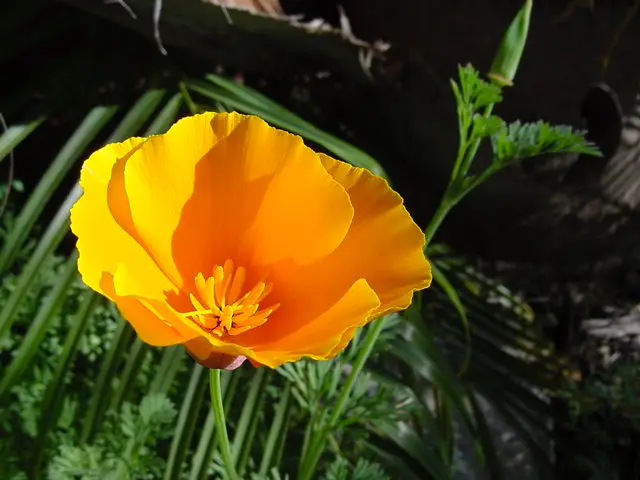
California poppy, the state flower of California
The state flower of California is the California poppy, or golden poppy, adopted in 1903. It is a native wildflower with four satiny orange petals and feathery blue-green leaves, and in spring it can turn whole hillsides orange.
How to recognize it
The California poppy grows in loose, bushy clumps up to about two feet tall. Its leaves are blue-green and finely divided, almost fern-like. Each flower is a cup of four silky petals, usually bright orange but sometimes pale yellow, often with a deeper orange center, and up to about two inches long. The flowers close at night and on cloudy days and open again in the sun.
After flowering it forms a long, thin seed pod. When the pod dries it splits with a snap and throws its seeds several feet, which is one reason poppies spread so readily along roadsides.
Where it grows
The poppy is native to the West, from southern Washington down to Baja California and east into the Great Basin and the Sonoran Desert. In California it grows almost everywhere below the high mountains: on coastal dunes, open slopes and grassland, in inland valleys and at the edges of the desert. It is drought-tolerant and needs full sun, and it is widely grown in gardens.
Where to see the best blooms
The most dependable display is at the Antelope Valley California Poppy Reserve, a state natural reserve about 15 miles west of Lancaster in northern Los Angeles County. In a good year the hills there turn solid orange. The bloom usually peaks in late March or early April, though it can start in mid-February and run into May, and a dry winter can mean a thin show.
Named in San Francisco in 1816
The poppy’s scientific name comes from a Russian voyage of exploration. In 1816 the ship Rurik spent a month in San Francisco Bay, and its naturalist, the poet and botanist Adelbert von Chamisso, collected plants around the Presidio. He named the poppy Eschscholzia californica after his friend Johann Friedrich Eschscholtz, the ship’s surgeon. Eschscholtz returned the favor by naming a local lupine after Chamisso.
Can you pick one?
Many Californians grow up hearing that picking a poppy is against the law because it is the state flower. That is not quite right. Penal Code section 384a makes it a misdemeanor to cut, destroy or remove plants growing along state or county highways, or on anyone else’s land without the owner’s written permission. It covers poppies, but only in the same way it covers every other plant. On your own land you can pick as many as you like, though there is little point: picked poppies drop their petals almost immediately.
The Capitol Museum also warns that all parts of the plant are toxic if eaten.
The state flower since 1903
The Legislature named the poppy the state flower in 1903. The law, now section 421 of the Government Code, also sets aside April 6 each year as California Poppy Day.
Questions about the California state flower
- What is the state flower of California?
- The California poppy (Eschscholzia californica), also called the golden poppy. It became the state flower in 1903.
- Is it illegal to pick a California poppy?
- Not because it is the state flower. California Penal Code section 384a makes it illegal to cut or remove plants along state and county highways or on someone else's land without written permission, and that applies to poppies like any other plant. Poppies in your own garden are yours to pick, although they wilt almost at once.
- When do California poppies bloom?
- Mainly from late winter or spring into early summer. At the Antelope Valley Poppy Reserve the bloom usually peaks in late March or early April, depending on the winter rains.
- Is there a California Poppy Day?
- Yes. The same section of the Government Code that names the state flower makes April 6 California Poppy Day every year.
Sources
- Flower - California Golden Poppy California State Capitol Museum
- "Plant Guide: California Poppy, Eschscholzia californica" USDA Natural Resources Conservation Service
- Antelope Valley California Poppy Reserve SNR California Department of Parks and Recreation
- California Penal Code section 384a California.Public.Law (text of the California codes)
- Adelbert von Chamisso National Park Service, Presidio of San Francisco
- California Government Code section 421 California.Public.Law (text of the California codes)
- PLANTS Profile: Eschscholzia californica, API record USDA NRCS PLANTS Database
- Flower - California Golden Poppy - California State Capitol Museum California State Capitol Museum