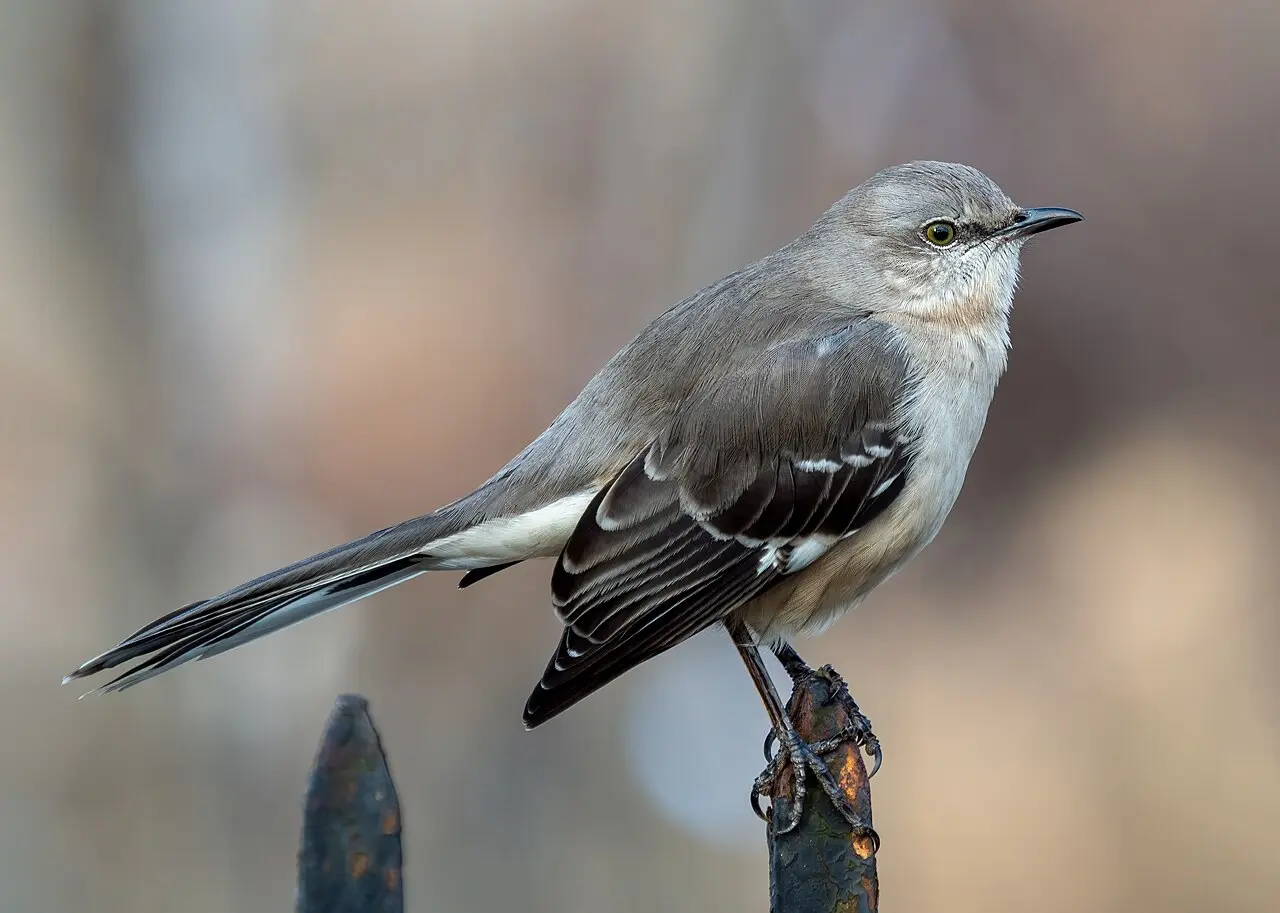
Northern mockingbird, the state bird of five states
The northern mockingbird is the state bird of five southern states: Florida and Texas in 1927, Arkansas in 1929, Tennessee in 1933 and Mississippi in 1944. Famous for copying the songs of other birds, and even sirens and whistles, it lives year-round across all five, in towns, farms and backyards. In several states women's clubs led the campaign to choose it.
The 5 states
| State | Designation | Name in state law | Adopted |
|---|---|---|---|
| Florida | State bird | Northern mockingbirdSenate Concurrent Resolution No. 3 (1927), approved April 23, 1927 | 1927 |
| Texas | State bird | Northern mockingbirdTex. Gov't Code § 3101.007 (originally S.C.R. No. 8, 40th Leg., R.S., 1927) | 1927 |
| Arkansas | State bird | MockingbirdHouse Concurrent Resolution No. 22 (1929); now A.C.A. § 1-4-118 | 1929 |
| Tennessee | State bird | Northern mockingbirdSenate Joint Resolution 51 (68th General Assembly, 1933) | 1933 |
| Mississippi | State bird | Northern mockingbirdMiss. Code § 3-3-11 | 1944 |
Five southern states
The mockingbird is a bird of the South, and five southern states have chosen it. Florida and Texas both named it in 1927, Arkansas in 1929, Tennessee in 1933 and Mississippi in 1944. South Carolina also once had the mockingbird as its state bird, before a 1948 law replaced it with the Carolina wren.
Women’s clubs and an election
Women’s clubs were behind several of these choices. The Texas Federation of Women’s Clubs asked the Texas Legislature to name the mockingbird in 1927. In Arkansas, the Arkansas Federation of Women’s Clubs led the campaign; legislators reportedly treated it as a joke at first, but it passed after speeches stressing the bird’s usefulness to farmers. Mississippi’s Blue Book credits both the Women’s Federated Clubs and the Legislature. In Tennessee, the Tennessee Ornithological Society held a statewide election on April 11, 1933, and the Legislature confirmed the result. Florida’s choice rests on a 1927 resolution, and recent bills to replace it with the American flamingo have failed.
The many-tongued mimic
The mockingbird is a slim gray bird with flashing white wing patches and white outer tail feathers. Its song is a long medley of phrases, each repeated three or more times, much of it copied from other birds and even sirens and whistles; its scientific name, Mimus polyglottos, means roughly “many-tongued mimic.” Unmated males may sing all night. Mockingbirds also defend their nests fiercely, diving at cats, dogs and even people.
Common, but slipping
The northern mockingbird is still widespread, with a population of about 43 million, but numbers have fallen in recent decades. Partners in Flight documented a drop of about 19 percent in the United States and Canada between 1970 and 2014, and Tennessee reports a long-term decline in that state. In the 1800s the bird was heavily trapped for the cage-bird trade, and it recovered after that ended.
Questions people ask
- Which states have the mockingbird as state bird?
- Five - Arkansas, Florida, Mississippi, Tennessee and Texas.
- Why is it called a mockingbird?
- Because it imitates other birds and even mechanical sounds. Its scientific name, Mimus polyglottos, means roughly "many-tongued mimic."
- Was the mockingbird ever South Carolina's state bird?
- Yes. South Carolina's first state bird was the mockingbird, but a 1948 law replaced it with the Carolina wren.
- Has Florida tried to change its state bird?
- Bills to replace the mockingbird with the American flamingo have been filed in recent sessions, but none has passed.
Sources
- Northern Mockingbird National Audubon Society
- Bill Analysis and Fiscal Impact Statement, SB 150 (2026), Designation of the State Birds The Florida Senate
- Northern Mockingbird (Handbook of Texas Online) Texas State Historical Association
- Official State Bird Encyclopedia of Arkansas (Central Arkansas Library System)
- Tennessee State Symbols Tennessee Secretary of State
- Mississippi Official and Statistical Register (Blue Book) 2024-2028, General Information Mississippi Secretary of State