Northern mockingbird, the state bird of Mississippi
The state bird of Mississippi is the northern mockingbird, chosen in 1944. It is a slim gray songbird with flashing white wing patches and a long tail, famous for its endless song, much of it copied from other birds. It lives in every part of Mississippi all year round, and four other states, Arkansas, Florida, Tennessee and Texas, share it as their state bird.
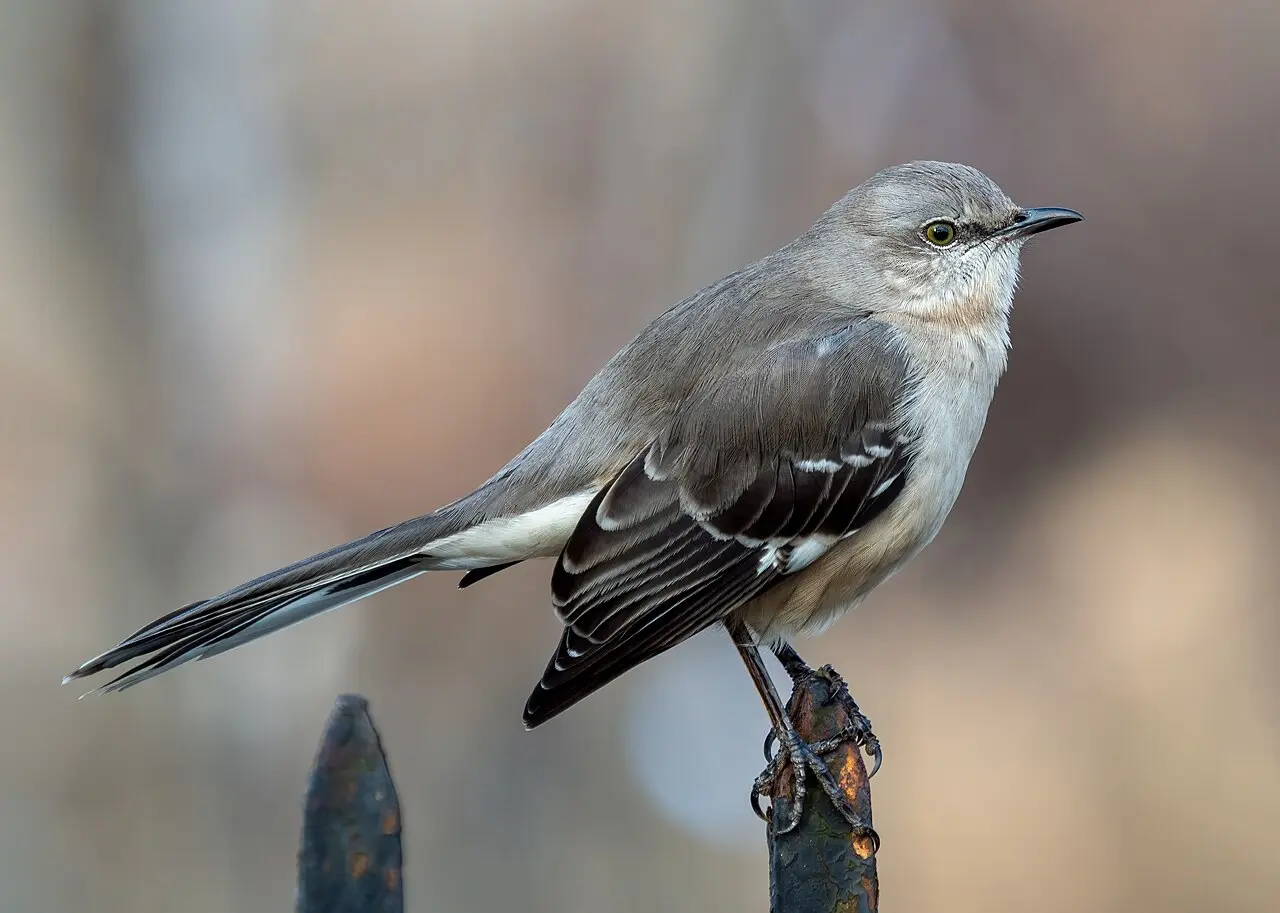
How to recognize it
The northern mockingbird is a slim, long-tailed songbird about 8 to 10 inches long, weighing under 2 ounces. Males and females look alike: pale gray above and paler below, with white outer tail feathers and white patches on the wings that show mostly in flight. Young birds have dark streaks on the breast and darker eyes than adults.
The easiest way to find one is to listen. Its song is a long string of musical and harsh phrases, each usually repeated three or more times before the bird moves on to the next, and much of it is copied from other birds and other sounds. Males often sing at night. The call note is a harsh chack.
How it lives
Over a year, the mockingbird’s diet is roughly half insects and other small creatures and half berries and wild fruit. It catches insects on the ground in spring and summer, and fruit carries it through fall and winter. A mockingbird running across a lawn often stops to half-open its wings and flash its white patches.
Mockingbirds are fearless in defending their nests. They dive at cats, dogs, hawks and even people that come too close, so anyone who has walked past a nesting pair in spring knows the bird’s temper.
Where to see one in Mississippi
The state’s Blue Book notes that the mockingbird is found in every part of Mississippi, and it stays year-round. Look for it anywhere dense low shrubs sit next to lawns or open ground: suburban yards, hedges, fencelines, roadsides and farm edges. Nesting starts by late winter in the South, and singing is heaviest during the breeding season.
Doing well
The northern mockingbird is a species of least concern. Partners in Flight found that its numbers in the United States and Canada fell about 19 percent between 1970 and 2014, but it is still widespread and common. Window strikes, pesticides and outdoor cats are among the threats. In the 1800s its numbers fell along the East Coast, when the birds were caught and sold as cage pets; they recovered after that trade ended.
The state bird since 1944
The Blue Book credits both the Women’s Federated Clubs and the Legislature with choosing the mockingbird in 1944. It is one of the most popular state birds: Arkansas, Florida, Tennessee and Texas have chosen it too. Mockingbirds also eat the bright red seeds of the magnolia, Mississippi’s state flower and tree.
Questions about the Mississippi state bird
- What is the state bird of Mississippi?
- The northern mockingbird (Mimus polyglottos), chosen in 1944.
- Why do mockingbirds sing at night?
- Male mockingbirds often sing at night, especially in the breeding season, when singing is heaviest. Their songs are long strings of phrases, much of them copied from other birds and other sounds.
- Why do mockingbirds dive at people?
- To defend their nests. Mockingbirds boldly dive at cats, dogs, hawks and even people that come too close.
- Which other states have the mockingbird as state bird?
- Arkansas, Florida, Tennessee and Texas. With Mississippi, that makes five.
Sources
- Northern Mockingbird National Audubon Society
- Northern Mockingbird American Bird Conservancy
- Mississippi Official and Statistical Register 2024–2028, General Information Mississippi Secretary of State