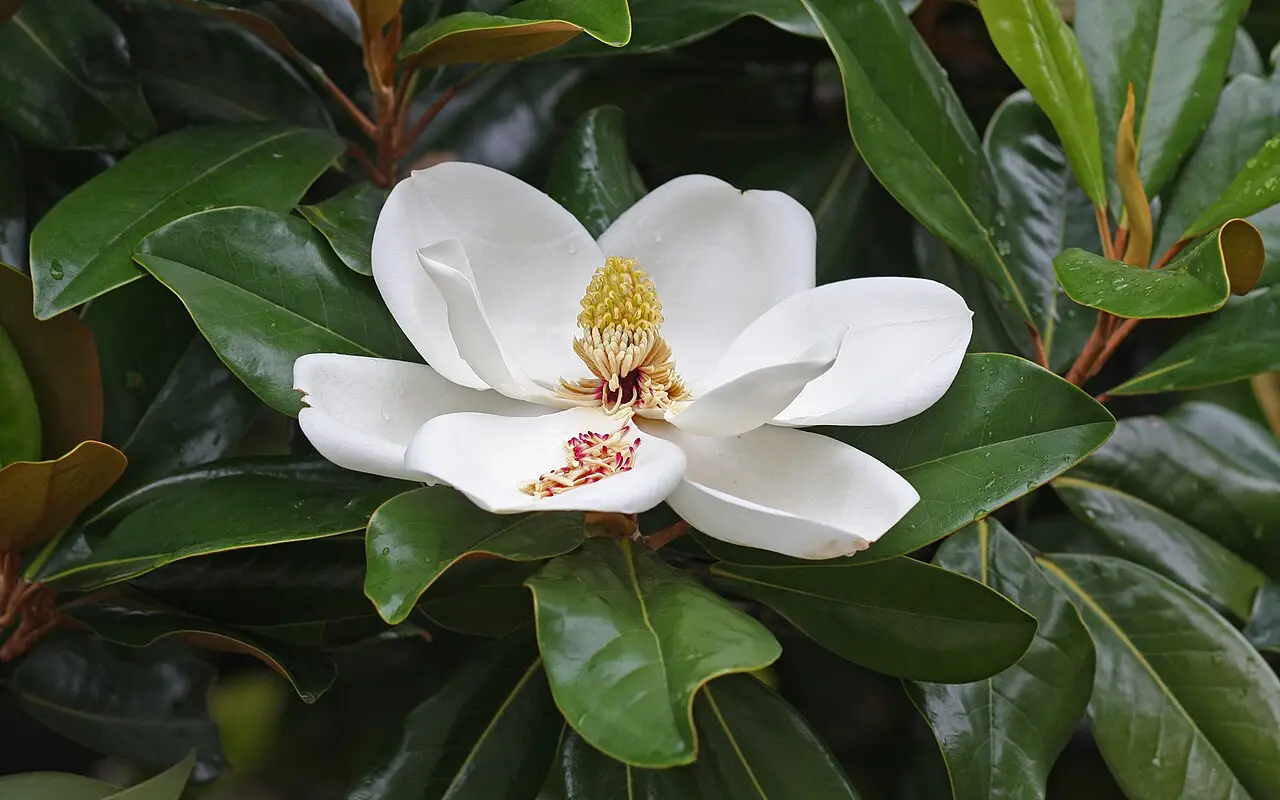
Magnolia, the state flower of Mississippi
The state flower of Mississippi is the magnolia, the large, white, fragrant bloom of the southern magnolia tree. The same tree is the state tree, so Mississippi is the Magnolia State twice over. Schoolchildren chose the flower in 1900, and the Legislature made it official in 1952. Magnolias bloom across the state from late spring into early summer.
How to recognize it
The magnolia is hard to miss. Its flowers are large, white and cup-shaped, up to about 8 inches across, with as many as 12 thick, waxy petals and a lemony fragrance. They grow one at a time at the tips of the branches, set against evergreen leaves 5 to 8 inches long that are leathery and glossy dark green on top and covered with rusty fuzz underneath.
The main bloom runs from April to June, and a few flowers can keep appearing through the summer and occasionally into fall. Each flower then becomes a cone-like seed pod that opens in fall to show bright red seeds hanging on thin threads.
The tree
The flower and the tree are the same species, Magnolia grandiflora, the southern or evergreen magnolia. It is a medium-sized evergreen with a dense, pyramid-shaped crown that typically grows 60 to 80 feet tall on good sites, and its bark is thin and gray to brown. Squirrels, opossums, quail, wild turkeys and songbirds, including Mississippi’s state bird, the mockingbird, eat its seeds. The Choctaw made a tea from the bark to use as a wash for itching and sores.
Where it grows
The southern magnolia is native to the Coastal Plain of the Southeast, from eastern North Carolina to central Florida and west to southeast Texas, and the Forest Service says it is most common in Louisiana, Mississippi and Texas. In the wild it covers roughly the southern half of Mississippi, growing on rich, moist, well-drained bottomlands and low slopes, but it has been planted all over the state.
Where to see it
Magnolias grow in yards, on campuses and around town squares across Mississippi, and the bloom can be seen in every corner of the state from late spring into early summer. The Mississippi State University campus in Starkville has a tree trail that features the species.
Chosen by schoolchildren
Mississippi’s children picked the magnolia long before the Legislature did. In a November 1900 election, 23,278 schoolchildren voted for a state flower. The magnolia won with 12,745 votes, far ahead of the cotton blossom with 4,171 and the cape jasmine with 2,484. In 1935 the state’s director of forestry began a second campaign, asking children to choose a state tree from the magnolia, the oak, the pine and the dogwood, and the magnolia won again. The Legislature named it the state tree on April 1, 1938, but did not make the bloom the state flower until 1952.
Since 2021 a white magnolia blossom has been the centerpiece of the state flag, where it stands for hope and rebirth because the magnolia often blooms more than once over a long season. Mississippi also has a separate state wildflower, coreopsis, adopted in 1991.
Questions about the Mississippi state flower
- What is the state flower of Mississippi?
- The magnolia, the bloom of the southern magnolia (Magnolia grandiflora). It was chosen by schoolchildren in 1900 and made official in 1952.
- Is the magnolia also Mississippi's state tree?
- Yes. The Legislature named the magnolia tree the state tree in 1938, fourteen years before it made the bloom the state flower.
- When do magnolias bloom in Mississippi?
- The main bloom runs from April to June, and a few flowers keep appearing through summer and sometimes into fall.
- Does Mississippi have a state wildflower?
- Yes, coreopsis, adopted in 1991. The law names the whole genus rather than a single species.
Sources
- Southern Magnolia (Silvics of North America) USDA Forest Service, via Virginia Tech Dendrology
- Southern magnolia plant guide USDA Natural Resources Conservation Service
- Tree of the Month, Southern Magnolia Mississippi State University Extension
- State Tree and Flower (Symbols of Our State) Mississippi State University Libraries
- Mississippi Official and Statistical Register 2024–2028, General Information Mississippi Secretary of State
- Southern magnolias add evergreen charm, beauty (Southern Gardening, 2023) Mississippi State University Extension Service