Arkansas state symbols
Arkansas has 36 official state symbols. The oldest is the apple blossom, adopted in 1901; the newest are the mallard, the official state duck, and the Labrador retriever, the official state canine, both from 2025. In between, Arkansas named a state cooking pot, a state steam locomotive and a tomato that is both fruit and vegetable.
A long list with a sense of humor
Arkansas’s symbols are mostly set out in Chapter 4 of Title 1 of the Arkansas Code, and many come with explanations written into the acts themselves. When the state named the pecan in 2009, the act made a point of saying that the nut gets no protected status, so it can still be harvested and eaten. The same clause appears for the state butterfly, the alligator gar and the mallard. The 1987 tomato act explains that the pink tomato is the official fruit because it is botanically a fruit, and the official vegetable because people eat it as one.
Early symbols: blossom, bird and pine
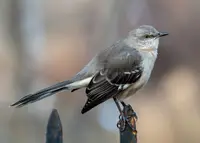
The apple blossom came first, in 1901, after a contest among women’s groups organized by the Arkansas Floral Emblem Society. One campaigner, Love Barton of Searcy, is said to have brought a bushel of polished apples into the Senate chamber to make her case. The mockingbird followed in 1929, pushed by the Arkansas Federation of Women’s Clubs, and the pine in 1939, praised in its resolution as one of the state’s great renewable sources of wealth.
Rocks, gems and the 1967 swap
In 1967 one act named the diamond the state gem, quartz crystal the state mineral and bauxite the state rock, partly so that rock clubs could trade official specimens with clubs in other states. All three tell a piece of Arkansas history. The diamonds come from the volcanic pipe at Crater of Diamonds State Park. Arkansas quartz became a war material in World War II, when it was needed for radio oscillators. And Arkansas supplied about 90 percent of the bauxite mined in the United States for most of the 20th century.
The outdoors
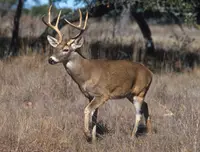
Many recent symbols come from hunting and fishing country. The white-tailed deer became the state mammal in 1993, a reminder of a comeback: by the mid-1930s only a few hundred deer were left in Arkansas, and restocking had rebuilt the herd to roughly a million by 2008. The alligator gar, a fish that can top eight feet and 240 pounds, became the state’s official “primitive fish” in 2019, after the legislature noticed that Arkansas was one of only five states without an official fish. The shotgun, the main tool of duck hunting, became the official state firearm the same year, and the Bowie knife, once known as the “Arkansas toothpick,” the official state knife.
In 2025 the legislature completed the set. It named the mallard, the most numerous duck in Arkansas, as the official state duck, and a few weeks later the Labrador retriever as the official state canine. The sponsor argued that a state with an official duck needed a dog to retrieve it. Arkansas was the first state to choose the Labrador.
Food, music and a locomotive
Arkansas is the country’s leading rice-producing state, and rice became the official state grain in 2007. Milk is the state beverage and the Cynthiana grape the state grape. The fiddle is the state instrument, linked to the old tune “The Arkansas Traveler,” which is also the state historic song. The Dutch oven is the official historic cooking vessel, because it was in use when Arkansas joined the Louisiana Purchase. In 2021 Arkansas even adopted an official steam locomotive: Cotton Belt No. 819, built in Pine Bluff in 1943 and the last steam locomotive built in the state, now kept at the Arkansas Railroad Museum.
The main symbols
The flag, the mockingbird and the apple blossom each have their own page. The state anthem, Eva Ware Barnett’s “Arkansas,” was published in 1916 and is old enough to be in the public domain.
Flag, seal, song, motto and nickname
-
 1913
Flag of Arkansas
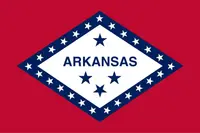
FlagA red field with a white diamond edged by a blue band holding 25 white stars, since Arkansas was the 25th state; the diamond stands for the state's diamond deposits. Inside the diamond, "ARKANSAS" appears with one blue star above and three below; the three stars recall France, Spain and the United States, and the star above was added in 1923 for the Confederacy.
A.C.A. § 1-4-101 (design adopted by the General Assembly in 1913; fourth star added 1923; star arrangement fixed in 1924)
- 1864
Great Seal of Arkansas
SealAn eagle holding a Regnat Populus scroll, arrows and an olive branch, with a shield on its breast showing a steamboat, beehive, plow and sheaf of wheat. The Goddess of Liberty stands above inside a circle of stars and rays, an angel marked "Mercy" is on the left and a sword marked "Justice" on the right, all within the words "Seal of the State of Arkansas."
A.C.A. § 1-4-108 (design dates from 1864; motto corrected in 1907)
- 1917
Arkansas (state anthem)
SongWritten in 1916. The lyrics are in the public domain. Official page.
Designated state song by the 1917 General Assembly; restored by 1963 resolution; named official state anthem in 1987; A.C.A. § 1-4-116
- 1907
Regnat Populus
MottoLatin, meaning “The people rule”.
Act of 1907 (approved May 24, 1907) amending the seal's motto from "Regnant Populi"; now A.C.A. § 1-4-107
- 1995
The Natural State
NicknameThe state parks system began promoting the phrase in the mid-1980s; Act 1352 of 1995 made it official, citing the state's scenery, lakes, rivers, forests and wildlife.
Animals
-
 1929
Mockingbird
BirdMimus polyglottosThe Arkansas Federation of Women's Clubs led the push for the mockingbird, in a campaign directed by Mrs. W. A. Utley. Legislators reportedly treated the proposal as a joke at first, but it passed after speeches stressing the bird's usefulness to farmers. Florida, Mississippi, Tennessee and Texas share the same state bird.
House Concurrent Resolution No. 22 (1929); now A.C.A. § 1-4-118 · Encyclopedia of Arkansas (Central Arkansas Library System)
-
 1993
White-tailed deer
MammalOdocoileus virginianusRep. Arthur F. Carter sponsored the bill, which Gov. Jim Guy Tucker signed. Deer had dwindled to a few hundred animals in Arkansas by the mid-1930s; restocking by the Game and Fish Commission rebuilt the herd to roughly a million by 2008.
Act 892 of 1993 (HB 2110); A.C.A. § 1-4-122 · Arkansas State Legislature
-
 1973
Honeybee
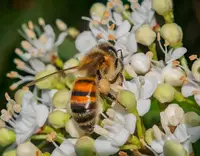
InsectApis melliferaRep. Albert "Tom" Collier of Jackson County sponsored the act, which praised the bee as a diligent worker typical of the state's best citizens, as well as noting its role in pollination.
Act 49 of 1973; now A.C.A. § 1-4-110 · Encyclopedia of Arkansas (Central Arkansas Library System)
- 2007
Diana fritillary
ButterflyArgynnis dianaRep. John Paul Wells of Logan County sponsored the bill, citing the butterfly's beauty, educational value and tourism appeal. Arkansas is the only state with the Diana fritillary as its butterfly; the act expressly grants the species no protected status.
Act 156 of 2007 (HB 1005); A.C.A. § 1-4-126 · Arkansas State Legislature
-
 2019
Alligator gar (official primitive fish)
FishAtractosteus spatulaThe act's findings note that Arkansas was one of only five states without an official fish and that alligator gar there can top eight feet and 240 pounds. Its legal title is the official "primitive fish"; the act grants the species no protected status.
Act 576 of 2019 (HB 1640); A.C.A. § 1-4-137 · Arkansas State Legislature
- 2025
Labrador retriever (official canine)
DogCanis familiarisRep. Shad Pearce of Batesville sponsored the bill, arguing that a state with an official duck needed a dog to retrieve it. Arkansas was the first state to pick the Labrador as its state dog.
Act 823 of 2025 (HB 1886); A.C.A. § 1-4-142 · Arkansas State Legislature
- 2025
Mallard
DuckAnas platyrhynchosThe mallard is the most numerous duck in Arkansas and the backbone of its waterfowl-hunting economy; a 2023 bill to replace the mockingbird with the mallard as state bird went nowhere. The act grants the mallard no protected status.
Act 215 of 2025; A.C.A. § 1-4-141 · Arkansas State Legislature
Plants and fungi
-
 1901
Apple blossom
FlowerMalus coronariaIn 1900 the Arkansas Floral Emblem Society polled women's groups; holly, honeysuckle, passionflower, the cotton boll and apple blossom were all in contention. Love Barton of the Searcy chapter championed the apple blossom, pointing to the state's prize-winning apple crop, and is said to have brought a bushel of polished apples to the Senate chamber on January 30, 1901. Arkansas was the second state, after Michigan, to choose the apple blossom.
Resolution of the 1901 General Assembly, signed by Gov. Jeff Davis; now A.C.A. § 1-4-109 · Encyclopedia of Arkansas (Central Arkansas Library System)
- 1939
Pine
TreeRep. Boyd Tackett of Pike County introduced the resolution, citing timber as one of the state's greatest and renewable sources of wealth; it passed without opposition on January 20, 1939. The resolution names no particular species; the shortleaf pine (Pinus echinata) and loblolly pine (Pinus taeda) are the ones usually mentioned.
House Concurrent Resolution No. 2 (1939); now A.C.A. § 1-4-119 · Encyclopedia of Arkansas (Central Arkansas Library System)
Earth and sky
- 1967
Diamond
GemstoneAn omnibus act signed by Gov. Winthrop Rockefeller named the state gem, mineral and rock together, partly so rock clubs could trade official specimens with other states. Diamonds come from the Prairie Creek volcanic pipe near Murfreesboro, now Crater of Diamonds State Park, where visitors may dig for them.
Act 128 of 1967 (SB 143); now A.C.A. § 1-4-111 · Encyclopedia of Arkansas (Central Arkansas Library System)
- 1967
Quartz crystal
MineralQuartz crystals are mined from a belt in the central Ouachita Mountains running from near Little Rock toward Oklahoma. Demand for oscillator crystals made Arkansas quartz a war material during World War II.
Act 128 of 1967 (SB 143); now A.C.A. § 1-4-111 · Encyclopedia of Arkansas (Central Arkansas Library System)
- 1967
Bauxite
RockBauxite is the main ore of aluminum; for most of the twentieth century Arkansas supplied about ninety percent of the bauxite mined in the United States, and the Saline County town of Bauxite was named for it.
Act 128 of 1967 (SB 143); now A.C.A. § 1-4-111 · Encyclopedia of Arkansas (Central Arkansas Library System)
- 1997
Stuttgart soil series
SoilRep. Wanda Northcutt sponsored the act; the soil covers roughly 200,000 acres of east and southeast Arkansas and its slow-draining clay subsoil suits rice farming.
Act 890 of 1997 (HB 1885); now A.C.A. § 1-4-124 · Arkansas State Legislature
- 2017
Arkansaurus fridayi
DinosaurJoe B. Friday found the foot bones of this small two-legged theropod in a gravel pit on his land near Lockesburg (Sevier County) in August 1972. High school student Mason Cypress Oury suggested the designation to Rep. Greg Leding, who sponsored the resolution. The bones are the only dinosaur bones known from Arkansas; the species was formally described in 2018.
House Concurrent Resolution 1003 of 2017 · Arkansas State Legislature
Food and drink
- 1987
South Arkansas Vine Ripe Pink Tomato
FruitSolanum lycopersicumThe act names the tomato both state fruit and state vegetable, reasoning that it is botanically a fruit but eaten as a vegetable. Rep. John Lipton, whose district included tomato-growing Bradley County, sponsored it; Warren holds a Pink Tomato Festival each June.
Act 255 of 1987 (HB 1480); now A.C.A. § 1-4-115 · Arkansas State Legislature
- 1987
South Arkansas Vine Ripe Pink Tomato
VegetableSolanum lycopersicumThe same 1987 act made the pink tomato the official state vegetable as well as the state fruit.
Act 255 of 1987 (HB 1480); now A.C.A. § 1-4-115 · Arkansas State Legislature
-
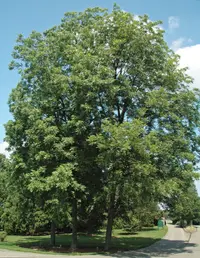 2009
Pecan
NutCarya illinoinensisRep. Larry Cowling of Little River County sponsored the bill, which had twenty-two co-sponsors; the act states that the pecan gets no protected status, so it may still be harvested and eaten.
Act 638 of 2009 (HB 1906); A.C.A. § 1-4-130 · Arkansas State Legislature
- 1985
Milk
BeverageRep. Bobby Glover sponsored the measure, which passed without opposition and took effect June 28, 1985; supporters cited milk's health benefits and the state's dairy industry.
Act 998 of 1985; now A.C.A. § 1-4-112 · Encyclopedia of Arkansas (Central Arkansas Library System)
- 2007
Rice
GrainOryza sativaRep. Bruce Maloch of Magnolia sponsored the act; Arkansas is the country's leading rice-producing state.
Act 513 of 2007 (HB 2434); A.C.A. § 1-4-127 · Arkansas State Legislature
- 2009
Cynthiana grape
GrapeVitis aestivalisReps. Beverly Pyle and Kathy Webb sponsored the bill at the suggestion of Audrey House of Chateau Aux Arc vineyards in Franklin County. The Cynthiana is nearly identical to the Norton grape, which Missouri adopted as its state grape in 2003.
Act 547 of 2009 (HB 2193); A.C.A. § 1-4-129 · Arkansas State Legislature
Songs, words and language
- 1987
"Arkansas (You Run Deep in Me)" by Wayland Holyfield
State songArkansas Power and Light commissioned Holyfield, a Nashville songwriter from Mallettown, to write it for the 1986 sesquicentennial.
1987 General Assembly; A.C.A. § 1-4-116 · Arkansas Secretary of State
- 1987
"Oh, Arkansas" by Terry Rose and Gary Klaff
State songThe song was widely performed during the 1986 sesquicentennial by Little Rock musician Terry Rose.
1987 General Assembly; A.C.A. § 1-4-116 · Arkansas Secretary of State
- 1987
"The Arkansas Traveler"
Historic songThe fiddle tune dates from the mid-1800s and its composer is uncertain: it is often linked to Sandford (Sandy) Faulkner, whose Arkansas Traveler story dates to about 1840, but it has also been credited to Cincinnati violinist Jose Tosso and others. The words were written by the state song selection committee in 1947. It served as the de facto state song from 1949 to 1963 while Eva Ware Barnett's "Arkansas" was set aside during a copyright dispute.
1987 General Assembly; A.C.A. § 1-4-116 · Arkansas Secretary of State
- —
English
Official languageEnglish is the official language of Arkansas under section 1-4-117 of the Arkansas Code.
- 1972
Arkansas Creed
CreedNone of the 91 entries in a public contest satisfied the commission, so state historian John Ferguson wrote a creed combining the best parts of several entries. Gov. Dale Bumpers unveiled it on August 1, 1972.
House Concurrent Resolution 2 of 1969 (created the Creed Commission); text adopted by the commission April 26, 1972 · Encyclopedia of Arkansas (Central Arkansas Library System)
Culture and history
- 1991
Square dance (official American folk dance)
DanceSen. Jack Gibson sponsored the measure, signed by Gov. Bill Clinton; it was part of a nationwide push by club square dancers after a 1988 bid for national folk dance status failed. The act defines square dancing broadly enough to include clogging, contra and line dancing.
Act 93 of 1991; now A.C.A. § 1-4-120 · Arkansas State Legislature
- 1985
Fiddle
InstrumentRep. Bob Watts of Harrison sponsored the bill, describing the fiddle as the instrument of Arkansas's pioneer families; the state's link to the fiddle runs through the tale and tune "The Arkansas Traveler."
Act 277 of 1985 (HB 749); now A.C.A. § 1-4-113 · Encyclopedia of Arkansas (Central Arkansas Library System)
- 2019
Shotgun
FirearmSen. Trent Garner sponsored the act, which notes that the shotgun is the main tool of waterfowl hunting and was in use in Arkansas before statehood.
Act 685 of 2019 (SB 6); A.C.A. § 1-4-138 · Arkansas State Legislature
- 2001
Dutch oven
Historic cooking vesselSen. Joseph K. Mahony II sponsored the bill, noting that Dutch ovens were in use when Arkansas joined the Louisiana Purchase in 1803 and at statehood in 1836.
Act 476 of 2001 (SB 402); now A.C.A. § 1-4-125 · Arkansas State Legislature
- 2019
Bowie knife
KnifeThe act's findings say the Bowie knife was known as the "Arkansas Toothpick" as early as 1835 and is the state's most famous weapon.
Act 510 of 2019 (SB 5); A.C.A. § 1-4-136 · Arkansas State Legislature
- 2021
St. Louis Southwestern (Cotton Belt) No. 819
Steam locomotiveEngine 819, a class L1 4-8-4 "Northern," was built at the Cotton Belt shops in Pine Bluff and entered service on February 8, 1943; it was the last steam locomotive built in Arkansas. It ran more than 804,000 miles before retirement in 1953, was restored to operation in 1986 (the restoration group formed in 1983), and is kept at the Arkansas Railroad Museum in Pine Bluff.
Act 405 of 2021 (HB 1657); A.C.A. § 1-4-140 · Arkansas State Legislature
Questions about Arkansas's symbols
- What is the Arkansas state animal?
- Arkansas's state mammal is the white-tailed deer, adopted in 1993. The state also has an official duck (the mallard) and an official canine (the Labrador retriever), both from 2025.
- Is the tomato a fruit or a vegetable in Arkansas?
- Both. A 1987 law made the South Arkansas Vine Ripe Pink Tomato the official state fruit and the official state vegetable, because it is botanically a fruit but eaten as a vegetable.
- How many state songs does Arkansas have?
- Four: the state anthem, "Arkansas," by Eva Ware Barnett; two state songs, "Arkansas (You Run Deep in Me)" and "Oh, Arkansas"; and the state historic song, "The Arkansas Traveler."
- What is the Arkansas state dinosaur?
- Arkansaurus fridayi, a small two-legged meat-eater known from foot bones found near Lockesburg in 1972. They are the only dinosaur bones ever found in Arkansas.
Photo credits (7)
- Flag of Arkansas: Unknown author, Public domain, via Wikimedia Commons
- Mockingbird: Rhododendrites, CC BY-SA 4.0, via Wikimedia Commons
- Apple blossom: Billpowellisalive, CC BY-SA 3.0, via Wikimedia Commons
- White-tailed deer: USDA photo by Scott Bauer, Public domain, via Wikimedia Commons
- Honeybee: Didier Descouens, CC BY-SA 4.0, via Wikimedia Commons
- Pecan: James St. John, CC BY 2.0, via Wikimedia Commons
- Alligator gar: Greg Hume, CC BY-SA 3.0, via Wikimedia Commons
Something out of date? Tell us and we will check it against the law.
Sources
- History of the Arkansas State Flag Arkansas Secretary of State
- Arkansas State Seal Arkansas Secretary of State
- Official State Songs Encyclopedia of Arkansas (Central Arkansas Library System)
- Arkansas Code, Title 1, Chapter 4 (state symbols) Justia (text of the Arkansas Code)