Mockingbird, the state bird of Arkansas
The state bird of Arkansas is the mockingbird, the northern mockingbird, adopted in 1929. It is a slim gray songbird famous for its endless song, much of it copied from other birds, and it lives in yards, parks and farm edges across Arkansas all year. Florida, Mississippi, Tennessee and Texas chose the same bird.
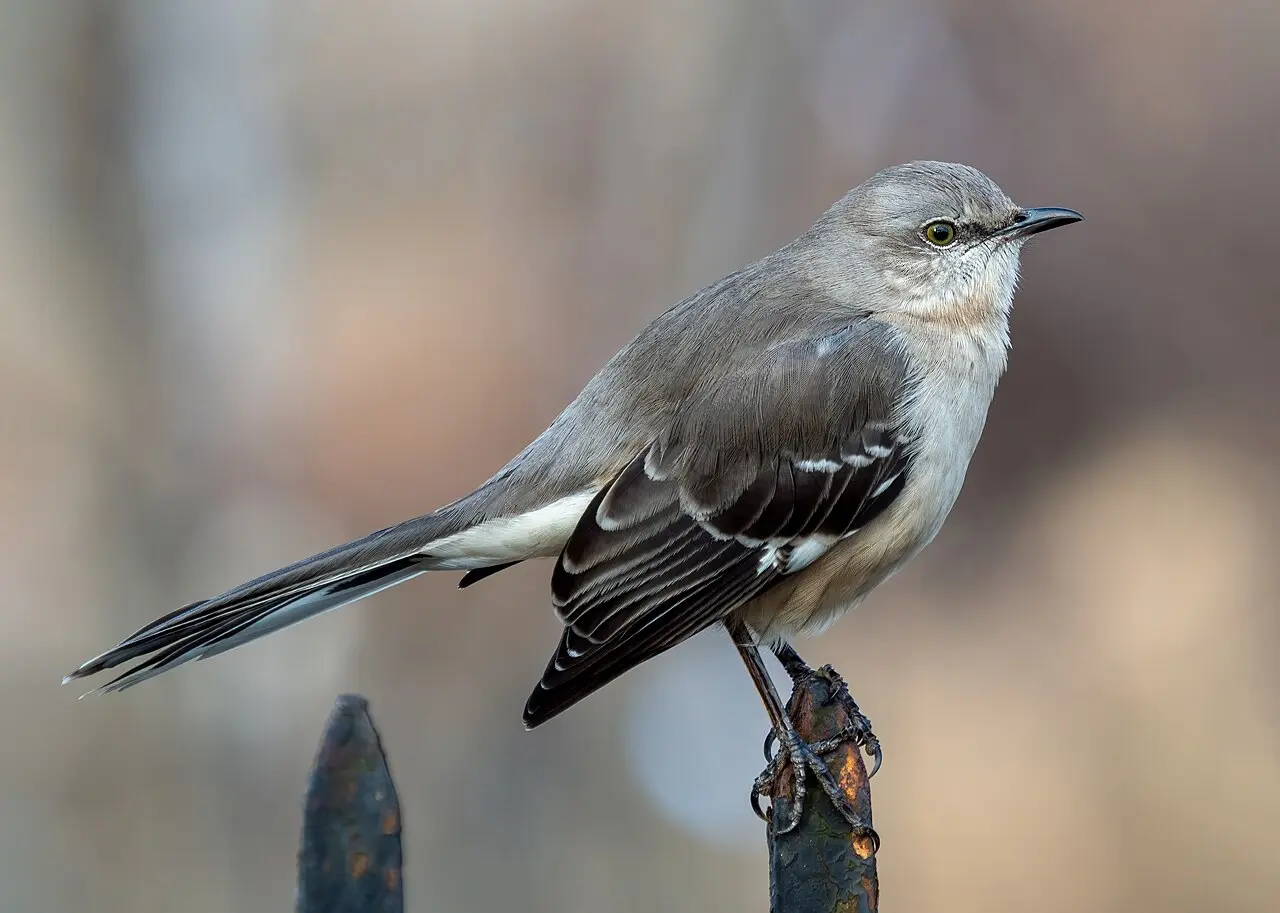
How to recognize it
The mockingbird is a slim, long-tailed songbird about eight to ten inches long, plain gray above and paler below. Its giveaway is the flash of white: large white patches on its dark wings and white outer feathers on its long tail, both easiest to see when it flies. Males and females look alike. Young birds have dark streaks on the chest.
You are likely to hear one before you see it. A mockingbird sings long runs of varied phrases, repeating each one three or more times before moving to the next, and many of the phrases are copied from other birds. Its scientific name, Mimus polyglottos, means “many-tongued mimic.” It often sings at night, especially in spring. Its call note is a harsh chack.
How it lives
Mockingbirds eat about half insects and half fruit, depending on the season: insects and other small creatures in spring and summer, berries and wild fruit in fall and winter. They hunt on the ground, and they have a curious habit of pausing to half-open their wings and flash the white patches, a behavior that may startle insects into moving.
They are fierce defenders of their nests. Mockingbirds will dive at cats, dogs, hawks and even people who come too close during nesting season.
Where to see one in Arkansas
The mockingbird lives in Arkansas all year and is common throughout the state. Look in yards, parks, farm edges and along roadsides with thick shrubs next to open ground. Singing males like high, open perches: utility wires, rooftops, chimneys and the tops of trees.
A common bird
The northern mockingbird is not of conservation concern. Audubon estimates the population at about 43 million birds, and it lives across much of the United States and Mexico.
Chosen in 1929
Arkansas’s state bird was the project of the Arkansas Federation of Women’s Clubs, in a campaign led by Mrs. W. A. Utley. When the proposal reached the legislature in 1929, some lawmakers reportedly treated it as a joke. It passed after supporters gave speeches about how useful the mockingbird was to farmers. House Concurrent Resolution No. 22, adopted on March 5, 1929, made it official. A 2023 bill to replace the mockingbird with the mallard, the duck so important to Arkansas hunters, went nowhere; the mallard got its own title as state duck in 2025 instead.
Questions about the Arkansas state bird
- What is the state bird of Arkansas?
- The northern mockingbird (Mimus polyglottos), adopted in 1929 by House Concurrent Resolution No. 22.
- Which other states have the mockingbird as state bird?
- Florida, Mississippi, Tennessee and Texas. With Arkansas, that makes five states, the third most popular state bird after the cardinal and the western meadowlark.
- Why do mockingbirds sing at night?
- Unmated males often sing at night, especially in spring and early summer, and around bright lights. Their song advertises their territory and attracts a mate.
- Do mockingbirds really copy other birds?
- Yes. A mockingbird's song is a long string of phrases, each repeated three or more times, many of them imitations of other birds and sometimes of other sounds.
Sources
- Northern Mockingbird National Audubon Society
- Official State Bird CALS Encyclopedia of Arkansas