Scissor-tailed flycatcher, the state bird of Oklahoma
The state bird of Oklahoma is the scissor-tailed flycatcher, adopted in 1951. It is a pale gray bird with salmon-pink sides and a forked black-and-white tail that can reach about nine inches, longer than its body. It breeds only in the southern Great Plains, and from April to October it is a common sight on roadside wires and fences across Oklahoma.
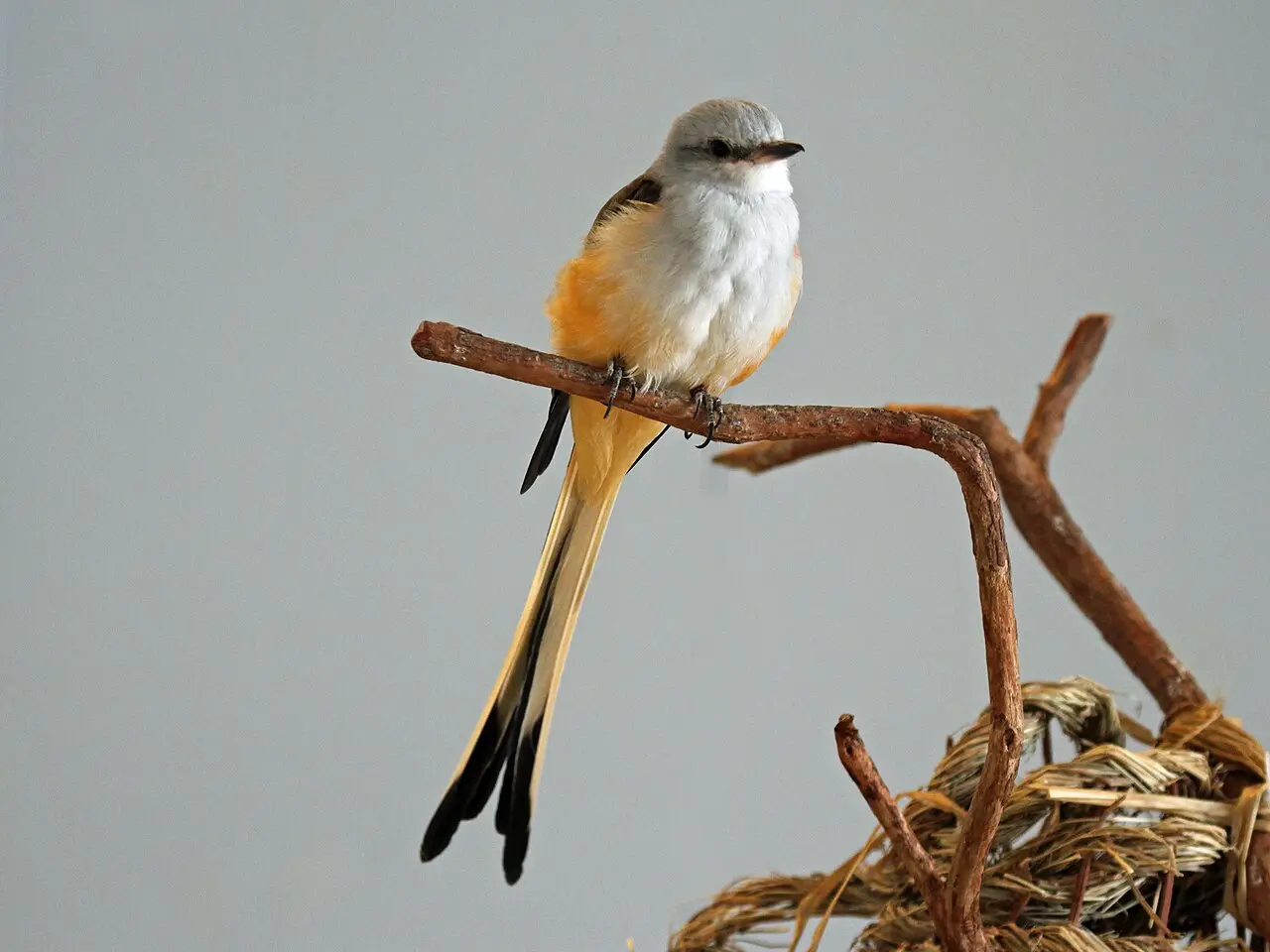
How to recognize it
The scissor-tailed flycatcher is about 14 to 15 inches long, but much of that is tail: the long, forked tail can reach about 9 inches. Its head and back are pale pearl-gray, its breast whitish, its wings dark and sooty, and its sides and underwings salmon pink, with a touch of red at the shoulder. Males and females look alike, though the female’s tail streamers are a little shorter. Young birds have short tails and can be mistaken for western kingbirds.
In flight the bird opens and closes its long black-and-white tail like a pair of scissors; when it perches, the tail is folded. Its calls are harsh, repeated kee or ka-kee notes and chattering sounds, which males give during a climbing, zigzag courtship “sky dance.”
How it lives
Scissor-tails hunt from exposed perches such as wires and fences, darting out to snatch insects in the air. Grasshoppers and crickets can make up more than half their diet, along with beetles, bees, wasps, spiders and some berries. In the evening they gather in communal roosts that can hold from about 100 to more than 1,000 birds, and some roost sites are used for more than 20 years.
The species breeds only in the southern Great Plains, from Nebraska to southern Texas and from New Mexico to Louisiana, in open grassland, ranch and farm country with scattered trees. It winters in Central and South America, though small numbers regularly spend the winter in southern Florida.
Where to see one in Oklahoma
Scissor-tails are common across Oklahoma from early April to late October, and occasionally from late March to mid-November. Look for them perched on roadside power lines, fences and flagpoles in open prairie, ranch country and small towns.
Doing well
The scissor-tailed flycatcher is a species of least concern, with a population of about 9.1 million. Audubon notes that it has gained in some areas from the planting of shelterbelts but declined in others in recent decades.
The state bird since 1951
The Legislature named the scissor-tailed flycatcher Oklahoma’s state bird in 1951; the law uses its older scientific name, Muscivora forficata. It is also one of the symbols named in “Oklahoma, My Native Land,” the official state children’s song.
Questions about the Oklahoma state bird
- What is the state bird of Oklahoma?
- The scissor-tailed flycatcher (Tyrannus forficatus), adopted in 1951.
- When can you see scissor-tailed flycatchers in Oklahoma?
- From early April to late October, and occasionally from late March to mid-November. They winter in Central and South America.
- How long is a scissor-tail's tail?
- Up to about 9 inches, on a bird about 14 to 15 inches long in all.
- What do scissor-tailed flycatchers eat?
- Mostly insects caught in the air from a perch. Grasshoppers and crickets can make up more than half the diet, along with beetles, bees, wasps, spiders and some berries.
Sources
- Scissor-tailed Flycatcher National Audubon Society
- Scissor-tailed Flycatcher (field guide) Oklahoma Department of Wildlife Conservation
- Oklahoma Symbols Oklahoma Historical Society
- Oklahoma Statutes, Title 25 Oklahoma Legislature