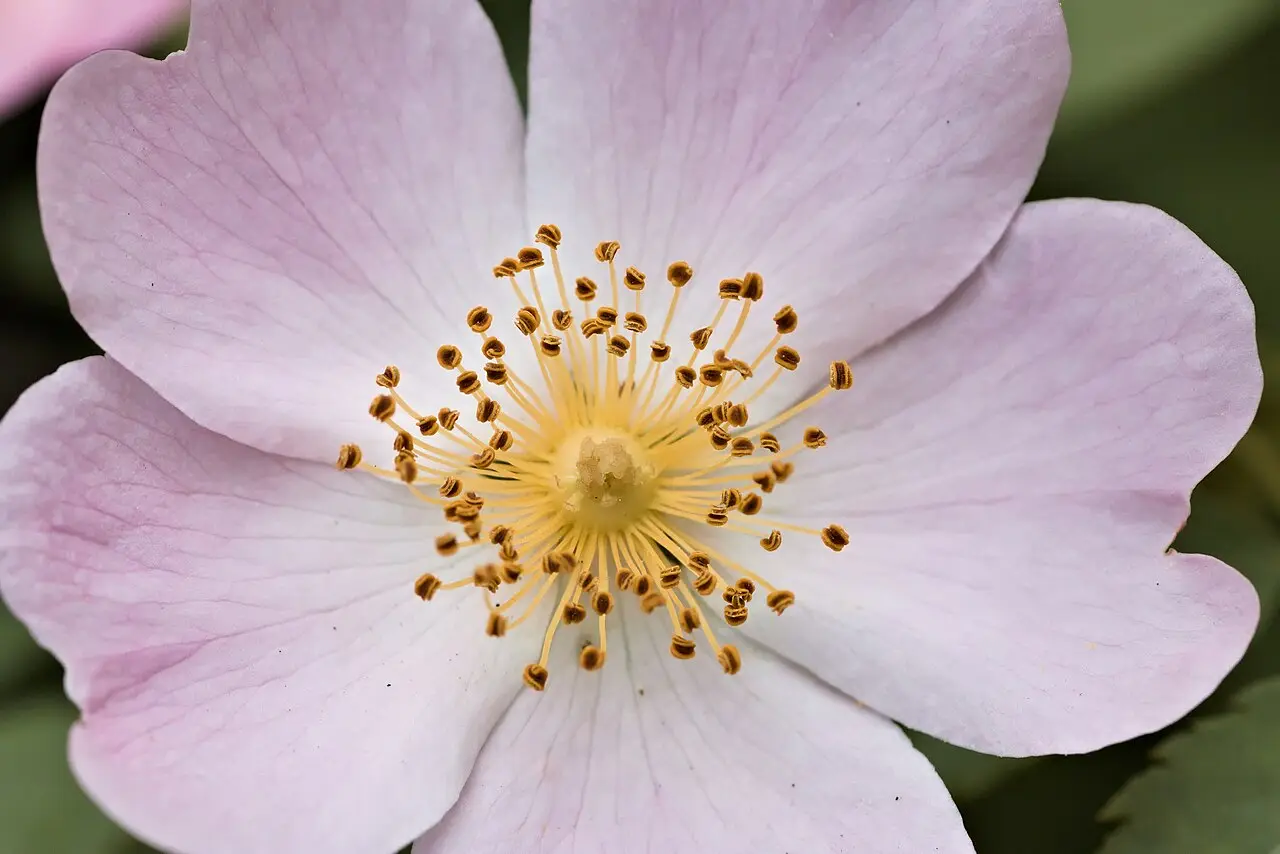
Wild prairie rose, the state flower of North Dakota
The state flower of North Dakota is the wild prairie rose, adopted in 1907. The law covers two native species, the smooth rose and the prairie rose, both with five broad pink petals around a cluster of yellow stamens. They bloom in June and July along roadsides, in pastures and on the prairie throughout the state. The rose's pink and green had already become the University of North Dakota's school colors in 1889.
How to recognize it
Both of North Dakota’s wild roses bear flowers with five broad, rounded pink petals around a cluster of yellow stamens, and both produce round hips about half an inch across that turn bright red by late summer.
- Smooth rose (Rosa blanda) is the taller, a shrub about 4 to 7 feet high. Its new stems have no prickles, though older stems develop a few bristles near the base. Its leaves usually have five to nine leaflets, and its flowers are 2 to 3 inches across, pink to deep rose.
- Prairie rose (Rosa arkansana) is a low plant, often only about a foot tall, with densely bristly stems and nine to eleven leaflets per leaf. Its flowers, about 1.5 to 2 inches across, range from nearly white to deep pink and are often two-toned.
Two roses in one law
North Dakota’s law names the state flower as the wild prairie rose, “rosa blanda or arkansana,” so both species are covered.
Where it grows
Both roses are native to the lower 48 states and Canada, and the State Historical Society notes that the wild prairie rose grows along roadsides and in pastures throughout North Dakota.
Where to see it
Watch roadsides, pastures, prairie and woodland edges anywhere in the state in June and July. The low prairie rose favors open, often sandy prairie, while the taller smooth rose also grows along thickets, fence rows and lakeshores. Come back in late summer for the red hips.
The state flower since 1907
The rose was a North Dakota emblem before it was official. The University of North Dakota’s first graduating class chose its pink and green as the school colors in 1889, the year of statehood, and the Legislature made the wild prairie rose the state flower in 1907.
Questions about the North Dakota state flower
- What is the state flower of North Dakota?
- The wild prairie rose, adopted in 1907. The law names two native species, Rosa blanda and Rosa arkansana.
- When does the wild prairie rose bloom?
- In June and July.
- Where does the wild prairie rose grow?
- Along roadsides and in pastures throughout North Dakota. The low prairie rose favors open, often sandy prairie, and the taller smooth rose also grows along thickets, fence rows and lakeshores.
- What are the University of North Dakota's colors?
- Pink and green, taken from the wild prairie rose by the university's first graduating class in 1889.
Sources
- Wild Prairie Rose State Historical Society of North Dakota
- Smooth wild rose Minnesota Wildflowers
- Prairie rose Minnesota Wildflowers
- North Dakota Century Code § 54-02-03 (state flower) North Dakota Legislative Branch
- Plant Profile: Rosa blanda Aiton (smooth rose) USDA PLANTS Database
- Plant Profile: Rosa arkansana Porter (prairie rose) USDA PLANTS Database