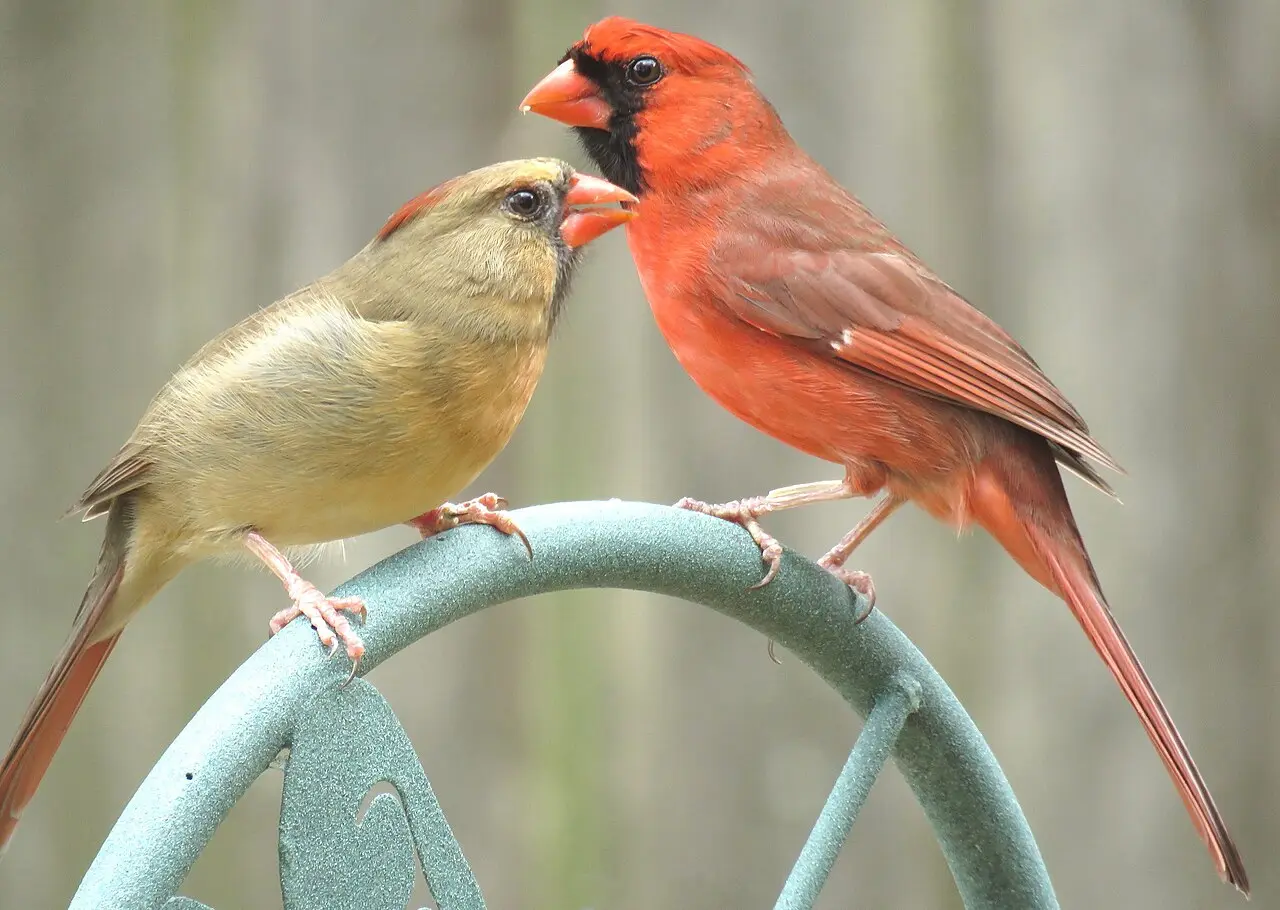
Northern cardinal, the state bird of North Carolina
The state bird of North Carolina is the northern cardinal, adopted in 1943 after a statewide poll by the North Carolina Bird Club. The male is bright red all year, with a black mask and a pointed crest; the female is warm brown with red tints. Cardinals do not migrate, so they can be seen across North Carolina in every season. Six other states share the cardinal as their state bird.
How to recognize it
The northern cardinal is a sturdy, long-tailed songbird about 8 to 9 inches long, a bit smaller than an American robin. The male is bright red all year, with a black mask around a short, very thick, cone-shaped reddish bill and a pointed crest; it is the only red bird with a crest in eastern North America. The female is warm brown to grayish, with reddish tints on the wings, tail and crest, and has the same crest, dark face and big pinkish bill. Young birds start out with dark bills.
Both males and females sing loud, clear whistled phrases. The usual call is a sharp, metallic chip.
How it lives
Cardinals feed largely on seeds, along with insects and their larvae, berries, wild fruit, buds and some sap, usually hopping on the ground or through low shrubs. Pairs stay together, and the female builds a cup nest hidden in dense shrubs or vines, often 3 to 10 feet off the ground. She may raise two or three broods a year.
Where to see one in North Carolina
Because cardinals do not migrate, they can be seen in North Carolina in every season, in backyards, town parks, hedgerows and brushy woodland edges. Sunflower seed draws them to feeders.
Doing well
The northern cardinal is a species of least concern. Audubon calls it widespread and abundant, with numbers probably stable after a long expansion of its range. Once mainly a southeastern bird, it has pushed north into southeastern Canada over the past century.
The state bird since 1943
North Carolina’s first state bird did not last. In 1933 the Legislature named the Carolina chickadee, then repealed the resolution about a week later, partly because lawmakers did not want the state’s bird known as the tomtit. A decade later the North Carolina Bird Club ran a statewide poll in which more than 23,000 votes were cast for 26 candidate birds. The cardinal led with about 5,000 votes, ahead of the dove with 3,395, and the Legislature made it the state bird on March 8, 1943. Six other states, Illinois, Indiana, Kentucky, Ohio, Virginia and West Virginia, have also chosen the cardinal.
Questions about the North Carolina state bird
- What is the state bird of North Carolina?
- The northern cardinal (Cardinalis cardinalis), adopted on March 8, 1943.
- Was the chickadee ever North Carolina's state bird?
- Briefly. In 1933 the Legislature named the Carolina chickadee the state bird, then repealed the resolution about a week later, partly because lawmakers disliked its nickname, the tomtit.
- Do cardinals stay in North Carolina all winter?
- Yes. Cardinals do not migrate and live in North Carolina year-round.
- Which other states have the cardinal as state bird?
- Illinois, Indiana, Kentucky, Ohio, Virginia and West Virginia.
Sources
- Northern Cardinal (identification) Cornell Lab of Ornithology (All About Birds)
- Northern Cardinal National Audubon Society
- State Bird of North Carolina NCpedia (State Library of North Carolina)