Sagebrush, the state flower of Nevada
The state flower of Nevada is sagebrush, the gray-green, strong-smelling shrub that covers much of the state and gives it the nickname the Sagebrush State. Its flowers are tiny and yellowish, blooming in late summer and fall, so it is an unusual choice for a state flower, but few plants say more about Nevada. Sprays of sagebrush also form the wreath on the state flag.
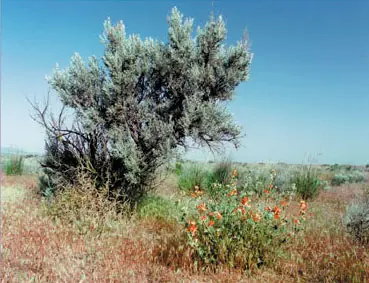
How to recognize it
Big sagebrush is a rounded, evergreen native shrub with a short, branching woody trunk. It is usually about 4 feet tall, but ranges from 2 feet on dry sites to as much as 15 feet on good ones. Its gray-green leaves are wedge- or fan-shaped, usually with three rounded lobes at the tip, and covered in fine silvery hairs. The whole plant smells strongly of sage, especially the leaves.
The flowers are easy to overlook. Tiny, yellowish, stalkless flower heads grow in clusters in late summer and fall. Buds form around June, and the seed ripens in the fall.
Which sagebrush?
Nevada’s law names the state flower as sagebrush, “Artemisia tridentata or trifida,” so it covers more than one plant. Artemisia tridentata is big sagebrush, which has several recognized subspecies. Artemisia trifida is an older name for threetip sagebrush, Artemisia tripartita. Both are native.
Where it grows
Big sagebrush is native to Canada and the lower 48 states. It grows throughout the western United States on most rangeland except meadows and high elevations, and it tolerates drought on well-drained, neutral to slightly alkaline soils.
Where to see it
Almost anywhere in Nevada’s open country. In Great Basin National Park it grows across a wide range of elevations, and its small yellow flowers appear in August.
Food and shelter
Sagebrush supports a whole community of wildlife. Sage grouse depend on it: its foliage and flower clusters can make up 70 to 75 percent of their diet, and the shrub gives them cover for nesting and escape. Pronghorn eat it all year, and mule deer eat a lot of it from late fall to spring. Cattle mostly avoid it, because of its bitter, resinous taste.
The state flower
Sagebrush has been written into Nevada law as the state flower since at least 1959, when it was added to the Nevada Revised Statutes; some sources date the choice to 1917. It also gives Nevada one of its nicknames, the Sagebrush State, and two crossed sprays of it form the wreath on the state flag.
Questions about the Nevada state flower
- What is the state flower of Nevada?
- Sagebrush. The law names Artemisia tridentata or trifida, that is, big sagebrush and threetip sagebrush.
- Does sagebrush have flowers?
- Yes, but they are tiny, yellowish, stalkless flower heads that grow in clusters in late summer and fall. In Great Basin National Park they appear in August.
- Why is Nevada called the Sagebrush State?
- Because sagebrush covers much of the state. It is also the state flower and appears on the state flag.
- What animals depend on sagebrush?
- Sage grouse rely on it most: its leaves and flower clusters can make up 70 to 75 percent of their diet, and it gives them cover for nesting and escape. Pronghorn eat it all year, and mule deer eat a lot of it from late fall to spring.
Sources
- Big sagebrush fact sheet USDA Natural Resources Conservation Service
- Trees and Shrubs National Park Service, Great Basin National Park
- NRS 235.050, State flower Nevada.Public.Law (reproducing NRS Chapter 235)
- USDA PLANTS profile: Artemisia tridentata (ARTR2) USDA NRCS PLANTS Database
- USDA PLANTS profile: Artemisia trifida (ARTR8, synonym of A. tripartita ssp. tripartita) USDA NRCS PLANTS Database