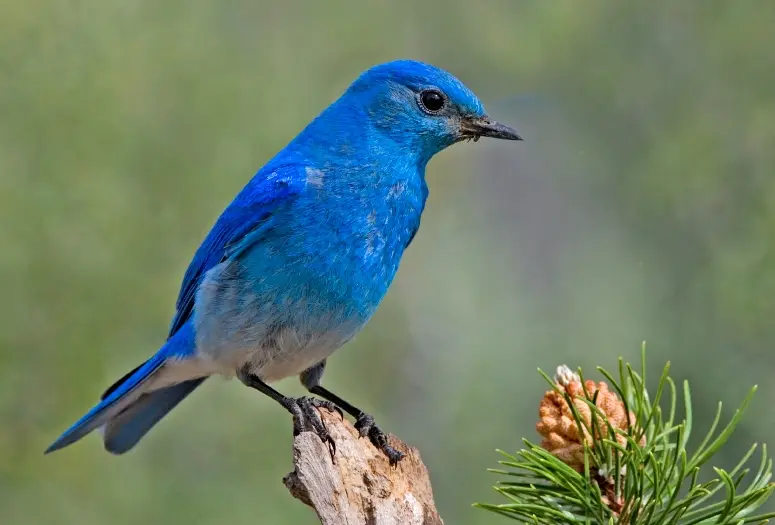
Mountain bluebird, the state bird of Nevada
The state bird of Nevada is the mountain bluebird, adopted in 1967. The male is sky-blue all over, paler below; the female is gray with blue in the wings and tail. In Nevada it nests high in the state's many mountain ranges, from about 5,000 to 12,000 feet. Idaho also has it as state bird.
How to recognize it
The mountain bluebird is a small thrush, about 6 to 8 inches long and weighing about an ounce. The male is sky-blue all over and slightly paler below, much lighter than other all-blue birds such as the indigo bunting. The female is gray, with blue tinges on the wings and tail and gray flanks against a white belly. Compared with the other bluebirds it has longer wings and tail, a round head and a thin, straight bill. Its call is a thin tew, and its song is made of soft, warbling notes.
How it lives
The mountain bluebird has a distinctive way of hunting: it often hovers low over open ground and then drops onto insects such as beetles, grasshoppers, caterpillars, crickets and ants. It also catches insects in flight from a low perch, and it eats berries such as juniper and mistletoe, especially in winter. It nests in tree cavities, old woodpecker holes, nest boxes or cliff crevices, often raises two broods a year, and gathers in large flocks in winter.
It is a bird of open country with scattered trees across the West, from prairie and sagebrush flats up to alpine areas above treeline. In winter it moves down to pinyon-juniper woods, grassland, desert and farm fields, ranging as far as its food supply takes it.
Where to see one in Nevada
In Nevada the mountain bluebird nests at about 5,000 to 12,000 feet in the state’s many mountain ranges. Look in meadows with scattered trees and perches rather than in thick forest. In winter, check lower pinyon-juniper woods, grassland and farm fields.
Doing well
The mountain bluebird is a species of least concern. Audubon puts the population at about 5.6 million and calls its numbers apparently stable. Because it often nests in remote places, it competes less than other bluebirds with starlings and other introduced birds for nest holes.
The state bird since 1967
The Legislature named the mountain bluebird Nevada’s state bird in 1967. Idaho had chosen it in 1931, and the two states still share it.
Questions about the Nevada state bird
- What is the state bird of Nevada?
- The mountain bluebird (Sialia currucoides), adopted in 1967.
- Where can I see mountain bluebirds in Nevada?
- In the state's mountain ranges, where they nest at about 5,000 to 12,000 feet. Look in meadows with scattered trees and perches rather than in thick forest.
- What do mountain bluebirds eat?
- Insects such as beetles, grasshoppers, caterpillars, crickets and ants, often caught by hovering and dropping to the ground, and berries such as juniper and mistletoe, especially in winter.
- Which other state has the mountain bluebird?
- Idaho, which chose it in 1931.
Sources
- Mountain Bluebird National Audubon Society
- Mountain Bluebird National Park Service
- Where the Wild Things Are Nevada Magazine
- NRS 235.060, State bird Nevada.Public.Law (reproducing NRS Chapter 235)
- Birds - Great Basin National Park U.S. National Park Service