Syringa, the state flower of Idaho
The state flower of Idaho is the syringa, also called Lewis' mock orange, a native shrub covered in fragrant white four-petaled flowers in early summer. It is named for Meriwether Lewis, who collected it on the Lewis and Clark expedition in 1806. It was Idaho's flower in practice long before the 1931 law: it already appears on the state seal designed in 1891.
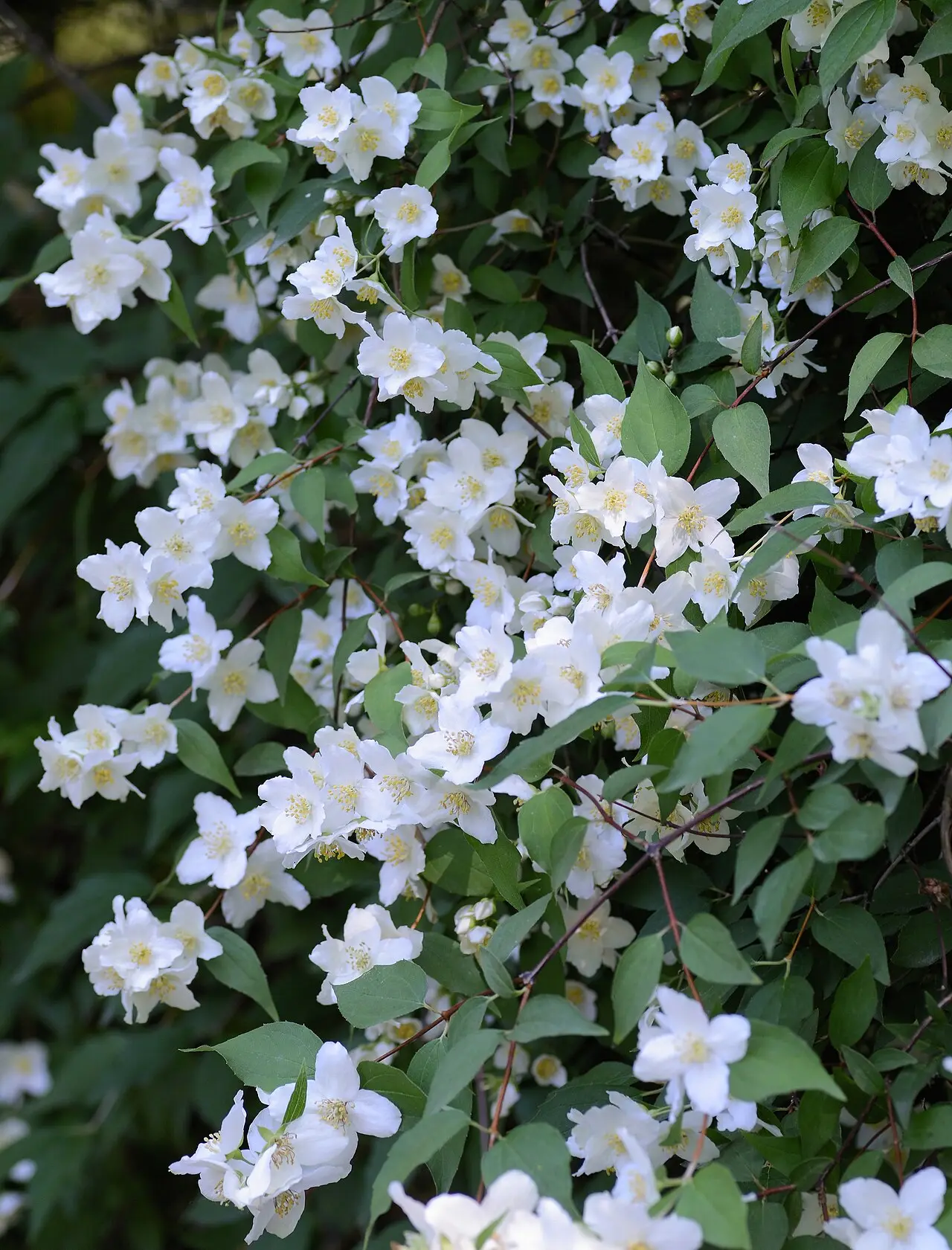
How to recognize it
The syringa is a deciduous shrub, upright to spreading, usually 3 to 10 feet tall. In late spring and early summer it is covered with white flowers about an inch across, each with four rounded petals around a cluster of yellow stamens, borne in clusters of 3 to 15. The flowers are fragrant, with a sweet scent that gives the “mock orange” its name: it smells a little like orange blossoms. The leaves are oval and simple, growing in opposite pairs along the stems.
A confusing name
Idaho’s syringa is not a lilac, although lilacs belong to a genus called Syringa. The common name “syringa” was long applied to mock oranges too, and it stuck in Idaho. Botanically, the state flower is Philadelphus lewisii, a mock orange.
Where it grows
The syringa is native to the Northwest: Idaho, Washington, Oregon, Montana and California, and to Alberta and British Columbia. It grows on well-drained sites with some moisture: rocky slopes, the foot of talus slopes and cliffs, stream banks and moist draws. In Idaho look for it on canyon slopes and rocky hillsides and along streams, especially in the north and central parts of the state, in late spring and early summer. It is also widely planted in gardens and hedges.
Named for Meriwether Lewis
The species is named for Meriwether Lewis, who collected specimens of the shrub in 1806 as the Lewis and Clark expedition passed through the Northwest on its return journey. Native Americans used its straight, strong stems to make arrows, bows, combs and pipes.
On the seal before the law
The syringa was Idaho’s flower in spirit well before it was in law. According to the Idaho State Historical Society, legislators had already agreed on it as the state flower when Emma Edwards Green designed the state seal in 1890 and 1891, and she painted it growing at the feet of the woman on the seal. The legislature gave it legal standing by an act approved on March 2, 1931, the same year it adopted the mountain bluebird as the state bird.
Questions about the Idaho state flower
- What is the state flower of Idaho?
- The syringa, or Lewis' mock orange (Philadelphus lewisii), made official by an act approved on March 2, 1931.
- Is Idaho's syringa the same as lilac?
- No. Lilacs belong to the genus Syringa, which confuses many people, but Idaho's syringa is a mock orange, Philadelphus lewisii, a different plant with white flowers.
- When does syringa bloom in Idaho?
- In late spring and early summer, roughly June into early July depending on elevation.
- Is syringa native to Idaho?
- Yes. It is native to Idaho, Washington, Oregon, Montana and California and to parts of western Canada.
Sources
- "Plant Guide: Lewis' Mock Orange, Philadelphus lewisii" USDA Natural Resources Conservation Service
- Philadelphus lewisii plant profile USDA PLANTS Database
- Idaho State Emblems (Reference Series No. 60) Idaho State Historical Society