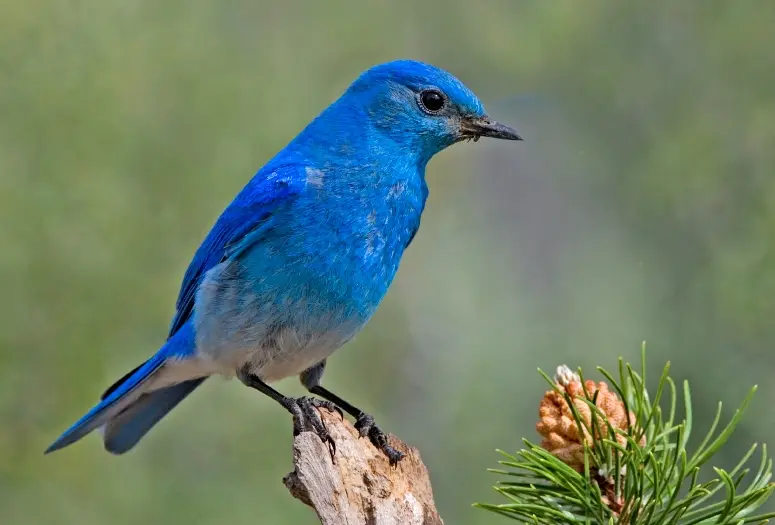
Mountain bluebird, the state bird of Idaho
The state bird of Idaho is the mountain bluebird, adopted in 1931. The male is sky blue all over, one of the most vivid birds in the West, and both sexes hunt by hovering over open ground before dropping onto insects. In Idaho it lives in high-desert and mountain country, usually above about 4,000 feet.
How to recognize it
The mountain bluebird is a small, slender thrush about six to eight inches long, with longer wings and a longer tail than other bluebirds. The male is unmistakable: sky blue all over, a little darker on the wings and tail and paler below, with white under the tail. Unlike the eastern and western bluebirds, he has no orange or rust on his breast. The female is mostly gray-brown, with pale blue tinges in her wings and tail and sometimes a faint orange-brown wash on her chest.
Watch how it hunts. A mountain bluebird often hovers low over open ground, fluttering in place like a small kestrel, before dropping onto an insect. Its song is a soft, quiet warble.
Where it lives
Mountain bluebirds breed across western North America in open country with scattered trees: prairie, sagebrush flats, mountain meadows, burned forests and alpine slopes as high as 12,500 feet. In winter they move to lower elevations and farther south, sometimes in large flocks.
How it lives
In summer mountain bluebirds eat mainly insects, such as beetles, grasshoppers and caterpillars. In winter they switch to berries, especially juniper berries, and seeds. They nest in cavities: old woodpecker holes in trees, crevices in rocks and, very often, nest boxes. The female chooses her mate partly by the quality of the nest cavity he holds.
Where to see one in Idaho
Idaho Fish and Game reports bluebirds throughout the state, in high-desert juniper and mountain mahogany country, forest meadows and mountain valleys and ridges, most commonly above about 4,000 feet. They return early in spring, and males are often scouting for nest sites by late March. Drive slowly along rural roads and watch fence posts, treetops and power lines, where males perch in the open.
Doing well
The mountain bluebird is not of conservation concern. Partners in Flight estimates the breeding population at about 5.6 million, and Breeding Bird Survey counts were fairly steady between 1966 and 2019. Nest boxes, put up by volunteers along “bluebird trails,” have helped where natural cavities are scarce.
The state bird since 1931
Idaho adopted the mountain bluebird by an act approved on February 28, 1931. The original law used an older scientific name, Sialia arctcia; a 2015 amendment updated it to Sialia currucoides. Nevada chose the same bird in 1967.
Questions about the Idaho state bird
- What is the state bird of Idaho?
- The mountain bluebird (Sialia currucoides), adopted on February 28, 1931.
- Which other state has the mountain bluebird as state bird?
- Nevada, which adopted it in 1967.
- When do mountain bluebirds return to Idaho?
- In early spring. Males are often scouting nest sites by late March.
- Do mountain bluebirds use nest boxes?
- Yes, very often. Nest boxes have helped the species where natural tree cavities are scarce.
Sources
- Mountain Bluebird National Audubon Society
- Mountain Bluebird overview Cornell Lab of Ornithology
- Bluebirds arriving in Idaho; nest boxes available Idaho Department of Fish and Game (archived)
- Idaho State Emblems (Reference Series No. 60) Idaho State Historical Society