West Virginia state symbols
West Virginia has 29 official state symbols, and almost all of them were adopted by legislative resolution rather than by statute. The oldest are the Great Seal and motto of 1863; the rhododendron, chosen by schoolchildren in 1903, is the oldest natural symbol. Public votes and school classes picked many of the rest, from the cardinal and the black bear to the timber rattlesnake and the northern red salamander.
Chosen by the public
West Virginia has a tradition of letting the people pick. In 1903 public school pupils voted for the rhododendron, which beat the honeysuckle and the wild rose by more than 15,000 votes and became the state flower. A 1949 resolution let schoolchildren and civic groups choose a state bird and tree by vote: the cardinal beat 10 other birds, including the robin and the bluebird, by more than 11,000 votes, and the sugar maple won as state tree. In a 1954-55 poll by the state’s natural resources agency, teachers, students and sportsmen picked the black bear, the only bear native to the state, though the Legislature did not adopt it until 1973. At the same time it named the brook trout, which sportsmen had chosen almost unanimously in another poll, the state fish.
Rocks, gems and fossils
West Virginia’s gem, adopted in 1990, is not a true gemstone but a silicified fossil coral, Lithostrotionella, turned to chalcedony, from seas of about 350 to 325 million years ago, found in Greenbrier and Pocahontas counties. Monongahela silt loam, covering more than 100,000 acres in 42 counties, became the state soil in 1997. A petition by a Mingo County high school student led to bituminous coal becoming the state rock in 2009; the resolution traces the state’s coal back to John Peter Salley, who found it in 1742 and named the Coal River.
In 2008 the Legislature named the state fossil: Jefferson’s ground sloth, whose bones Thomas Jefferson described in 1797 from a limestone cave in what is now Monroe County. Caspar Wistar recognized them in 1799 as those of a giant ground sloth, and the species was named after Jefferson in 1822.
Animals by students
Eighth graders at Romney Middle School in Hampshire County were behind two symbols: the timber rattlesnake, named the state reptile in 2008, the first state to choose it, and the northern red salamander, named the state amphibian in 2015, whose resolution compares its red to fall maple leaves and to the red bandanas of the Mine Wars. The monarch became the state butterfly in 1995, and the honey bee, chosen over the lady beetle after long debate, the state insect in 2002.
Apples and colors
The Golden Delicious apple, which the 1995 resolution credits Anderson Mullins with finding in Clay County in 1905, replaced the plain apple as state fruit. Old gold and blue became the state colors in the centennial year of 1963, and the state tartan, adopted in 2008, is based on an old shawl found at the Daughters of the American Revolution museum in Barboursville, with each color standing for something in the state, from the cardinal to coal.
History and culture
The Hall Model 1819 flintlock rifle, made at Harpers Ferry and described in its resolution as the first breech-loading rifle adopted by any nation’s military, became the state firearm in 2013. The Shay No. 5 at Cass Scenic Railroad State Park, built in 1905, is the state steam locomotive. Other official titles go to the Greenbrier Valley Theatre, the River City Youth Ballet Ensemble, the Beckley Exhibition Coal Mine and the Grafton Memorial Day Parade.
Flag, seal, song, motto and nickname
-
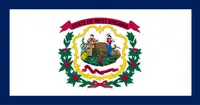 1929
A white field bordered in blue on all four sides, with the state coat of arms in the center. A ribbon reading "State of West Virginia" is above the arms and a wreath of rhododendron is below. Parade flags get gold fringe on three sides.
Senate Joint Resolution No. 18 (1929)
- 1863
Great Seal of West Virginia
SealA farmer and a miner stand on either side of a large ivy-draped rock bearing the admission date, June 20, 1863. In front of the rock, two crossed hunting rifles hold up a Phrygian cap of liberty, and the seal carries the motto Montani Semper Liberi. Joseph H. Diss Debar of Doddridge County drew it.
Joseph H. Diss Debar of Doddridge County drew the seal, adopted on September 26, 1863. The secretary of state reads its symbols this way: the rock stands for strength, the farmer for agriculture, the miner for industry, and the crossed rifles under a cap of liberty show that freedom was won by arms and will be defended. Using the seal requires the secretary of state's written permission.
Use restricted: The Secretary of State keeps the Great Seal, and using it requires the Secretary's permission under procedural rule W. Va. C.S.R. § 153-9 (Authorized Use of the Great Seal).
Adopted by the Legislature Sept. 26, 1863; W. Va. Const. art. II, § 7
- 1961
The West Virginia Hills
SongWritten in 1885. The lyrics are in the public domain. Official page.
West Virginia has four official songs of equal rank. "West Virginia, My Home Sweet Home" was adopted in 1947, but the designation was forgotten, so in 1961 the Legislature adopted "The West Virginia Hills," whose lyrics were published in 1885. In 1963 it made both official and added "This Is My West Virginia," the centennial song, and in 2014 it added John Denver's "Take Me Home, Country Roads."
Senate Concurrent Resolution No. 5 (1961); redesignated by House Concurrent Resolution No. 19 (1963)
- 1863
Montani Semper Liberi
MottoLatin, meaning “Mountaineers Are Always Free”.
Adopted with the Great Seal by the Legislature, Sept. 26, 1863; confirmed by W. Va. Const. art. II, § 7 (1872)
Animals
-
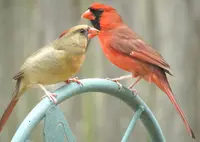 1949
Northern cardinal
BirdCardinalis cardinalisA 1949 resolution let public school pupils and civic groups choose a state bird and tree by vote. The cardinal beat 10 other birds, including the robin, tufted titmouse and bluebird, by more than 11,000 votes.
House Concurrent Resolution No. 12 (1949) · West Virginia Legislature
-
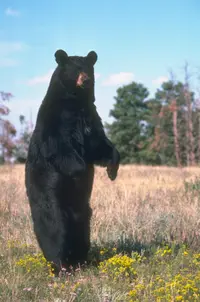 1973
Black bear (state animal)
MammalUrsus americanusTeachers, students and sportsmen chose it in a 1954-1955 poll run by the state's natural resources agency, but the Legislature did not adopt it until 1973. It is the only bear species native to West Virginia.
House Concurrent Resolution No. 6 (1973) · West Virginia Legislature
-
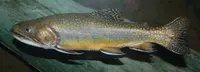 1973
Brook trout
FishSalvelinus fontinalisSportsmen chose the native trout almost unanimously in a Division of Natural Resources poll, ahead of smallmouth bass, largemouth bass, musky and bluegill.
House Concurrent Resolution No. 6 (1973) · West Virginia Legislature (Wrap Up)
-
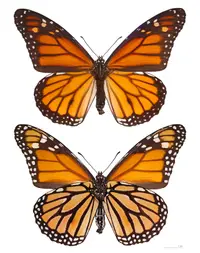 1995
Monarch butterfly
ButterflyDanaus plexippusA 2004 legislative proclamation made September 12 Monarch Butterfly Day.
Senate Concurrent Resolution No. 11 (1995) · West Virginia Legislature (Wrap Up)
-
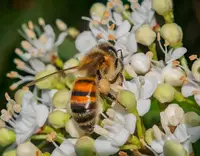 2002
Honey bee
InsectApis melliferaThe resolution praised the bee because its work benefits the state's economy more than any other insect's, including through honey sales. It was chosen over the lady beetle after long debate. A 1996 push to name the praying mantis did not pass.
Senate Concurrent Resolution No. 9 (2002) · West Virginia Archives and History
-
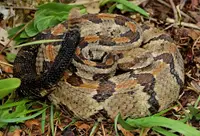 2008
Timber rattlesnake
ReptileCrotalus horridusProposed by an eighth-grade class at Romney Middle School in Hampshire County. West Virginia was the first state to name it a state reptile. It passed on the last night of the 2008 session, in the same resolution that named the state fossil.
Senate Concurrent Resolution No. 28 (2008) · West Virginia Legislature (Wrap Up)
- 2015
Northern red salamander
AmphibianPseudotriton ruber ruberProposed by the eighth-grade West Virginia Studies class at Romney Middle School, the same school behind the state reptile. The resolution compares its color to sugar maple leaves in fall and to the red bandanas of the Mine Wars. It likens its black spots to the spread of coal mines and says its toe count stands for the 55 counties and 8 major rivers.
House Concurrent Resolution No. 31 (2015) · West Virginia Legislature
Plants and fungi
-
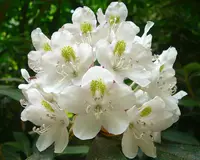 1903
Rhododendron (big laurel)
FlowerRhododendron maximumIt is the state's oldest official natural symbol; only the Great Seal and its motto, adopted in 1863, are older. Public school pupils voted for it, and the governor and his predecessor both recommended the flower. In the schoolchildren's vote the rhododendron beat the honeysuckle and the wild rose by more than 15,000 votes.
House Joint Resolution No. 19 (Joint Resolution No. 8, Acts of 1903) · West Virginia Archives and History
-
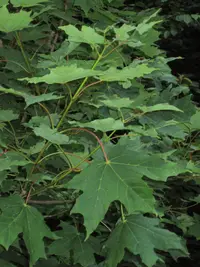 1949
Sugar maple
TreeAcer saccharumPicked in the same 1949 vote of schoolchildren and civic groups that chose the cardinal.
House Concurrent Resolution No. 12 (1949) · West Virginia Legislature
Earth and sky
- 1990
Silicified Mississippian fossil coral
GemstoneLithostrotionellaIt is not a true gemstone but a fossil coral turned to chalcedony. It is found in the Hillsdale Limestone of Greenbrier and Pocahontas counties. The coral lived in warm, shallow seas about 350 to 325 million years ago and is often cut and polished for jewelry.
House Concurrent Resolution No. 39 (1990) · West Virginia Legislature
- 1997
Monongahela silt loam
SoilIt covers more than 100,000 acres in 42 counties and is used for crops, hay, pasture, woodland and housing. Earlier resolutions in 1995 and 1996 never completed passage.
Senate Concurrent Resolution No. 5 (1997) · West Virginia Legislature
- 2008
Jefferson's ground sloth
FossilMegalonyx jeffersoniiThomas Jefferson got and described the bones in 1797. They came from a limestone cave in what is now Monroe County. Caspar Wistar re-examined the bones in 1799 and recognized them as those of a giant ground sloth; the French zoologist Anselme Gaëtan Desmarest named the species after Jefferson in 1822.
Senate Concurrent Resolution No. 28 (2008) · West Virginia Legislature
- 2009
Bituminous coal
RockStarted by a petition from Britnee Gibson, a student at Gilbert High School in Mingo County. The resolution traces coal in the state back to John Peter Salley, who found it in 1742 near present-day Racine and named the Coal River.
House Concurrent Resolution No. 37 (2009) · West Virginia Legislature (Wrap Up)
Food and drink
- 1995
Golden Delicious apple
FruitMalus domesticaIt replaced the plain apple, which had been the state fruit since House Concurrent Resolution No. 56 of 1972. The resolution credits Anderson Mullins with finding the variety in Clay County in 1905, and says that by 1921 it led apple plantings in the U.S. and abroad. A copy of the resolution was sent to Guyan Valley Junior High.
Senate Concurrent Resolution No. 7 (1995) · West Virginia Archives and History
Songs, words and language
- 1947
West Virginia, My Home Sweet Home (by Julian G. Hearne Jr.)
State songThe state's first official song. Its designation was later forgotten, which is why a second song was adopted in 1961.
Senate Concurrent Resolution No. 11 (1947); redesignated by House Concurrent Resolution No. 19 (1963) · West Virginia Archives and History
- 1963
This Is My West Virginia (by Iris Bell)
State songIt had been the official centennial song, and the 1963 resolution made it an official state song ranking equally with the others.
House Concurrent Resolution No. 19 (1963) · West Virginia Archives and History
- 2014
Take Me Home, Country Roads (by John Denver, Taffy Nivert and Bill Danoff)
State songThe resolution notes that the 1971 single reached No. 2 on the Billboard Hot 100 and is sung at West Virginia University games. Earlier attempts to make it a state song in 2011 and 2013 did not pass.
House Concurrent Resolution No. 40 (2014) · West Virginia Archives and History
Culture and history
- 1963
Old gold and blue
ColorsAdopted in 1963, the state's centennial year.
Senate Concurrent Resolution No. 20 (1963) · West Virginia Legislature
- 2008
West Virginia Shawl (adaptation)
TartanBased on an old shawl that tartan scholar Dr. Philip D. Smith found at the Daughters of the American Revolution museum in Barboursville. Each color stands for something: red for the cardinal, yellow for fall leaves, dark blue for rivers and lakes, black for the black bear, coal and oil, green for the rhododendron and meadows, azure for the sky, and white to complete the national colors.
House Concurrent Resolution No. 29 (2008) · West Virginia Legislature (Wrap Up)
- 2013
Hall Flintlock Model 1819 rifle
FirearmJohn H. Hall made the rifle at Harpers Ferry, and the U.S. Army adopted it in 1819. The resolution calls it the first breech-loading rifle adopted by any nation's military. It was still in use during the Civil War.
Senate Concurrent Resolution No. 7 (2013) · West Virginia Legislature
- 2004
Shay No. 5 (Cass Scenic Railroad State Park)
Steam locomotiveLima Locomotive Works built it in November 1905 for the Greenbrier and Elk River Railroad. The resolution calls it the oldest operating steam locomotive in the state. The same resolution named 2005 the "Year of the Shay No. 5."
Senate Concurrent Resolution No. 34 (2004) · West Virginia Legislature
- 2007
River City Youth Ballet Ensemble (official state youth ballet)
Youth ballet
Places and institutions
- 2006
Greenbrier Valley Theatre (official state year-round professional theatre)
Professional theatre - 2012
Beckley Exhibition Coal Mine (official exhibition coal mine)
Exhibition coal mine - 2018
Grafton Memorial Day Parade (official state Memorial Day parade)
Memorial day parade
Questions about West Virginia's symbols
- What is the West Virginia state bird?
- The northern cardinal, chosen in a 1949 vote of schoolchildren and civic groups, in which it beat 10 other birds.
- What is the West Virginia state flower?
- The rhododendron, or big laurel (Rhododendron maximum), adopted in 1903 after a schoolchildren's vote.
- What is the West Virginia state animal?
- The black bear, the only bear native to West Virginia, chosen in a 1954-55 poll and adopted in 1973.
- Is "Country Roads" the West Virginia state song?
- It is one of four official state songs, adopted in 2014. The others are "West Virginia, My Home Sweet Home," "The West Virginia Hills" and "This Is My West Virginia."
- What is the West Virginia state fossil?
- Jefferson's ground sloth, whose bones Thomas Jefferson described in 1797 from a cave in what is now Monroe County. It was adopted in 2008.
Photo credits (9)
- Flag of West Virginia: Militaryace, Denelson83, Public domain, via Wikimedia Commons
- Rhododendron: Arx Fortis, CC BY-SA 3.0, via Wikimedia Commons
- Northern cardinal: patricia pierce, CC BY 2.0, via Wikimedia Commons
- Sugar maple: MPF, CC BY 2.5, via Wikimedia Commons
- Black bear: California Department of Fish and Wildlife from Sacramento, CA, USA, CC BY 2.0, via Wikimedia Commons
- Brook trout: and (C)2007 Derek Ramsey (Ram-Man), CC BY-SA 2.5, via Wikimedia Commons
- Monarch butterfly: Didier Descouens, CC BY-SA 4.0, via Wikimedia Commons
- Honey bee: Didier Descouens, CC BY-SA 4.0, via Wikimedia Commons
- Timber rattlesnake: Peter Paplanus from St. Louis, Missouri, CC BY 2.0, via Wikimedia Commons
Something out of date? Tell us and we will check it against the law.
Sources
- West Virginia State Flag West Virginia Archives and History
- About the Seal West Virginia Secretary of State
- "The West Virginia Hills" e-WV: The West Virginia Encyclopedia (West Virginia Humanities Council)
- Official State Symbols West Virginia Legislature
- Symbols of the Mountain State resolved by public opinion West Virginia Legislature
- State songs West Virginia Archives and History