Flag of West Virginia
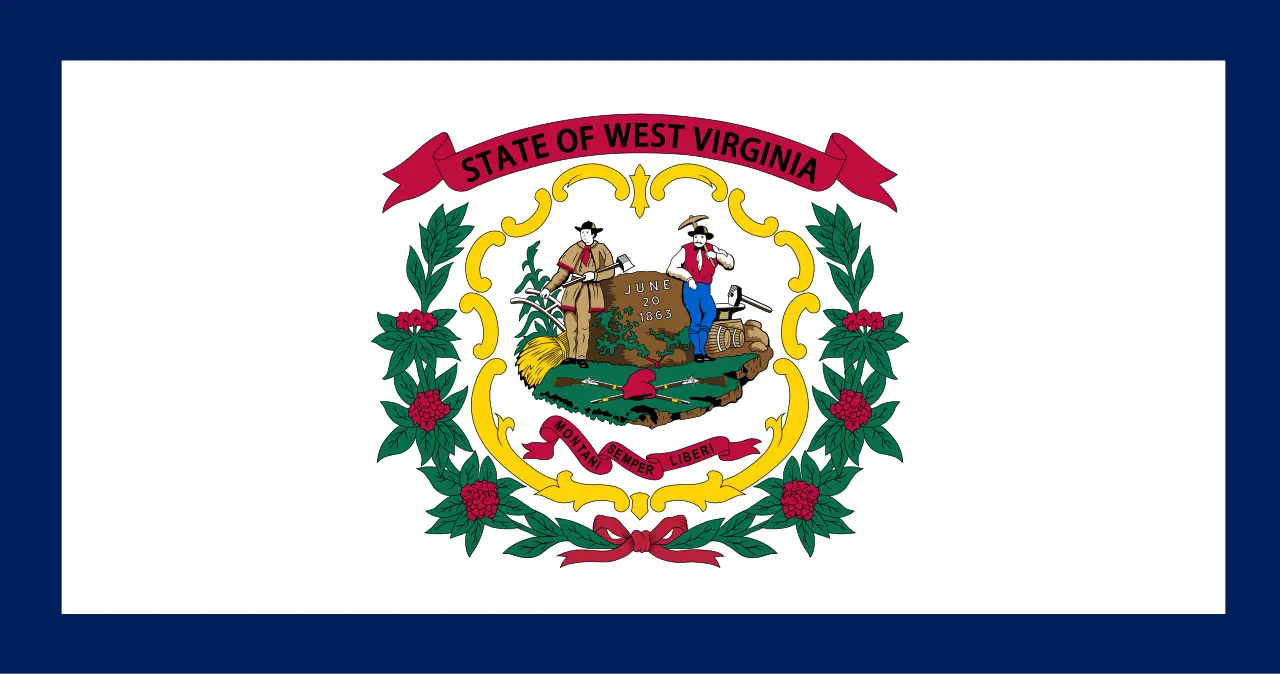
The flag of West Virginia is a white field bordered in blue, with the state coat of arms in the center: a farmer and a miner beside a rock bearing the date of statehood, June 20, 1863, with crossed rifles and a cap of liberty in front and the motto "Montani Semper Liberi." A ribbon reading "State of West Virginia" runs above, and a wreath of rhododendron, the state flower, below. The current design was adopted on March 7, 1929.
What the flag shows
- The field. Pure white, with a blue strip bordering all four sides.
- The coat of arms. In its proper colors at the center. A farmer and a miner stand beside a large rock bearing the admission date, June 20, 1863. In front, two crossed hunting rifles hold up a Phrygian cap of liberty, and the motto Montani Semper Liberi appears below.
- The ribbon. Above the arms, with the words “State of West Virginia.”
- The wreath. Rhododendron maximum, the state flower, around the lower part of the arms.
The secretary of state reads the arms this way: the rock stands for strength, the farmer with his axe for agriculture, the miner with his pick for industry, and the rifles and cap of liberty show that freedom was won by arms and will be defended. The flag’s proportions match those of the US flag, and flags for parades get gold fringe on three sides.
The first flags
On January 28, 1864, the Legislature authorized a first state flag, which was presented to military regiments before the Civil War ended. In 1905 a resolution made official the flag first used at the 1904 St. Louis exposition: a sprig of big laurel, or rhododendron, on a white field, with the coat of arms and motto on the back, a blue border and a carmine-red fringe.
Two sides that didn’t work
That flag had problems. A 1907 resolution called it unworkable: the lettering on one side read toward the staff, and the designs on the two sides showed through the white cloth. The new version put the seal and a “State of West Virginia” scroll on the front and the rhododendron on the back, with a blue border and old-gold fringe.
One side, 1929
The two-sided flag cost too much for schools and others to buy, so on March 7, 1929, the Legislature adopted the current single design, moving the rhododendron into a wreath around the coat of arms. West Virginia has no official pledge or salute to its flag.
Questions about the West Virginia state flag
- What do the symbols on the West Virginia flag mean?
- The secretary of state explains that the central rock stands for strength, the farmer with his axe for agriculture, the miner with his pick for industry, and the crossed rifles under a cap of liberty show that freedom was won by arms and will be defended.
- What is the flower on the West Virginia flag?
- A wreath of Rhododendron maximum, the state flower, around the lower part of the coat of arms.
- When was the West Virginia flag adopted?
- The current design dates from a resolution adopted on March 7, 1929. Earlier official flags were adopted in 1905 and 1907.
- What does "Montani Semper Liberi" mean?
- '"Mountaineers Are Always Free." The 1929 flag resolution translated it as "Mountaineers Always Freeman."'
Sources
- West Virginia State Flag West Virginia Archives and History
- State flag e-WV, The West Virginia Encyclopedia
- About the Seal West Virginia Secretary of State
- West Virginia State Seal West Virginia Secretary of State