Rhododendron, the state flower of West Virginia
The state flower of West Virginia is the rhododendron, specifically the great rhododendron, or big laurel, a native evergreen shrub with large clusters of white to rose-pink flowers that bloom in early summer. Schoolchildren chose it in a vote, beating the honeysuckle and the wild rose by more than 15,000 votes, and the Legislature adopted it on January 23, 1903, making it the state's oldest natural symbol.
How to recognize it
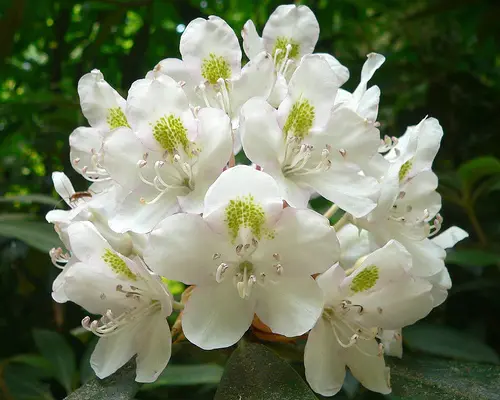
The great rhododendron is an evergreen, loose, many-stemmed shrub or small tree, usually 5 to 15 feet tall and sometimes up to about 20. Its leathery, dark green leaves are 4 to 8 inches long, with smooth edges and rusty hairs underneath, the largest leaves of any native rhododendron. Its bell- or funnel-shaped flowers, up to 2 inches across, grow in clusters of about 16 to 24 and range from white to rose-pink, often with green to orange spots.
It blooms in summer, from June to August; in West Virginia the peak is usually late June to early July. The fruit is an oblong capsule that splits open in September and October to release many small seeds.
Where it grows
The great rhododendron is native to eastern North America, from Ontario and Nova Scotia south to Ohio, Alabama and Georgia, and is most common in the southern Appalachians. In West Virginia it grows in acidic soils, mostly ones formed from sandstone, and the Monongahela National Forest has the most survey plots with the species.
Where to see it
Wonderful West Virginia, the Division of Natural Resources magazine, gives June 25 to July 10 as the usual peak bloom and recommends Coopers Rock State Forest, Blackwater Falls State Park, New River Gorge National Park and Preserve and the Gauley River National Recreation Area.
Handle with care
All parts of the plant, including the leaves, flowers, nectar and roots, contain grayanotoxins and can harm cats, dogs and horses, though NC State Extension rates the poison’s severity as low. In gardens it needs moist, well-drained, acidic soil rich in organic matter and light shade, and deer often browse it.
The state flower since 1903
West Virginia’s public school pupils voted for the rhododendron, which beat the honeysuckle and the wild rose by more than 15,000 votes, and the governor and his predecessor both recommended it. The Legislature adopted it on January 23, 1903, making it the state’s oldest official natural symbol; only the Great Seal and the motto are older. It also appears on the state flag, in a wreath around the coat of arms.
Questions about the West Virginia state flower
- What is the state flower of West Virginia?
- The rhododendron, or big laurel (Rhododendron maximum), adopted on January 23, 1903.
- When do rhododendrons bloom in West Virginia?
- Usually late June to early July. Wonderful West Virginia magazine gives June 25 to July 10 as the usual peak.
- Where can I see rhododendrons in West Virginia?
- Wonderful West Virginia recommends Coopers Rock State Forest, Blackwater Falls State Park, New River Gorge National Park and Preserve and the Gauley River National Recreation Area.
- Is rhododendron poisonous?
- All parts contain grayanotoxins and can harm cats, dogs and horses, though NC State Extension rates the severity as low.
Sources
- Rhododendron maximum NC State Extension Gardener Plant Toolbox
- Rhodo trippin' Wonderful West Virginia (WV Division of Natural Resources)
- The rhododendron as state flower West Virginia Archives and History
- West Virginia State Flag (1905 and 1907 resolutions naming Rhododendron maximum as the state flower) West Virginia Archives and History