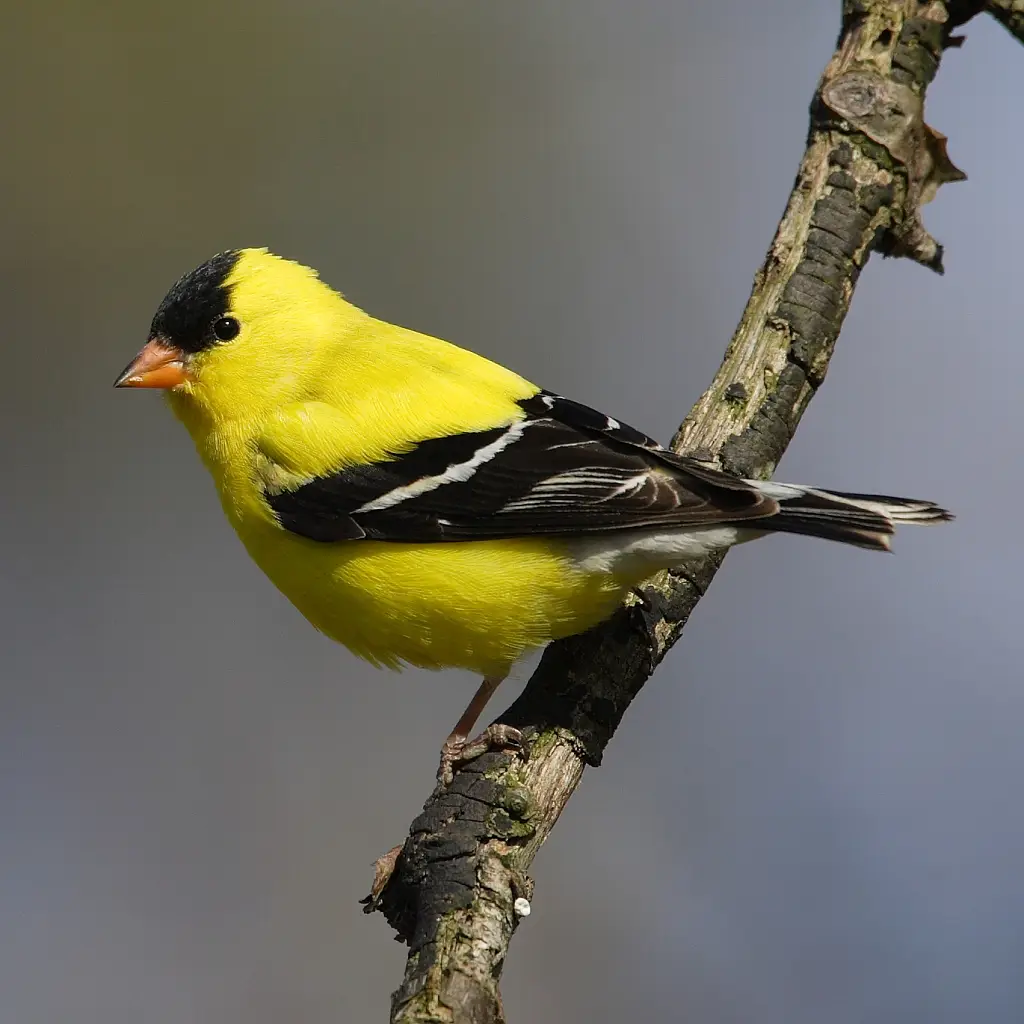
Willow goldfinch, the state bird of Washington
The state bird of Washington is the willow goldfinch, the western form of the American goldfinch, adopted in 1951. Breeding males are bright yellow with black wings, tail and forehead. Goldfinches are common in Washington's lowlands from April to October and nest unusually late, in July and August. Iowa and New Jersey also have the American goldfinch as state bird.
How to recognize it
The American goldfinch is a small finch, about 4 to 5 inches long. In the breeding season the male is bright yellow with a black forehead, black wings and tail and white in the wings and tail; in winter he turns drab brown with hints of yellow. The breeding female is duller, yellowish gray-brown above and yellow below, with two pale wing bars. White feathers under the tail, in every plumage, separate it from the lesser goldfinch. In its bouncing flight it calls a bright per-chick-o-ree, often written as “potato chip,” timed to each rise and dip.
How it lives
Goldfinches eat mostly small seeds, especially thistle and other plants of the daisy family, plus some insects such as aphids in summer, and they cling acrobatically to seed heads. They flock outside the breeding season. They nest unusually late, mostly in July and August, timed to the peak of thistle seed, and the female lines a tight cup nest with thistle down.
Where to see one in Washington
Goldfinches live in open, weedy country with scattered trees and shrubs: field edges, roadsides, streamsides, orchards, hedgerows and suburbs, especially where thistles grow. In Washington they are common in the lowlands from mid-April to mid-October, at weedy fields, river edges, hedgerows and backyard feeders. Fewer stay for the winter, when they are more common east of the Cascades, especially along the Columbia and Snake rivers. The Cascades divide the two subspecies found in the state, and the “willow goldfinch” of the law is the western one.
Doing well
The American goldfinch is a species of least concern, with about 44 million birds, though Audubon notes that it may be declining in some areas. In western Washington it was once rare and became common after forest clearing created weedy second growth and suburbs.
Two decades to decide
Washington took a while to settle on a bird. In 1928 schoolchildren voted for the western meadowlark, but several other states had already claimed it. In 1931 the Washington Federation of Women’s Clubs held its own vote, and the goldfinch came out ahead of the tanager, the song sparrow, the junco and the pileated woodpecker. With two informal favorites in play, a 1951 schoolchildren’s vote settled on the goldfinch, and the Legislature adopted it that year.
Questions about the Washington state bird
- What is the state bird of Washington?
- The willow goldfinch, the western subspecies of the American goldfinch (Spinus tristis), adopted in 1951.
- Why did Washington pick the goldfinch?
- Schoolchildren chose the western meadowlark in 1928, but other states already had it. In 1931 the Washington Federation of Women's Clubs picked the goldfinch, and a 1951 schoolchildren's vote settled on it too.
- When can you see goldfinches in Washington?
- They are common in the lowlands from mid-April to mid-October. Fewer stay for the winter, mostly east of the Cascades.
- How do you tell a goldfinch from a lesser goldfinch?
- American goldfinches have white feathers under the tail in every plumage; lesser goldfinches have yellow ones.
Sources
- American Goldfinch National Audubon Society
- American Goldfinch (BirdWeb) Seattle Audubon Society
- State bird Washington State Legislature
- RCW 1.20.040: State bird Washington State Legislature