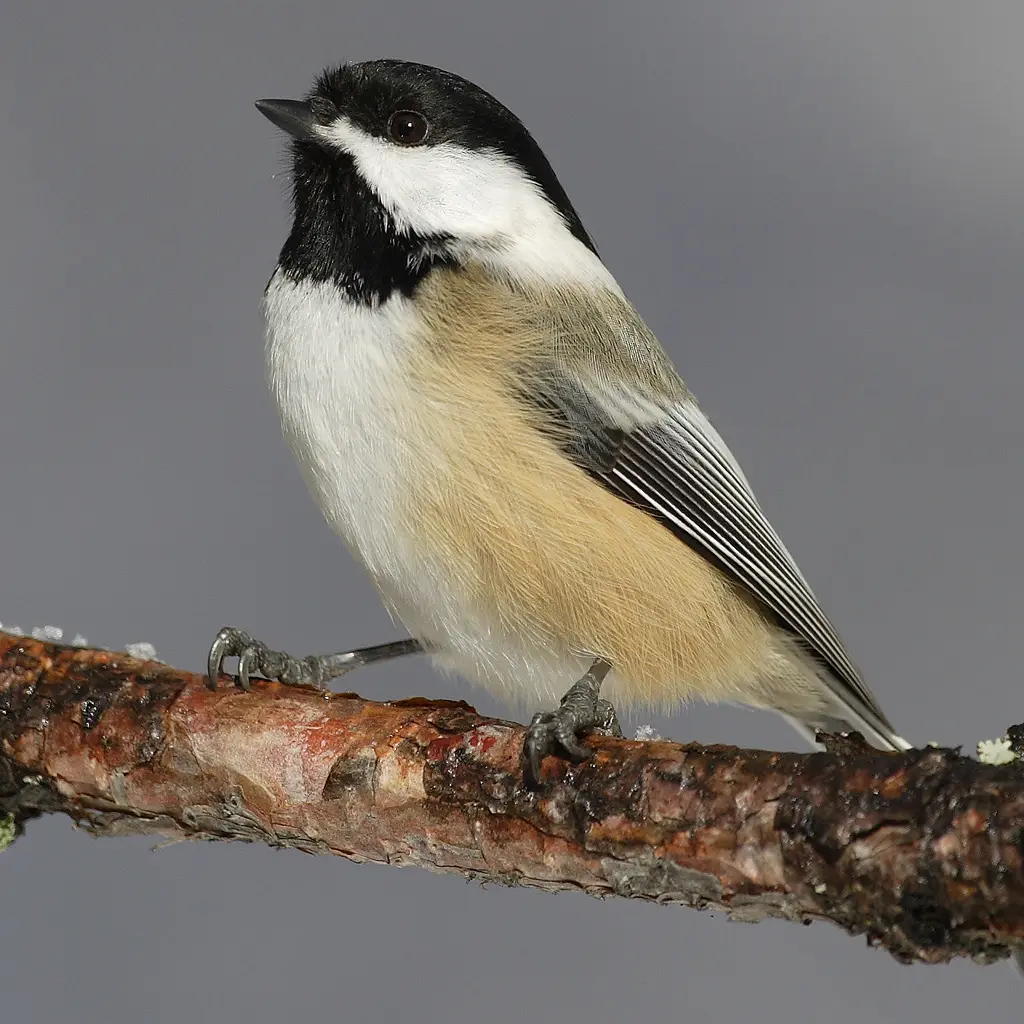
Black-capped chickadee, the state bird of Massachusetts
The state bird of Massachusetts is the black-capped chickadee, adopted in 1941 together with the state tree. It is a tiny, friendly songbird with a black cap and bib and a cheerful "chick-a-dee-dee-dee" call, and it is one of the most common and widespread birds in the state, found almost anywhere there are a few trees.
How to recognize it
The black-capped chickadee is a small songbird, about five to six inches long and weighing only a third to half an ounce. It has a black cap and a black bib, white cheeks, a gray back and buff-colored sides. It is easiest to identify by its call, a buzzy chick-a-dee-dee-dee that it gives in every season. Its song is a clear two-note whistle, fee-bee, with the second note lower.
It looks very much like the Carolina chickadee, which lives farther south; in Massachusetts the black-capped is the chickadee you will see.
How it lives
Chickadees forage by hopping among twigs and branches, often hanging upside down to reach insects underneath. In summer they eat mostly insects and caterpillars; in winter they switch to seeds, berries and food they have hidden away earlier. In winter they also travel in mixed flocks with nuthatches, titmice and downy woodpeckers, moving through the woods together.
At feeders a chickadee takes one seed at a time and flies off to a branch to crack it open, then comes back for another. Chickadees nest in tree cavities, usually laying six to eight eggs.
Where to see one in Massachusetts
Chickadees are found all year across Massachusetts, from backyards and town parks to deep woods. Mass Audubon describes the black-capped chickadee as one of the most common and widespread birds in the state, found anywhere there are a few trees. Winter feeders and mixed flocks moving through the woods are the easiest places to watch them.
Doing well
The black-capped chickadee is a species of least concern, with a stable or increasing population; Audubon estimates there are about 43 million. Mass Audubon reports that Massachusetts numbers are stable to increasing.
The state bird since 1941
Massachusetts adopted the chickadee in 1941, in the same act that made the American elm the state tree. The law, now section 9 of chapter 2 of the General Laws, uses an older scientific name, Penthestes atricapillus. Maine chose the same bird in 1927.
Questions about the Massachusetts state bird
- What is the state bird of Massachusetts?
- The black-capped chickadee (Poecile atricapillus), adopted on March 21, 1941.
- Which other state has the chickadee as state bird?
- Maine, which adopted it in 1927.
- Do chickadees stay in Massachusetts in winter?
- Yes. They live in Massachusetts all year, switching to seeds, berries and stored food in winter and joining mixed flocks with other small birds.
Sources
- Black-capped Chickadee National Audubon Society
- Black-capped Chickadees Mass Audubon
- Acts of 1941, chapter 121 (state tree and bird) State Library of Massachusetts