Flag of Kansas
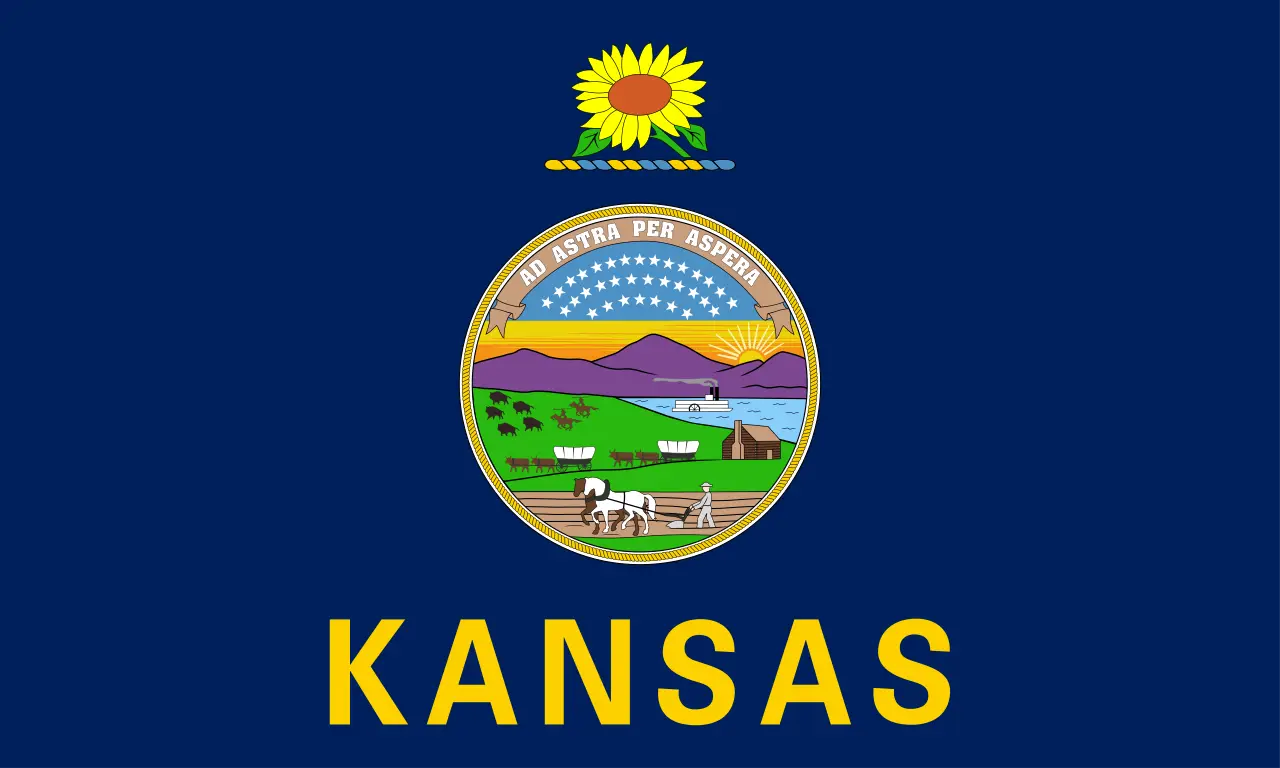
The flag of Kansas is dark blue, with the state seal in the center, a sunflower on a twisted gold-and-blue bar above it, and the word KANSAS in gold below. It was adopted on March 21, 1927, after two years in which Kansas was represented by a hanging sunflower banner instead of a flag. The word KANSAS was added in 1961.
A banner first
Kansas’s path to a flag was unusual. In 1916 Esther Northrup of Lawrence won a Daughters of the American Revolution contest with a red, white and blue striped design carrying a sunflower and the seal, but it was never adopted. The Grand Army of the Republic, the organization of Union Civil War veterans, opposed red-white-and-blue designs that might seem to rival the national flag.
On February 27, 1925, the legislature adopted something else: a state banner. It was a solid blue field with a large sunflower holding the state seal, meant to hang from a horizontal bar. It turned out to be impractical. It was hard to hang, it could not be carried in parades, and it was turned down for display with the other states’ flags in Washington, D.C. For two years Kansas was the only state represented by a hanging banner instead of a flag.
The 1927 flag
On March 21, 1927, the legislature adopted the first official state flag. Adjutant General Milton R. McLean pushed the act through. Its design was the state seal with a sunflower crest on a field of dark blue. No designer is officially credited.
Two later changes produced the flag flown today. In 1961 the word KANSAS was added in gold block letters beneath the seal, and schools were required to display the flag. In 1963 the flag’s official size was reduced so that it would be smaller than the national flag.
The old banner was never repealed. The law still describes it: a solid blue banner, three-fourths as wide as it is long, with a gold-petaled sunflower with a brown center filling two-thirds of the space.
What the flag shows
- The blue field. Dark blue, in proportions of three by five.
- The seal. The great seal of Kansas without its outer lettering. It shows a rising sun for the east, a river and steamboat for commerce, a settler’s cabin and a man plowing for agriculture, ox-wagons heading west, and a herd of buffalo pursued by two mounted Native American hunters. The motto Ad astra per aspera, “To the stars through difficulties,” runs above, with 34 stars for Kansas as the 34th state.
- The crest. A sunflower, the state flower, on a twisted bar of gold and blue. The Kansas Historical Society says the bar stands for the Louisiana Purchase and that the US War Department set this crest in 1923.
- KANSAS. The state’s name in gold letters below the seal, added in 1961.
The law even sets the colors of the seal: silver stars, purple hills, a deep yellow sun, a green prairie, a light blue river, a white boat and wagons and a buffalo of near black.
Questions about the Kansas state flag
- What is on the Kansas flag?
- The state seal, showing a prairie scene with a rising sun, a steamboat, a settler plowing, wagons heading west and buffalo, under the motto "Ad astra per aspera" and 34 stars. Above it is a sunflower on a gold-and-blue bar, and below it the word KANSAS.
- What do the 34 stars on the Kansas flag mean?
- Kansas was the 34th state admitted to the Union.
- Why did Kansas have a banner instead of a flag?
- In 1925 Union veterans of the Grand Army of the Republic opposed any red-white-and-blue state flag that might rival the US flag, so the legislature adopted a blue banner with a sunflower. It was hard to hang and could not be carried in parades, and a proper flag followed in 1927.
- Who designed the Kansas flag?
- Neither the law nor the Kansas Historical Society names a designer. Adjutant General Milton R. McLean pushed the flag act through the legislature.
Sources
- Kansas State Flag Kansas Historical Society
- State Banner Kansas Historical Society
- K.S.A. 73-702 (state flag) Kansas Office of Revisor of Statutes
- K.S.A. 73-701 State flag Kansas Office of Revisor of Statutes
- K.S.A. 73-703 State banner Kansas Office of Revisor of Statutes
- K.S.A. 73-704 Banner description Kansas Office of Revisor of Statutes
- K.S.A. 75-201 Great seal of the state of Kansas Kansas Office of Revisor of Statutes