Flag of Missouri
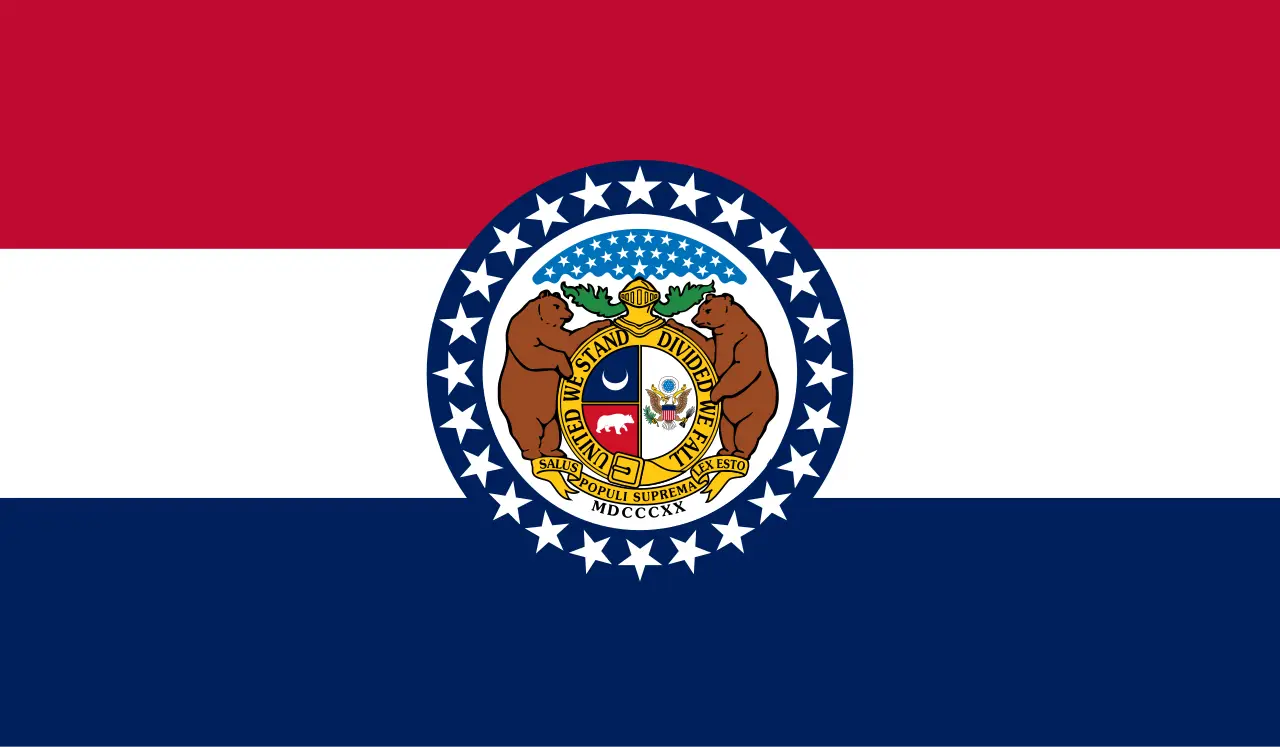
The flag of Missouri, adopted in 1913, has three equal horizontal stripes of red, white and blue. In the center, on the white stripe, is the state coat of arms, ringed by a blue band holding 24 stars that mark Missouri as the 24th state. It was designed by Marie Elizabeth Watkins Oliver of Cape Girardeau, and her original silk flag is still on display in Jefferson City.
What the flag shows
- Three stripes. Equal horizontal stripes of red, white and blue, in proportions of 7 to 12. The colors echo the US flag. The secretary of state’s explanation gives red for valor, white for purity, and blue for vigilance, permanency and justice.
- The coat of arms. In full color on the white stripe at the center. It is meant to show Missouri as an independent state that is also part of the whole Union.
- The blue band. A ring around the arms, its width one-fourteenth of the flag’s height and its diameter one-third of the flag’s length.
- Twenty-four stars. Evenly spaced five-pointed stars in the blue band, for Missouri’s place as the 24th state.
The coat of arms comes from the Great Seal, adopted in 1822. Its shield is split between a grizzly bear and a crescent for Missouri and the arms of the United States, and it is circled by the words “United we stand, divided we fall.” Two grizzly bears stand on either side of it, on a scroll bearing the state motto, Salus populi suprema lex esto, “The welfare of the people shall be the supreme law,” above the date 1820 in Roman numerals. Above, a helmet sits below one large star and 23 smaller stars.
A century without a flag
Missouri had a Great Seal from 1822, but no official flag for nearly a hundred years. In 1908 the Missouri Daughters of the American Revolution asked Marie Oliver, of Cape Girardeau, to chair a committee to create one. She worked out the design, and the artist Mary Kochtitzky painted it on paper.
Getting it adopted took five years. Senator Arthur L. Oliver, the nephew of Marie Oliver’s husband, introduced flag bills in 1909 and 1911. Both cleared the Senate but stalled in the House, where a rival design, known as the Holcomb flag, had its supporters.
Saved from the fire
In 1911 the paper flag was lost when fire destroyed the State Capitol. Oliver and Mrs. S. D. MacFarland then made a new version in silk, with the coat of arms painted by hand. On March 22, 1913, Governor Elliott W. Major signed the bill making Oliver’s design the official flag of Missouri.
That silk flag was given to the secretary of state in 1961 and displayed in the Capitol until 1980. In the late 1980s Missouri elementary school pupils raised money for its restoration in a penny drive. It is now on display at the Kirkpatrick State Information Center in Jefferson City.
Rules for the flag
The law requires the original copy of the flag design to be kept in the secretary of state’s office. Flag desecration is covered by a separate section of the criminal code. Missouri has no official pledge or salute to its flag.
Questions about the Missouri state flag
- What do the colors of the Missouri flag mean?
- According to the secretary of state, red stands for valor, white for purity, and blue for vigilance, permanency and justice. The colors also echo the US flag.
- Why are there 24 stars on the Missouri flag?
- Because Missouri was the 24th state admitted to the Union.
- Who designed the Missouri flag?
- Marie Elizabeth Watkins Oliver of Cape Girardeau, who led a committee of the Missouri Daughters of the American Revolution. Governor Elliott W. Major signed the law adopting her design on March 22, 1913.
- Why are there bears on the Missouri flag?
- The two grizzly bears are part of the state coat of arms, taken from the Great Seal of 1822. They hold up the shield, and a grizzly also appears on the shield itself.
- Where is the original Missouri flag?
- Marie Oliver's silk flag is on display at the Kirkpatrick State Information Center in Jefferson City.
Sources
- Missouri State Symbols, State Flag Missouri Secretary of State
- Marie Elizabeth Watkins Oliver State Historical Society of Missouri (Historic Missourians)
- Missouri State Symbols, State Seal Missouri Secretary of State
- RSMo § 10.020 (state flag) Missouri Revisor of Statutes
- The Missouri State Flag (Kids' page) Missouri Secretary of State