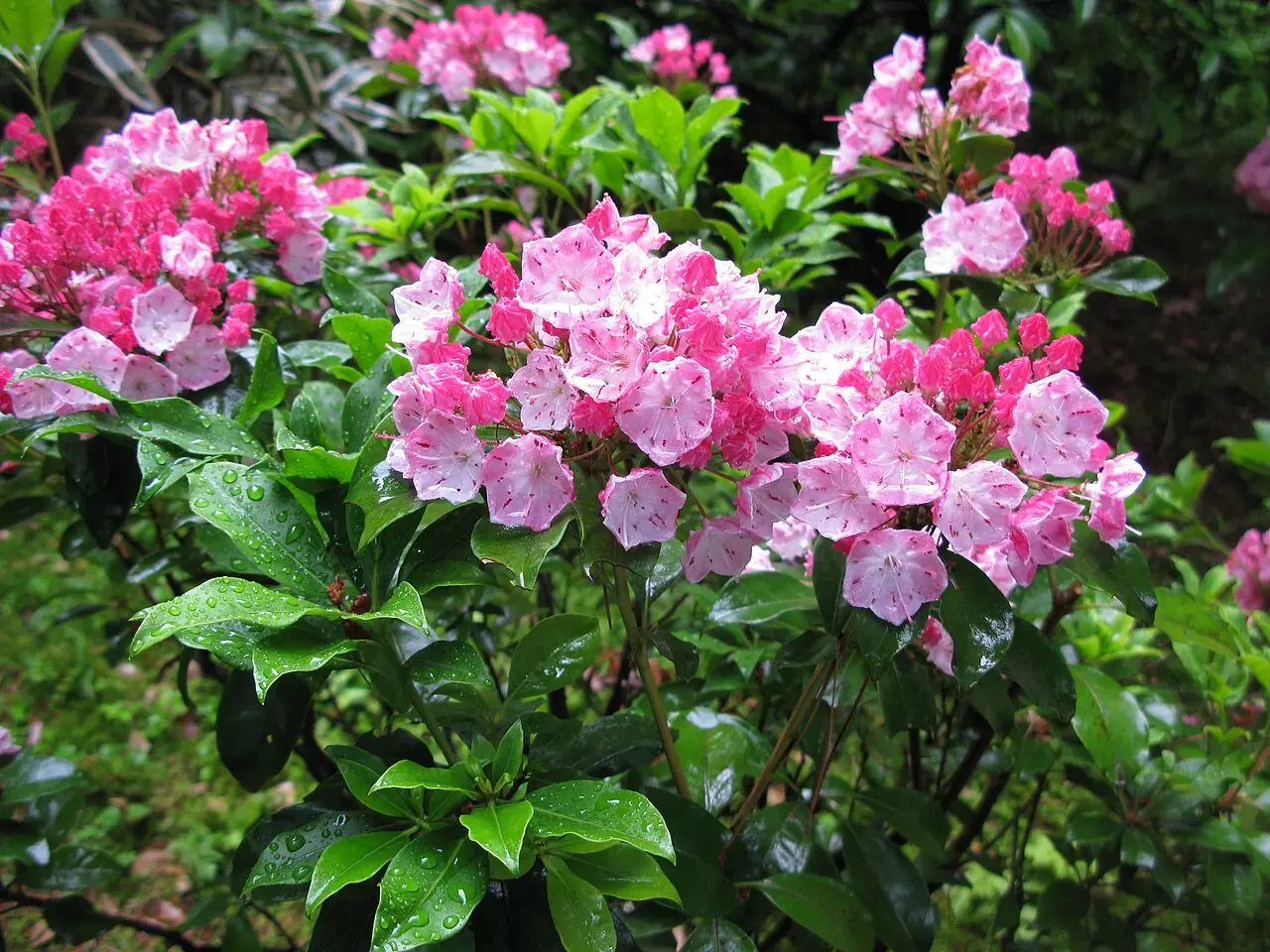
Mountain laurel, the state flower of Connecticut
The state flower of Connecticut is the mountain laurel, adopted in 1907. It is a native evergreen shrub that covers woodland hillsides with clusters of white and pink flowers in June. Each flower has spring-loaded stamens that fling pollen onto visiting bees. All parts of the plant are poisonous.
How to recognize it
Mountain laurel is a broadleaf evergreen shrub, usually 6 to 10 feet tall, with gnarled, twisting stems. Its leaves are glossy dark green, elliptical and two to five inches long, clustered near the ends of the branches, and they stay green all winter.
The flowers come in showy clusters three to six inches across. Each flower is about an inch wide, shaped like a small cup or bowl, white to rose-pink with purple markings, and the buds look like tiny piped icing. The most remarkable feature is inside. The flower’s ten stamens are bent back and tucked into little pockets in the petals, held under tension. When a bee lands, the stamens spring free and dust it with pollen.
Where it grows
Mountain laurel is native to eastern North America, from New England south through the Appalachians. It grows in rocky or sandy woods, acidic forests, on slopes and along woodland edges, and in Connecticut it is common in the hilly woodlands across the state. In the southern Appalachians it can occasionally grow into a small tree more than 25 feet tall.
Where to see it
Laurel blooms across Connecticut from mid-June to mid-July. One of the best places to see it is the Mountain Laurel Sanctuary in Nipmuck State Forest in Union, where a mile-long route passes through laurel first planted by the Civilian Conservation Corps in 1935. The Connecticut College Arboretum in New London also has large displays.
Poisonous in every part
For all its beauty, mountain laurel is dangerous to eat. Its leaves, flowers, stems, bark, roots and fruit contain grayanotoxins and are highly poisonous. It is a known danger to livestock and pets, and honey made mostly from its nectar can be toxic.
The name
The Swedish botanist Carl Linnaeus named the plant Kalmia latifolia, honoring Peter Kalm, a student of his who explored North America and sent him specimens in 1750; latifolia means “broad-leaved.” Older folk names include calico bush and spoonwood, from the use of its hard wood to carve spoons.
The state flower since 1907
The General Assembly made the mountain laurel the state flower in 1907. The law is now section 3-108 of the Connecticut General Statutes. Pennsylvania chose the mountain laurel as its state flower too, in 1933.
In 2015 Connecticut added a children’s state flower: Michaela Petit’s Four-O’Clocks, named for an 11-year-old killed in the 2007 Cheshire home invasion, whose garden four-o’clocks were among the few things saved from her family’s home.
Questions about the Connecticut state flower
- What is the state flower of Connecticut?
- The mountain laurel (Kalmia latifolia), adopted in 1907.
- When does mountain laurel bloom in Connecticut?
- From mid-June to mid-July, depending on location and elevation.
- Is mountain laurel poisonous?
- Yes. All parts of the plant contain grayanotoxins and are highly poisonous if eaten, to people, pets and livestock. Even honey made mostly from its nectar can be toxic.
- Does Connecticut have another state flower?
- It has a children's state flower, Michaela Petit's Four-O'Clocks, adopted in 2015.
Sources
- The State Flower State of Connecticut
- Kalmia latifolia North Carolina State Extension Gardener Plant Toolbox
- Mountain laurel fact sheet Virginia Tech Dendrology
- Spectacular sanctuaries Connecticut Office of Tourism
- Plant Profile: Kalmia latifolia L., mountain laurel (KALA) USDA NRCS PLANTS Database
- Connecticut General Statutes, Chapter 33: State Seal, Arms, Flag and Symbols (sections 3-105 to 3-110) Connecticut General Assembly