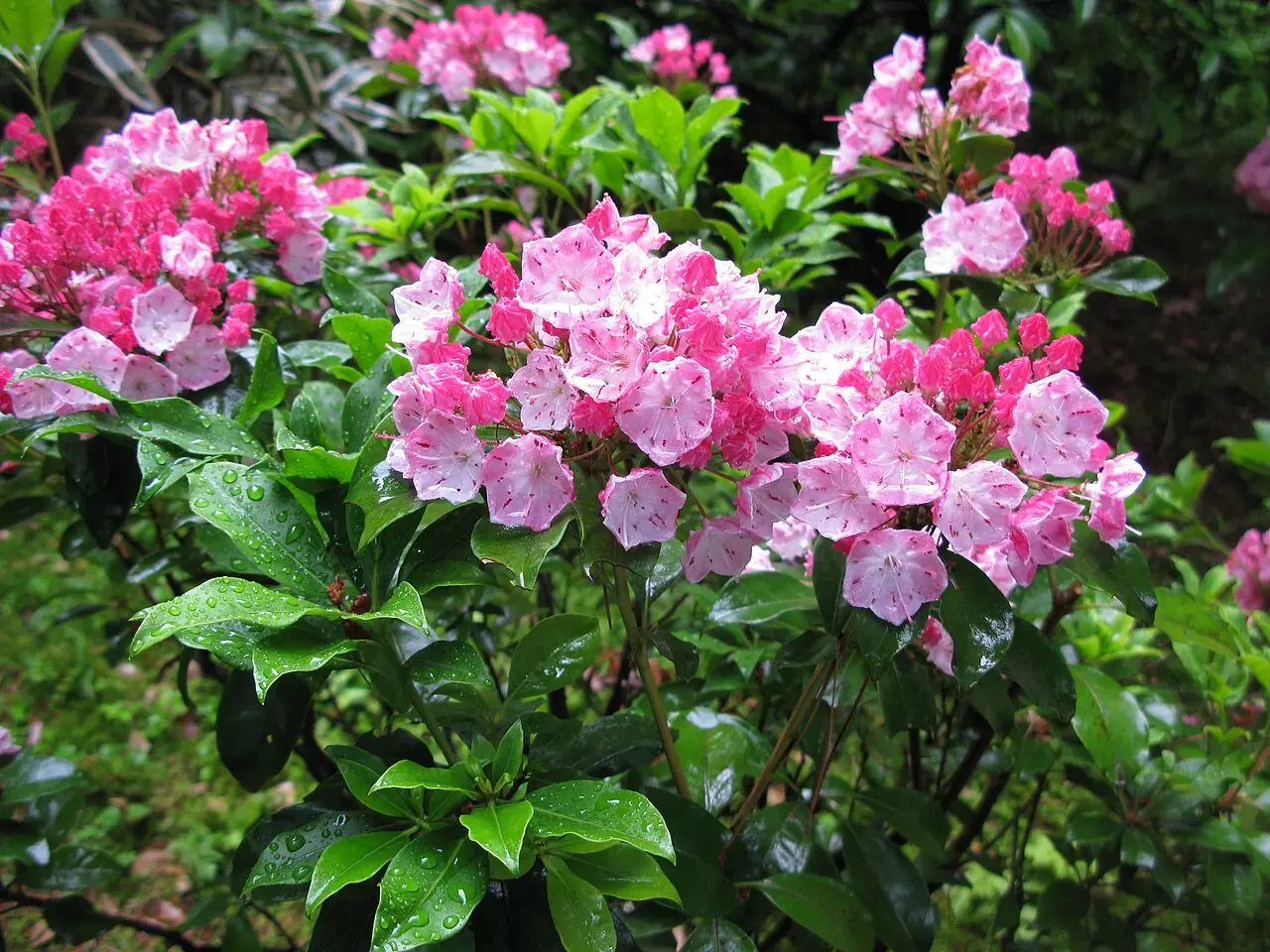
Mountain laurel, the state flower of Connecticut and Pennsylvania
The mountain laurel is the state flower of two states: Connecticut, which chose it in 1907, and Pennsylvania, which followed in 1933. It is a native evergreen shrub of eastern woodlands whose clusters of cup-shaped, white to pink flowers, marked with purple-red, fill the woods in late spring and early summer. Every part of the plant is poisonous if eaten.
The 2 states
| State | Designation | Name in state law | Adopted |
|---|---|---|---|
| Connecticut | State flower | Mountain laurelC.G.S. § 3-108 | 1907 |
| Pennsylvania | State flower | Mountain laurelAct of May 5, 1933, P.L. 457 | 1933 |
Two states
Connecticut’s General Assembly named the mountain laurel its state flower in 1907. Pennsylvania followed in 1933, when Governor Gifford Pinchot signed the bill, a choice linked to the enthusiasm of his wife, Cornelia Bryce Pinchot, for the shrub. In the 1920s about 20 million pounds of laurel foliage a year were being cut for holiday greenery, which had fed public concern for the plant.
Named for Peter Kalm
The scientific name, Kalmia latifolia, was given by the botanist Linnaeus, who honored Peter Kalm, who sent him specimens in 1750, and described the plant’s broad leaves. Older folk names include calico bush and spoonwood.
How to recognize it
Mountain laurel is an evergreen shrub, usually 7 to 10 feet tall, with leathery, glossy leaves 2 to 5 inches long. Its flowers grow in clusters, each about an inch across, cup-shaped and five-sided like a small star or parasol, white to pink with purple-red markings. The stamens are bent back under tension, and when a bumblebee visits they spring free and dust it with pollen.
Where it grows
Mountain laurel is native to eastern North America, from southern Maine to Louisiana and northern Florida. It grows in acidic woods, on rocky slopes and along woodland edges, sometimes in thickets so dense that woodsmen called them “laurel hells.” In Pennsylvania it grows in all 67 counties and blooms from late May to late June.
Poisonous
All parts of the mountain laurel are poisonous to people and livestock if eaten. Contrary to Pennsylvania folklore, picking the blossoms there is not illegal, though removing plants from someone’s land without permission is.
Questions people ask
- Which states have the mountain laurel as state flower?
- Connecticut, since 1907, and Pennsylvania, since 1933.
- Is mountain laurel poisonous?
- Yes. All parts of the plant are poisonous to people and livestock if eaten.
- Where does the name Kalmia come from?
- Linnaeus named the genus for Peter Kalm, who sent him specimens in 1750.
- When does mountain laurel bloom?
- In Pennsylvania, from late May to late June, peaking around mid-June.
Sources
- Kalmia latifolia NC State Extension Gardener Plant Toolbox
- The State Flower State of Connecticut (reproduced from the Connecticut State Register & Manual, Secretary of the State)
- Kids Corner: Pennsylvania state symbols and facts Office of the Governor of Pennsylvania