Flag of Vermont
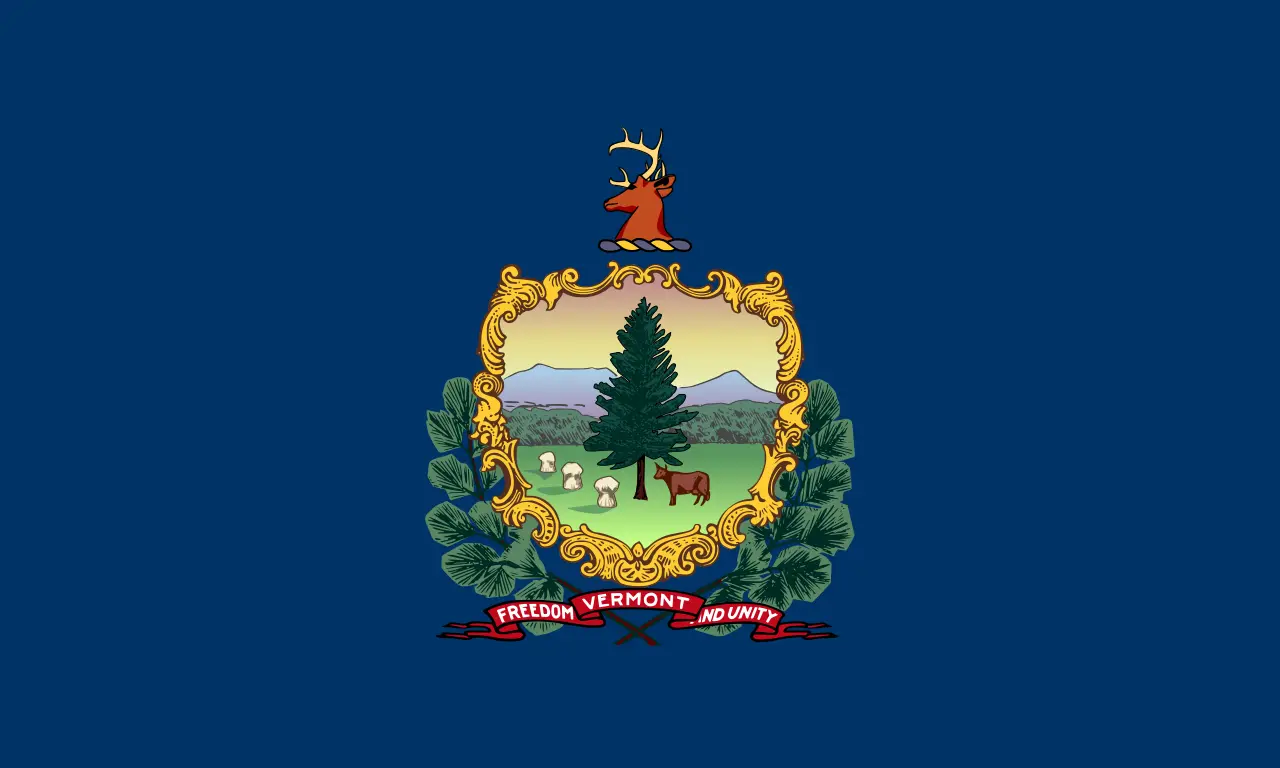
The flag of Vermont is a blue field bearing the state coat of arms: a tall pine tree, three sheaves of grain and a red cow before the blue Green Mountains, with a buck's head above, crossed pine branches below and a scroll reading "Vermont; Freedom and Unity." The current design dates from 1923. Vermont flags have traveled to the Moon on Apollo 11 and Apollo 17.
What the flag shows
The law says simply that the flag “shall be blue with the Coat of Arms of the State thereon.” The coat of arms includes:
- The pine tree. Rising from the base of the shield nearly to its top. The Vermont Historical Society says it has 14 branches, for Vermont as the 14th state, and also stands for the state’s forests.
- Sheaves and a cow. Three yellow sheaves of grain on one side and a red cow on the other, for agriculture.
- The landscape. Green fields with blue mountains, the Green Mountains, under a yellow sky.
- The crest and badge. A buck’s head above the shield, and two crossed pine branches, known as the “Vermonter’s badge,” between the shield and the scroll.
- The scroll. Below, reading “Vermont; Freedom and Unity,” the state motto.
Stars and stripes
Vermont’s first state flag, from 1803, was a militia flag with 17 stripes and 17 stars, one for each state then in the Union, and the word VERMONT across the top. After Congress fixed the US flag at 13 stripes in 1818, Vermont changed its own flag in 1837 to 13 red and white stripes, with the coat of arms inside a single star in the canton; Governor Silas Jenison signed the law on October 20. That design was rarely flown.
The blue flag
During the Civil War, Vermont’s regiments carried silk flags with the coat of arms hand-painted on solid-colored fields; most survive at the Vermont History Center in Barre. In 1923 the Legislature replaced the little-used 1837 design with the current blue flag bearing the coat of arms, in a law that took effect on June 1, 1923.
Flags far from home
Vermont flags have traveled far. The Vermont Historical Society reports that they have gone to the Moon on Apollo 11 in 1969 and Apollo 17 in 1972, to the North Pole in 1970 and to the summit of Mount Everest in 2006.
A new flag?
In January 2026 Representative Charles Kimbell introduced a bill to create a State Flag Task Force to recommend a new design. It was referred to the House Committee on Government Operations and Military Affairs, and no further action was found. Vermont has no official pledge or salute to its flag.
Questions about the Vermont state flag
- What is on the Vermont flag?
- The state coat of arms on a blue field. It shows a pine tree, three sheaves of grain and a red cow in a green landscape with blue mountains under a yellow sky, a buck's head crest, two crossed pine branches and the motto "Freedom and Unity."
- Why does the pine tree on the Vermont flag have 14 branches?
- The Vermont Historical Society says the 14 branches stand for Vermont as the 14th state; the tree also stands for the state's forests.
- When was the Vermont flag adopted?
- The current blue flag took effect on June 1, 1923. Earlier state flags date from 1803 and 1837.
- Is Vermont changing its flag?
- Not yet. A 2026 bill to create a State Flag Task Force to recommend a new design was referred to committee, with no further action found.
Sources
- Fun with flags Vermont Historical Society
- Vermont Statutes, Title 1, Chapter 11 (flag and coat of arms) Vermont General Assembly
- 1 V.S.A. § 495. State flag Vermont General Assembly
- 1 V.S.A. § 491. Coat of arms; crest; motto; badge Vermont General Assembly
- H.708 (2026) As Introduced: An act relating to creating a task force to recommend a new State Flag Vermont General Assembly