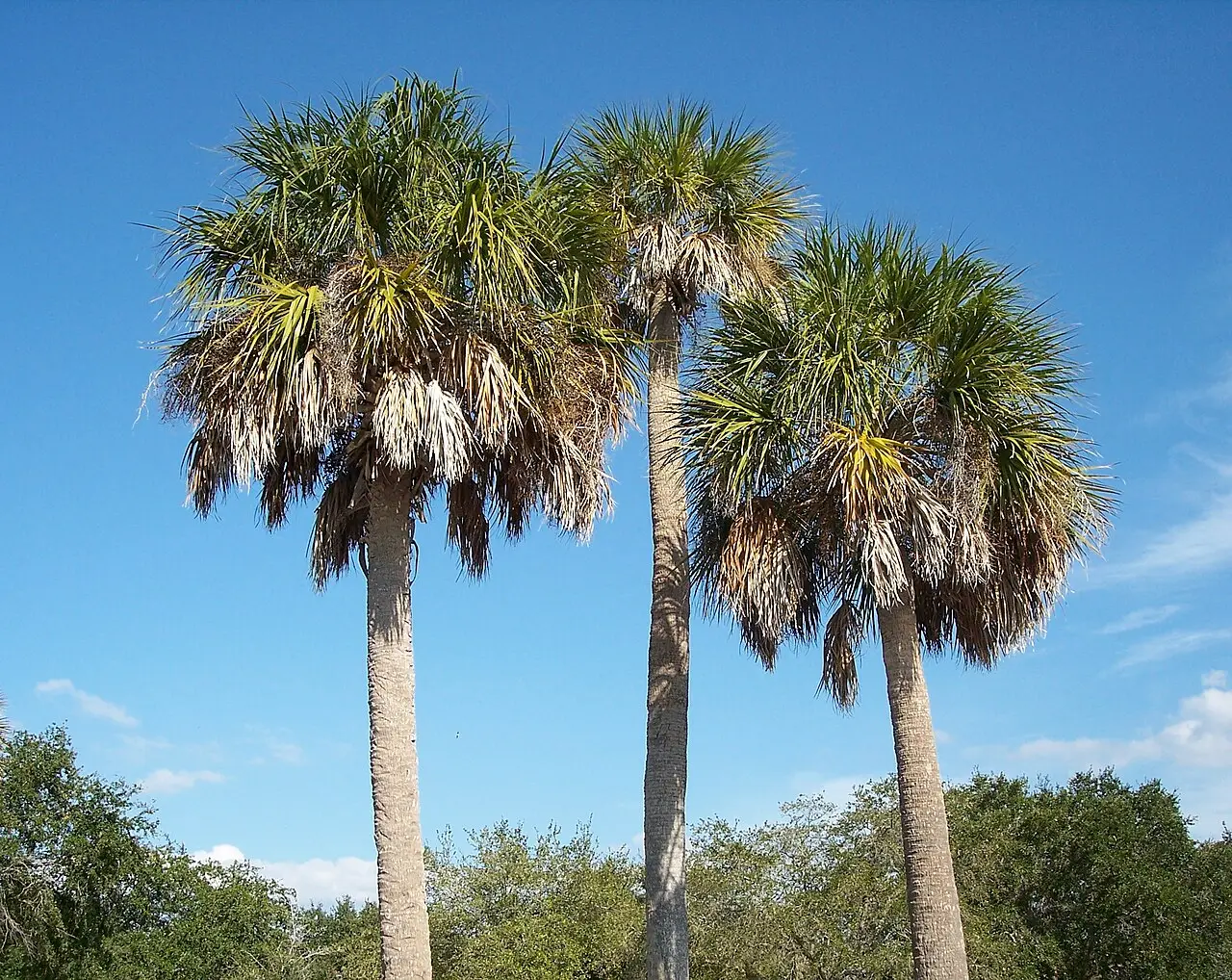
Sabal palm, the state tree of Florida and South Carolina
The sabal palm, also called the cabbage palm or cabbage palmetto, is the state tree of two southern states: South Carolina, which chose it in 1939, and Florida, which followed in 1953. In South Carolina it recalls the palmetto-log fort on Sullivan's Island that withstood a British fleet in 1776, and it appears on the state flags or seals of both states. Botanically it is a palm, not a true tree.
The 2 states
| State | Designation | Name in state law | Adopted |
|---|---|---|---|
| South Carolina | State tree | Sabal palmetto (cabbage palmetto)S.C. Code § 1-1-660 (Joint Resolution No. 63 of 1939) | 1939 |
| Florida | State tree | Sabal palm (cabbage palm)Fla. Stat. § 15.031 (ch. 28126, Laws of Fla., 1953) | 1953 |
Two states
South Carolina named the sabal palmetto its state tree in 1939. The palmetto recalls the fort on Sullivan’s Island, whose palmetto-log walls absorbed British cannonballs on June 28, 1776; the tree had already been on the state flag since 1861 and gives South Carolina its nickname, the Palmetto State. Florida adopted the sabal palm in 1953; its law expressly says the designation does not restrict commercial use of the palm. A sabal palm also appears on Florida’s Great Seal.
How to recognize it
The sabal palm has a single unbranched trunk, commonly 30 to 40 feet tall in South Carolina and up to about 65 feet, either bare or covered with old leaf bases called “boots.” Its crown holds large, fan-shaped, evergreen leaves about 5 feet long, with a distinctive downward arch. In midsummer long sprays of small, fragrant, creamy-white flowers appear, followed by small black fruits in fall that raccoons and other wildlife eat.
Questions people ask
- Which states have the sabal palm as state tree?
- South Carolina, since 1939, and Florida, since 1953.
- Why is the palmetto South Carolina's symbol?
- Because of the fort of palmetto logs on Sullivan's Island whose spongy walls absorbed British cannonballs on June 28, 1776. The palmetto is on South Carolina's flag and seal, and the state is called the Palmetto State.
- Is the sabal palm on the Florida seal?
- Yes. A sabal palm appears on Florida's Great Seal, replacing the "cocoa tree" named in the 1868 seal description.
Sources
- Sabal palmetto NC State Extension Gardener Plant Toolbox
- Plants & Edibles South Carolina Legislative Services Agency (Student Connection)
- The 2026 Florida Statutes, Chapter 15: Secretary of State The Florida Legislature