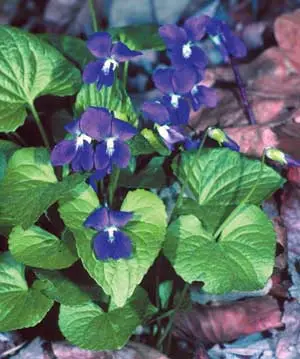
Common meadow violet, the state flower of New Jersey
The state flower of New Jersey is the common meadow violet, also called the common blue violet, a small native wildflower with deep blue-violet blooms and heart-shaped leaves. It flowers in early spring in lawns, yards and woodland edges across the state. New Jersey first named the violet in 1913, but that resolution lapsed, and the law that made it official was approved only in 1972.
How to recognize it
The common meadow violet is a low perennial, usually 3 to 10 inches tall, with no true stem; it spreads from underground rhizomes. Its flowers are under an inch across, deep blue-violet and sometimes white, with five unequal petals. The two side petals are hairy, and the lower petal has dark violet veins. The heart-shaped, toothed leaves grow only from the base and are often hairy, especially underneath.
It blooms in spring, and in summer it makes a second kind of flower, hidden and never opening, that still sets seed.
Where it grows
The violet is native to eastern and central North America, including New Jersey. It grows in woods, thickets, meadows and along streams, and just as happily in lawns and disturbed ground.
Where to see it
Look in yards, lawns and woodland edges in early spring. You may already have it: it self-seeds freely and is often treated as a lawn weed.
Small but useful
The violet is one of the first food sources for bees in spring, and its leaves feed the caterpillars of fritillary butterflies. Ants carry off its seeds for their oily attachments, spreading the plant as they go, and deer tend to leave it alone. The young leaves and flowers are edible. Older books list it under other names, such as Viola papilionacea.
Chosen, then chosen again
New Jersey picked the violet more than once. A 1913 concurrent resolution first named it the state flower, but the resolution lapsed when the next legislative session began. A 1961 bill to put it into law never passed the Senate. Garden clubs kept pressing, and the 1971 act, approved on February 15, 1972, finally made the common meadow violet the state flower. Rhode Island and Wisconsin have chosen violets too.
Questions about the New Jersey state flower
- What is the state flower of New Jersey?
- The common meadow violet (Viola sororia), made official by a law approved on February 15, 1972.
- Is the violet native to New Jersey?
- Yes. It is native to eastern and central North America, including New Jersey.
- Are violets edible?
- The young leaves and flowers are edible.
- Is the violet a weed?
- It self-seeds freely and is often treated as a lawn weed, but it is one of the first spring food sources for bees and a host plant for fritillary butterfly caterpillars.
Sources
- Viola sororia North Carolina State Extension Gardener Plant Toolbox
- Viola sororia, common blue violet Native Plant Trust (Go Botany)
- Viola sororia Jersey-Friendly Yards
- New Jersey State Symbols, State Flower New Jersey State Library
- Plant Profile: Viola sororia, common blue violet USDA PLANTS Database